Welding Procedure Specification (WPS): What It Is, With PQR and WPQ Explained | The Takeoff AI
What a welding procedure specification is, what goes on one, how a WPS relates to a PQR and welder qualification, what ASME Section IX requires, and what it costs on a bid.
Qualified under ASME Section IX on code piping and pressure work, and AWS D1.1 on structural steel.
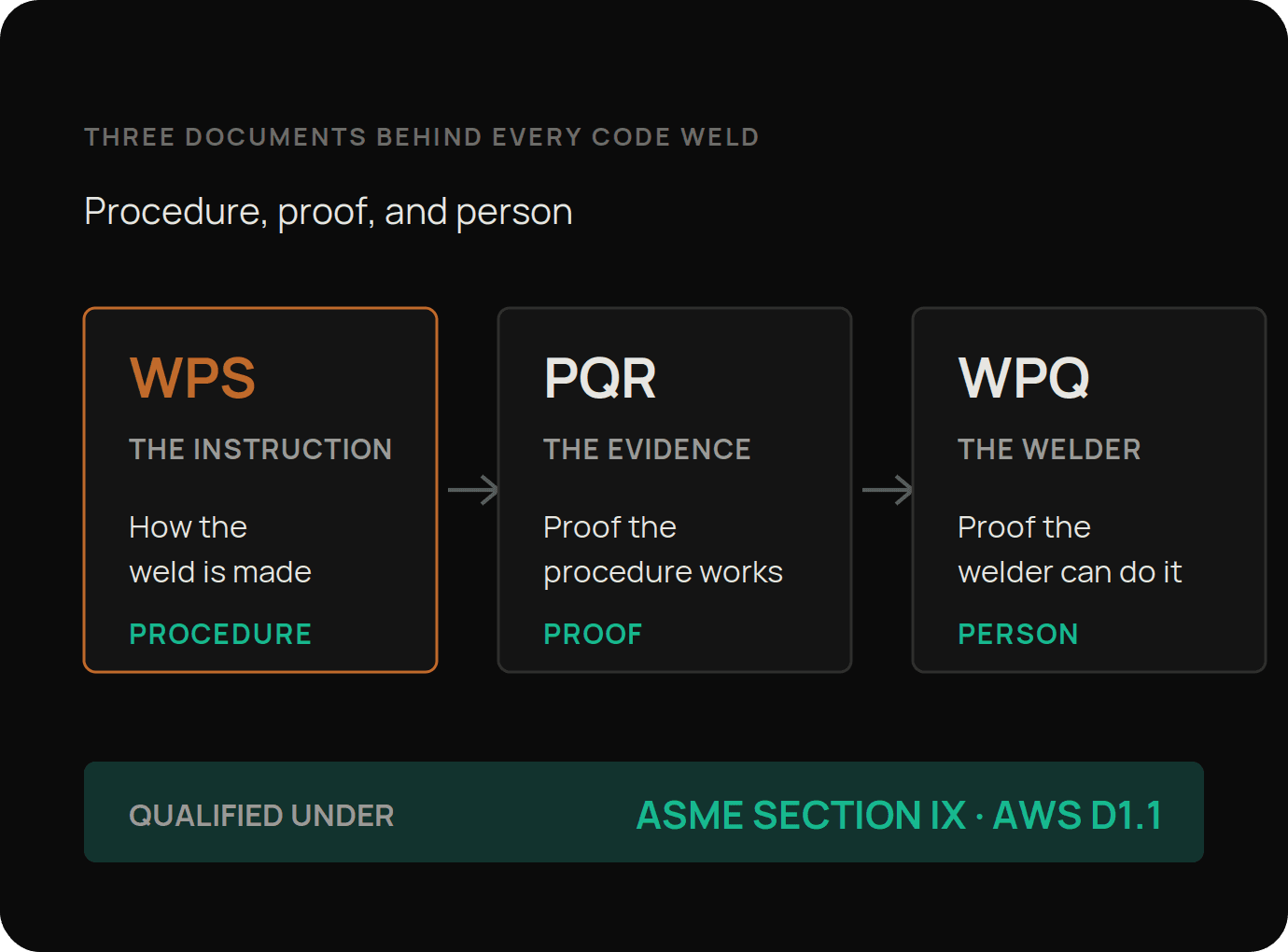
WPS, PQR and WPQ
Three records sit behind a code weld, and they get mixed up constantly, so it's worth separating what each one answers.
The Instruction
The welding procedure specification says how the weld is to be made: process, base materials, filler metal, joint design, positions, preheat, post-weld heat treatment and electrical characteristics. The welder works to it and the inspector checks against it.
The Evidence
The procedure qualification record documents a test weld made to that procedure and the mechanical test results that prove it produces a sound joint. The WPS is supported by one or more PQRs, so the PQR answers whether the procedure works.
The Welder
The welder performance qualification records that a specific welder has demonstrated they can produce a sound weld following the procedure, within a defined range of thicknesses, positions and materials. The WPQ answers whether this person can do it.
What Goes on a Welding Procedure Specification
Variables on a procedure are grouped by how much they affect the result. Changing an essential variable means requalification, which is why a package that mixes materials, thicknesses and processes needs more procedures than one that doesn't. ASME Section IX governs code piping and pressure work, and AWS D1.1 governs structural steel.
- Essential variables require requalification when changed
- Non-essential variables can be changed with a revision to the WPS
- Procedures belong to the fabricator that qualified them, so they don't transfer between contractors
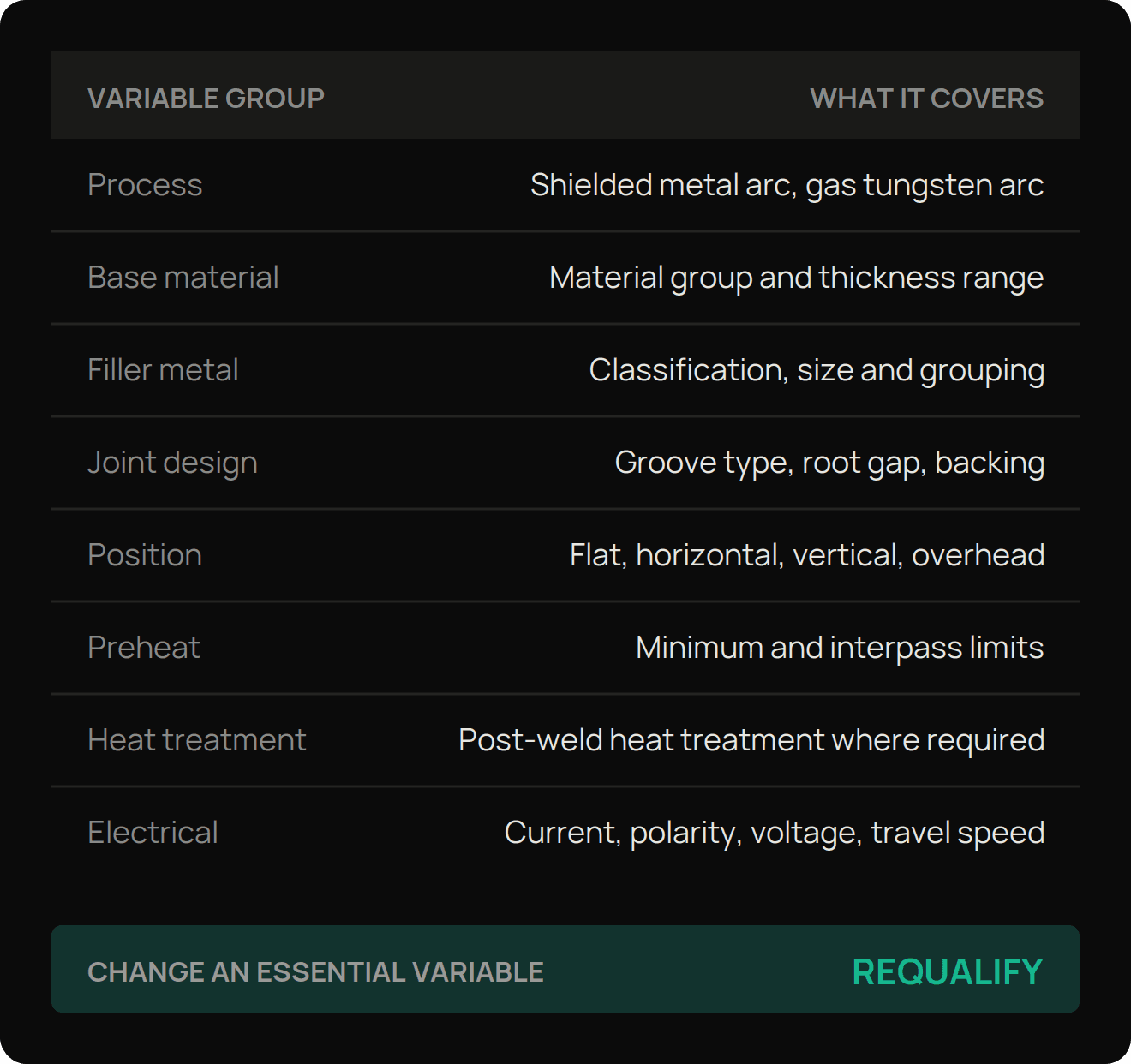
The variables a welding procedure specification defines.
Why the Procedure Mix Changes the Bid
Two welds of the same size cost different amounts depending on the process, material and position, so a weld count that isn't split by those things can't be priced properly. Stainless welded with gas tungsten arc welding and a purge takes considerably longer per diameter-inch than carbon steel with a stick process, and a package carrying both needs the counts separated before any rate is applied. The procedure and qualification work itself scales the same way, since more combinations means more procedures and more qualified welders.
The Takeoff AI counts welds by size and joint type, with the diameter-inches totaled and every weld traced back to its sheet. Your estimator applies your own labor rate to each group, so the qualification scope and the weld labor can both be judged off a count rather than an impression of the package.
- Welds counted by size and joint type, with diameter-inches totaled
- Your own rate applied to each group
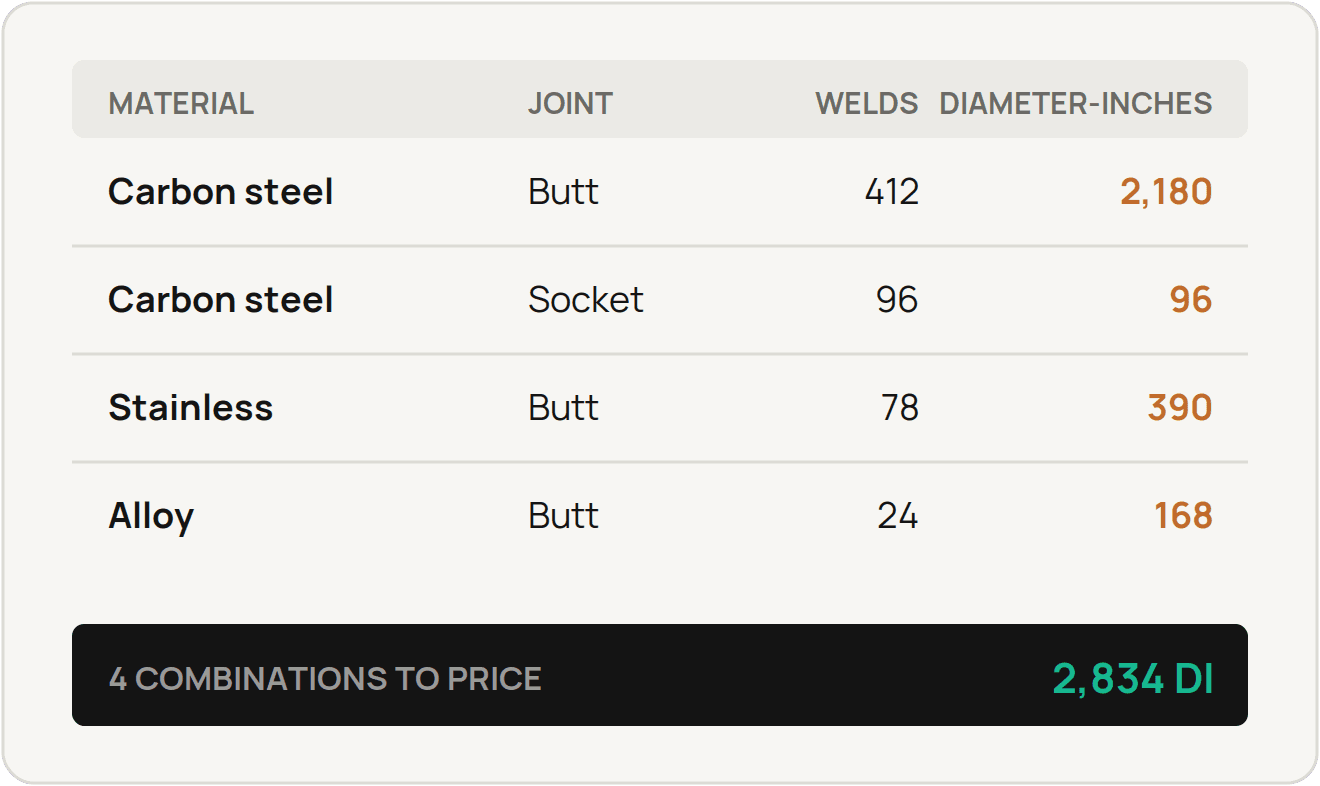
Illustrative example. Weld count split by material and joint type, the split that drives labor.
Qualification Cost Is Decided by the Drawings
A job running one material and one process on one thickness range needs very little procedure work, while a job mixing stainless, alloy and carbon across several thicknesses can need a procedure and qualified welders for each. The drawings decide that, not the schedule, so it can be worked out at bid time if the weld counts are split properly rather than discovered in the shop.
The variety in the package decides the qualification bill.
Trusted by 200+ enterprises across EPC, Infrastructure, and Energy











Reference the Estimating Library
Weld Joint Types | theTakeoff
Piping labor is priced per weld, so the joint count is the number that carries the estimate. This page covers which connections produce a weld and which do not, how joints get derived at bid stage, and what moves the hours on two joints of identical diameter.
Butt Weld vs Socket Weld
A butt weld joins two pipe ends edge to edge with a full penetration weld, and a socket weld slips the pipe into a fitting and closes it with a fillet weld around the outside. This page covers where each one is used, the standards behind them, and how each is counted and priced in a piping estimate.
https://www.thetakeoff.ai/diameter-inch-calculator
/handbook/asme-b31-3
Welding Procedure Specification (WPS): What It Is, With PQR and WPQ Explained | The Takeoff AI
What is a WPS in welding?
A written instruction covering how a specific weld is to be made, including the process, base and filler materials, joint design, position, preheat, heat treatment and electrical settings. Welders follow it, and inspectors check the finished weld against it.
What is the difference between a WPS and a PQR?
The WPS is the instruction, and the procedure qualification record is the evidence supporting it, documenting a test weld and its mechanical test results. One or more PQRs stand behind a WPS.
What is the difference between a WPS, a PQR and a WPQ?
The WPS says how the weld is made, the PQR proves the procedure produces a sound weld, and the welder performance qualification proves a particular welder can follow it. Procedure, proof and person.
What is an essential variable?
A variable that affects the mechanical properties of the weld, such as the process, material group or filler classification. Changing one means requalifying the procedure, while a non-essential variable can be changed with a revision to the WPS.
What does ASME Section IX cover?
It's the ASME Boiler and Pressure Vessel Code section governing welding, brazing and fusing qualification, setting out how procedures and performance are qualified for code work including B31.3 process piping. AWS D1.1 is the equivalent for structural steel.