Weld Joint Types and How Estimators Count Them | theTakeoff
Piping labor is priced per weld, so the joint count is the number that carries the estimate. This page covers which connections produce a weld and which do not, how joints get derived at bid stage, and what moves the hours on two joints of identical diameter.
Free reference, no signup. Written for estimators rather than welders.
Every member tagged, measured, and traced back to the sheet it came from.
What theTakeoff Does With a Piping Package
The joint count is derived rather than drawn, and everything it derives from is on the sheets. Reading those components off a package is repetitive rather than difficult, which is the part worth handing to a machine.
Read the Set
Plans, line lists, schedules, and specs ingested together, so the engine works from the same package your estimator does. Vector PDFs, scanned sheets, and the revision somebody dropped into the folder without telling anyone.
Count What Generates Joints
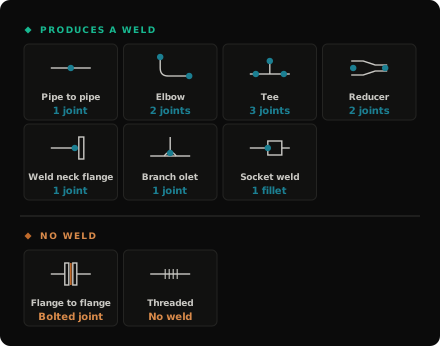
Fittings by type and by end count, valves, flanges, and branch connections, each tagged and measured off the geometry. An elbow is two ends and a tee is three, so the components carry the joint count with them.
Export for Your Conversion
Quantities structured by tag with a source link on every row, ready for the joint conversion, the labor units, and the shop-to-field split you already run. The counts are ours, the rates stay yours.
Footage Buys the Material, Joints Buy the Labor
A hundred feet of six inch pipe in two long runs and the same hundred feet cut into twelve spools carry identical material and very different hours. Everything an estimator does with a piping package runs from that. It is why a congested unit with heavy fitting density costs far more per foot than a straight rack run of the same diameter, and why a takeoff that stops at linear feet is only half a takeoff.
- The same footage, spooled differently, is a different job.
Why Labor Is Priced Per Diameter Inch
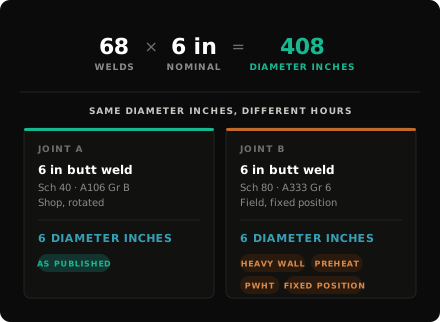
A diameter inch is nominal pipe diameter multiplied by weld count, so a six inch butt weld is six diameter inches and sixty-eight of them is four hundred and eight. The unit exists so one published rate can cover pipe of any size. It is not the end of it, though, because two joints at the same diameter take different hours depending on wall thickness, material, and position, and a shop weld on a positioner is a different line item from a field weld at elevation.
- Diameter inches equal nominal diameter multiplied by weld count
- Wall thickness, material, and position all move the hours at identical diameter
- Shop and field welds take separate rates, and the split is your judgement rather than the drawing's
Derived From P&IDs, Not Counted From Spools
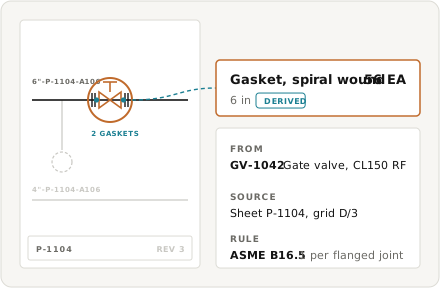
At bid stage isometrics usually do not exist, so weld counts come from line lengths, fitting counts, and the spec rather than from issued spools. That derivation is the largest assumption in a piping estimate, because the joint count drives the labor and the labor drives the bid. theTakeoff produces the quantities underneath it, with every line showing the component it came from and the sheet it was read on, so the assumptions are checkable rather than asserted.
- Fitting counts and line lengths are read, joint counts derive from them
- The conversion and your labor units stay in your own system
Footage Buys the Material, Joints Buy the Labor
A hundred feet of six inch pipe in two long runs and the same hundred feet cut into twelve spools carry identical material and very different hours. Everything an estimator does with a piping package runs from that. It is why a congested unit with heavy fitting density costs far more per foot than a straight rack run of the same diameter, and why a takeoff that stops at linear feet is only half a takeoff.
The same footage, spooled differently, is a different job.
Trusted by 200+ enterprises across EPC, Infrastructure, and Energy











Weld Joint Types and How Estimators Count Them | theTakeoff
How do you count welds on a piping drawing?
Work from the components rather than the length. Each fitting produces a joint at every end, so an elbow gives one to the run it joins, a tee gives three, and a reducer gives two. Each flange gives one weld at the weld neck. Pipe-to-pipe joints follow from how the runs get spooled, which at bid stage you are estimating. Flanged, threaded, and mechanically coupled connections produce no weld at all.
What is a diameter inch?
Nominal pipe diameter multiplied by weld count. A six inch butt weld is six diameter inches, and sixty-eight six inch welds is four hundred and eight. Industrial piping labor units are published against this unit so a single rate can cover pipe of any size, which is why a takeoff that reports only footage cannot feed them.
What makes two welds of the same size take different hours?
Wall thickness first, since pass count rises with wall. Then material, because low-temperature and alloy materials typically require preheat and often post-weld heat treatment where standard carbon steel does not. Then position, since a joint that cannot be rotated is slower. Then examination, because the radiography percentage set by the spec carries hours of its own.
Does a flanged connection count as a weld?
No. A flanged connection is a bolted joint with one gasket and one stud bolt set. There is a weld where each flange attaches to its pipe, so a flanged valve installation carries welds at the weld necks and bolted joints at the faces, and those belong in two different parts of the estimate. Counting a flanged connection as a weld inflates your labor and counting it as nothing loses your bolt material.