Butt Weld vs Socket Weld
A butt weld joins two pipe ends edge to edge with a full penetration weld, and a socket weld slips the pipe into a fitting and closes it with a fillet weld around the outside. This page covers where each one is used, the standards behind them, and how each is counted and priced in a piping estimate.
Butt welds carry most large-bore process piping, and socket welds usually cover small-bore lines at NPS (nominal pipe size) 2 inch and below.
Every member tagged, measured, and traced back to the sheet it came from.
How Butt Welds and Socket Welds Differ
Both joints connect pipe to pipe or pipe to fitting, but the prep, the weld and the inspection are different, and each difference shows up somewhere in the estimate.
How the Joint Is Made
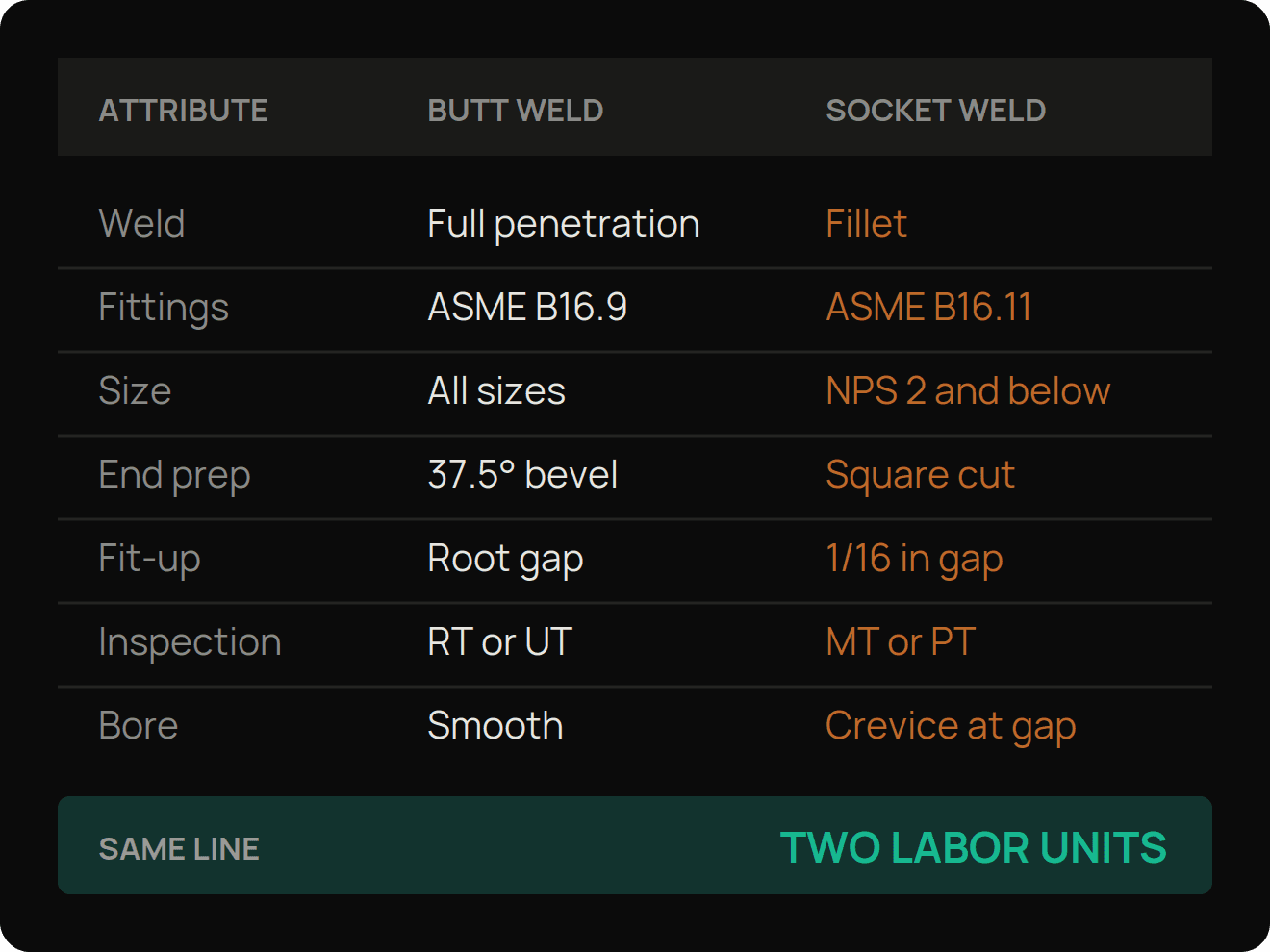
A butt weld joins two beveled ends with a small root gap and fills the groove in several passes. A socket weld seats the square-cut pipe in the fitting's socket, backs it off about 1/16 inch to leave an expansion gap, and runs a fillet weld around the outside.
Where Each Is Used
Butt welds run across every size and are standard above NPS 2. Socket welds are mostly used at NPS 2 and below, where beveling and fitting small pipe edge to edge is slow and difficult.
How Each Is Inspected
Butt welds can be checked right through the joint with radiography (RT) or ultrasonic testing (UT). Socket welds are usually checked on the surface with magnetic particle (MT) or liquid penetrant (PT) testing, because the joint shape makes volumetric testing impractical.
Butt Weld vs Socket Weld, Side by Side
The fittings for each joint come from different ASME (American Society of Mechanical Engineers) standards, and the piping code puts limits on where socket welds can go. The table covers the points that change what you buy, how long the weld takes and what inspection you carry.
- Butt weld fittings to ASME B16.9, weld bevels to ASME B16.25
- Socket weld fittings to ASME B16.11, in Class 3000, 6000 and 9000
- ASME B31.3 limits socket welds where crevice corrosion or severe cyclic conditions are expected
Why the Weld Type Changes the Estimate
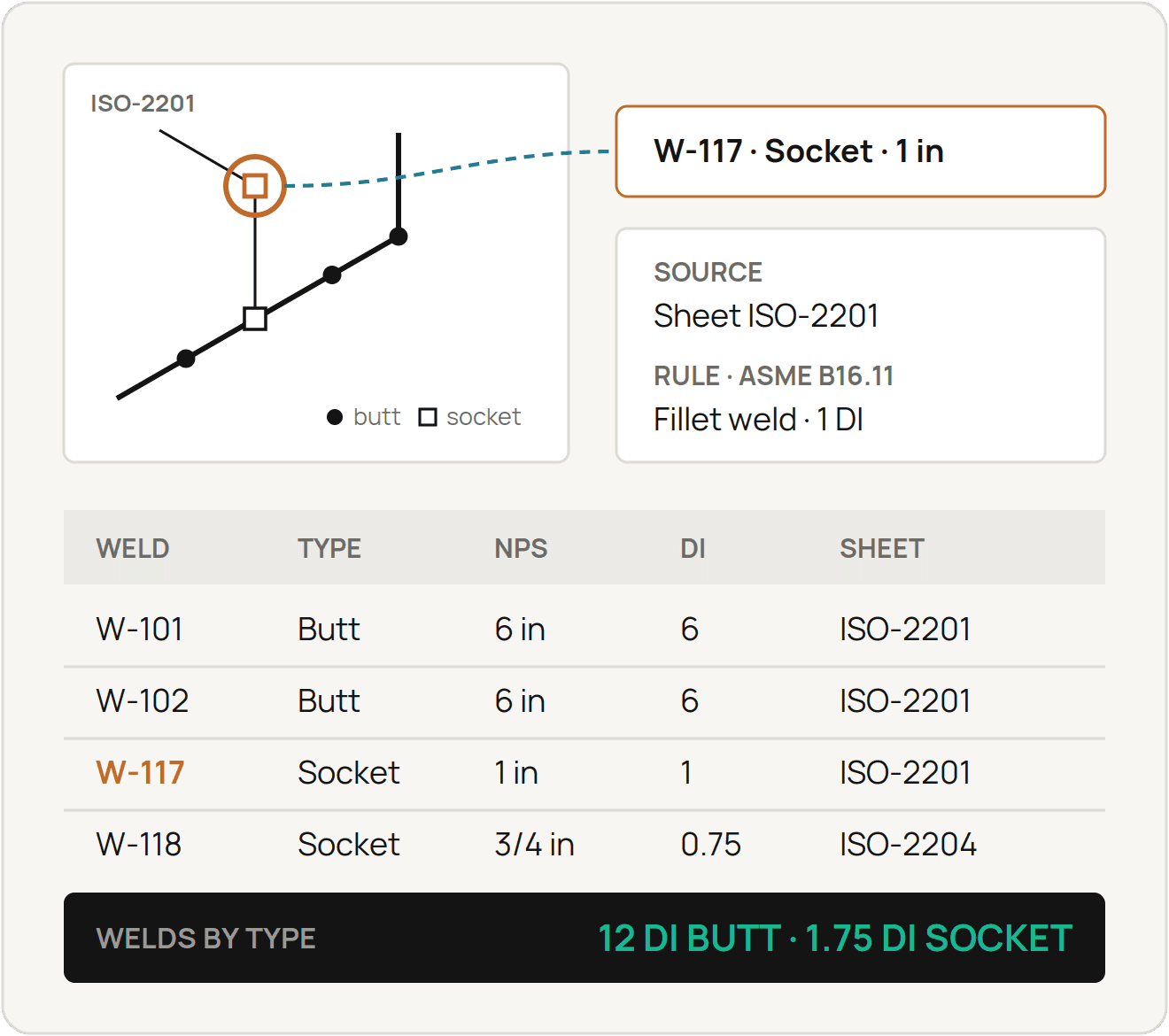
Welds are usually priced by diameter-inch (DI), which is the pipe size in inches multiplied by the number of welds, so a 6 inch butt weld counts as 6 DI. A socket weld and a butt weld at the same size don't take the same time, so most estimators carry them as separate lines with separate labor units, and mixing them into one count skews the labor on small-bore work.
The Takeoff AI reads the isometrics and counts every weld by type and size, with the diameter-inches totaled and each weld traced back to the sheet it came from. Your estimator checks the count, applies your own labor rates, and the priced weld lines go straight into the estimate.
- Welds counted by type and size, with diameter-inches totaled
- Every weld traced to its isometric and priced off your rates
Weld Counts Drive the Labor, and the Labor Drives the Bid
On most process piping jobs, welding is one of the largest labor lines in the estimate, and a large package can carry thousands of welds across hundreds of isometrics. Counting them by hand, by type and size, is where the hours go and where small-bore welds get lumped in or missed.
The weld count sets the labor, and the labor sets the number.
Trusted by 200+ enterprises across EPC, Infrastructure, and Energy











Reference The Estimating Library
Practical takeoff references, charts and workflow guides, built for working estimators.
Butt Weld vs Socket Weld
What is the difference between a butt weld and a socket weld?
A butt weld joins two pipe ends edge to edge with a full penetration weld. A socket weld seats the pipe inside a fitting and closes the joint with a fillet weld around the outside.
Which is stronger, a butt weld or a socket weld?
A butt weld, because the full penetration weld makes the joint about as strong as the pipe itself and holds up better to fatigue. Socket welds are adequate for most small-bore service, but the fillet weld and the gap make them weaker under vibration and cycling.
When should you not use a socket weld?
Where the crevice at the gap could trap fluid and corrode, on lines under severe vibration or cycling, and on sanitary piping that has to be cleaned inside. The project piping spec usually sets the cutoff size and the services where socket welds are allowed.