Steam Tracing
Steam tracing runs a small tube along the outside of a process pipe, under the insulation, so heat from the steam keeps the product from cooling, freezing or thickening. The tracer never appears as a line on the isometric, which is why traced scope is one of the easier things to leave out of a takeoff.
Common on water lines in freezing climates, instrument lines, and any product that thickens as it cools.
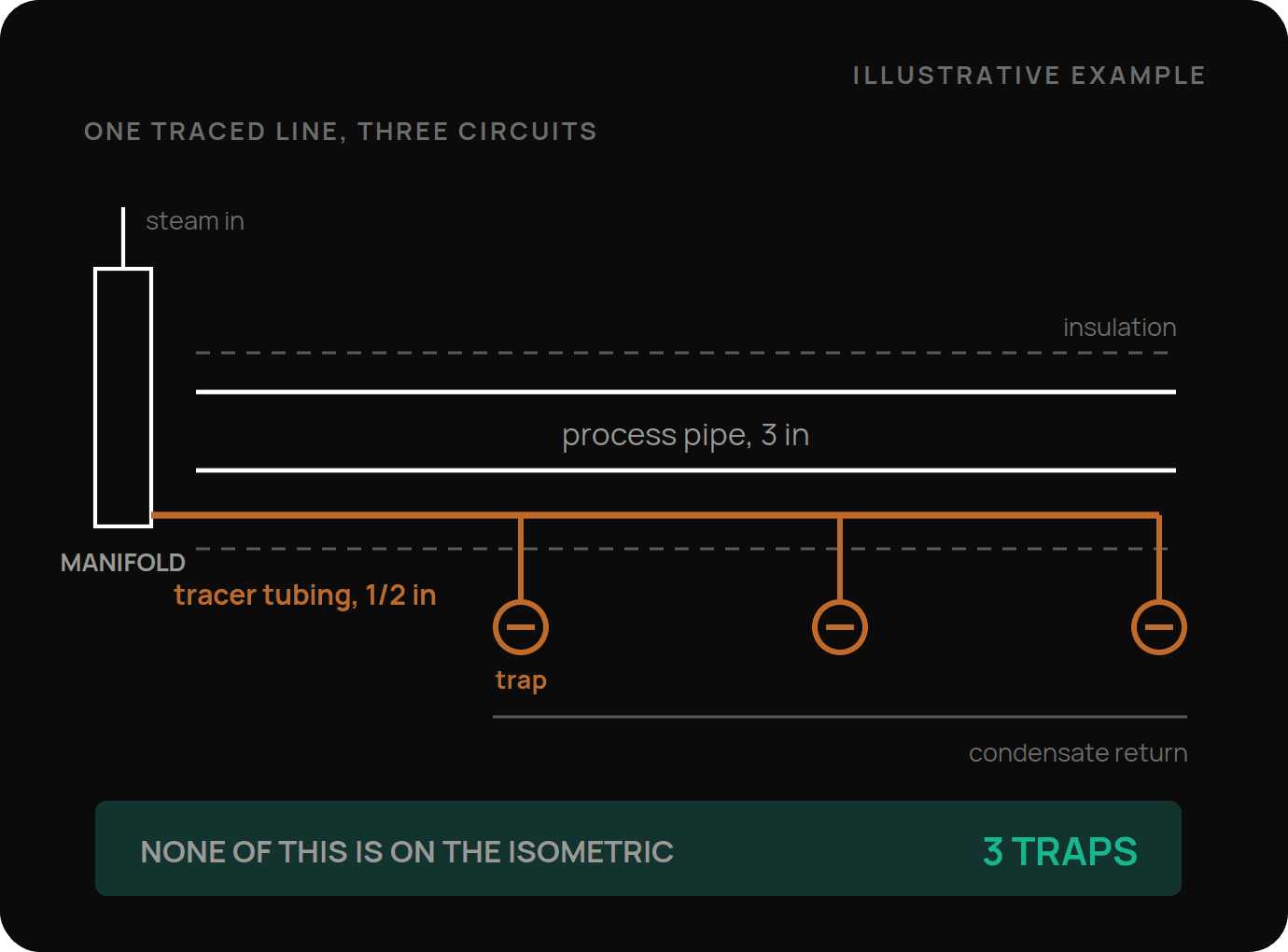
How a Steam Tracing System Is Built
Steam comes off a distribution manifold, runs the length of the traced line as a tracer, and leaves through a trap into a condensate return.
Steam Supply and Manifold
Steam is taken from a header and split at a distribution manifold, with one connection per tracer circuit and an isolation valve on each.
The Tracer Run
Small bore tubing, often copper or stainless, runs along the pipe and is held against it with wire or banding. Heat transfer cement is used where the spec calls for faster heat transfer, and the circuit length is limited, so a long line needs several circuits.
Trap and Condensate Return
Each circuit ends in a steam trap that discharges condensate and holds back steam, then returns it to a collection manifold and the condensate system. Insulation over the whole assembly keeps the heat where it's wanted.
Steam Tracing and Electric Heat Tracing
The choice is usually made in design rather than by the estimator, and it changes the trade doing the work, which matters at bid time. Steam tracing is piping scope with a mechanical crew, and electric tracing is electrical scope with cable, connection kits, controllers and power supply.
- Steam tracing is piping scope, electric tracing is electrical scope
- Steam needs traps and condensate return, electric needs power and controls
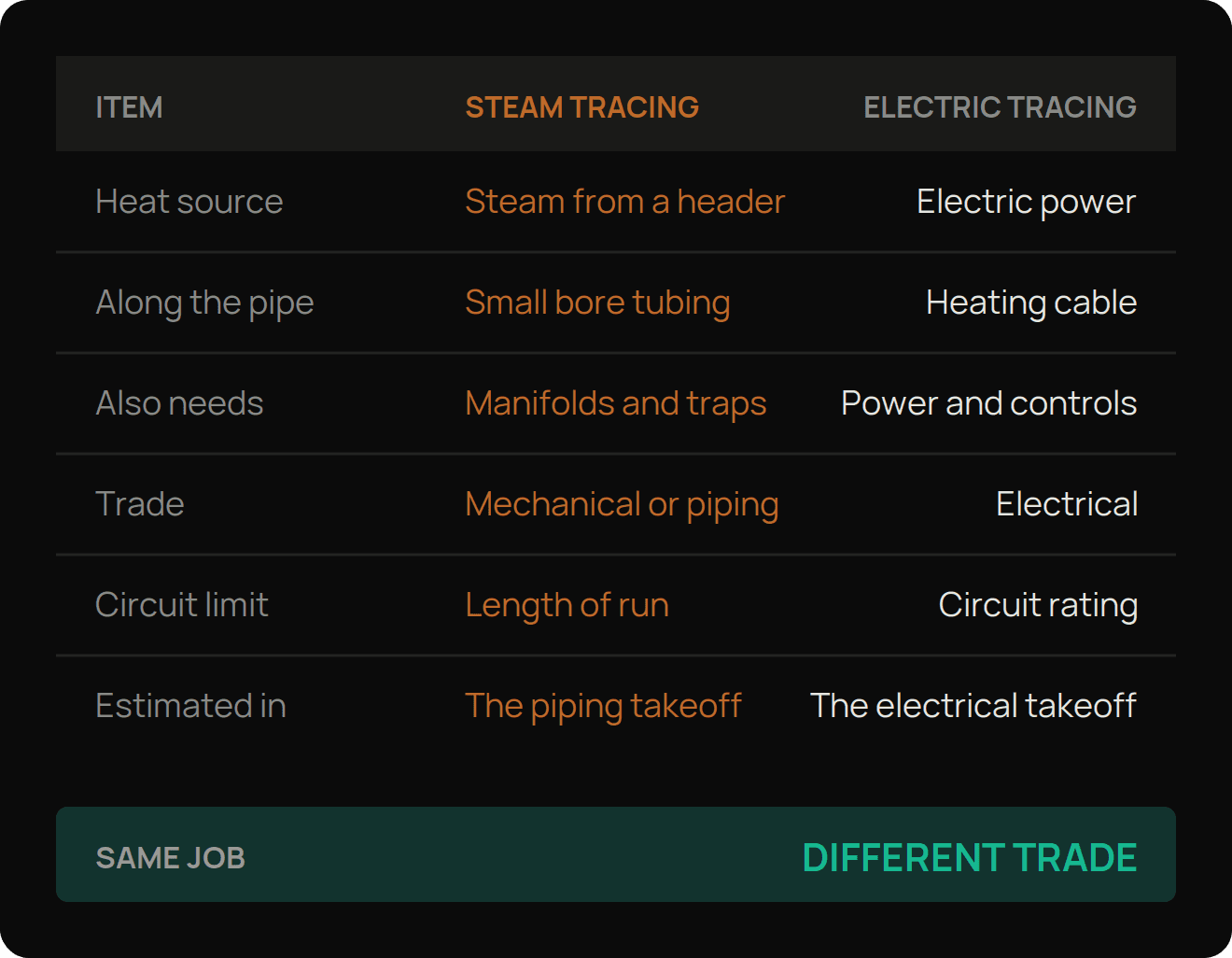
What changes between the two systems at bid time.
Why Traced Scope Gets Left Out
Tracing is called out in the line designation or on a tracing schedule rather than drawn on the isometric, so the takeoff has to go looking for it. The tubing itself is cheap, and the cost sits in the count around it, the traps, the manifold connections, the valves and the labor of running and banding tubing along a line that's already congested.
The Takeoff AI reads the line designation and the spec, works out which lines are traced, and carries the tracer, traps and manifold connections as their own material lines traced back to the line they belong to. Your estimator checks the traced scope against the schedule, applies your own rates, and nothing depends on remembering which lines carried a tracing note.
- Traced lines identified from the line designation and the spec
- Tracer, traps and connections carried as their own lines
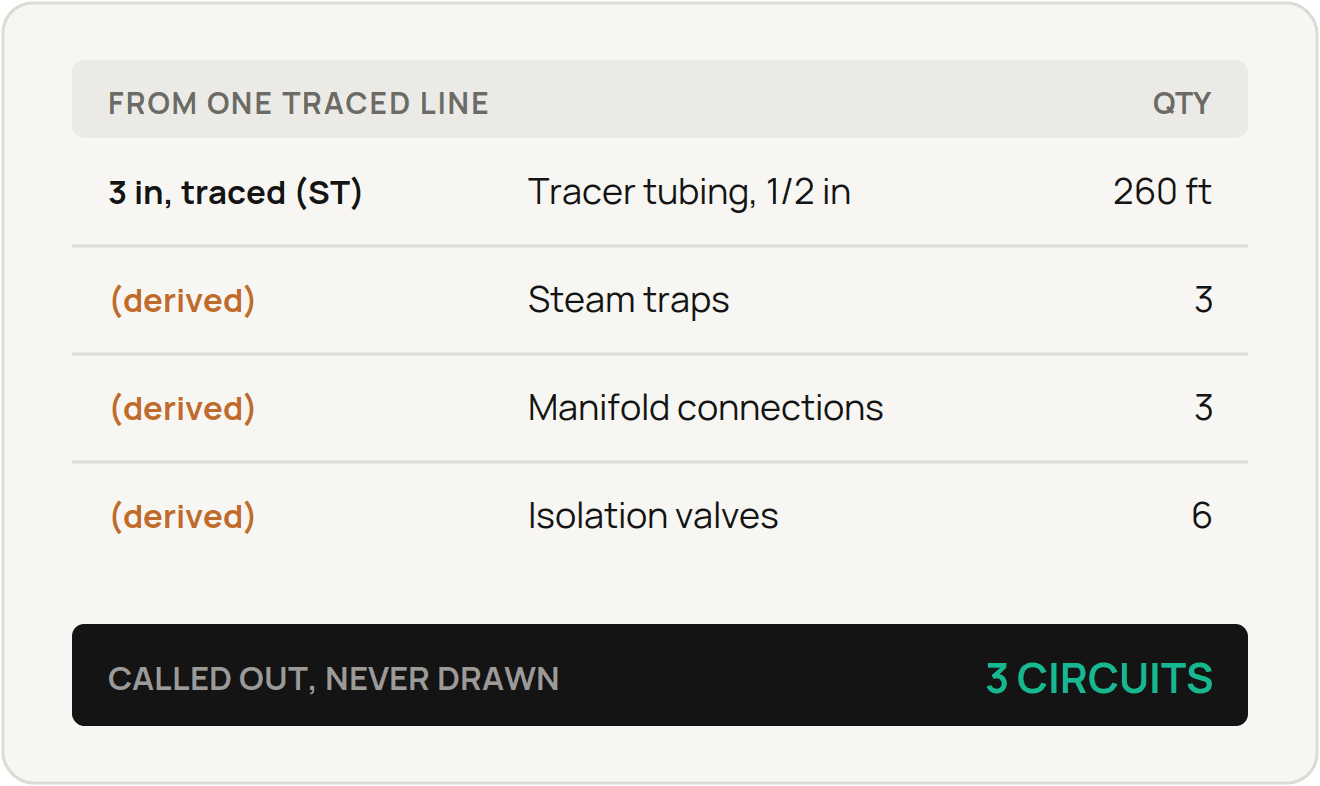
Illustrative example. Tracing quantities derived from the traced line, not drawn on it.
Small Bore Scope Is Where the Hours and the Misses Hide
Tracing is low value per foot and high count per package, which is exactly the combination that gets rushed when a bid is due. The tubing is a rounding error, and the traps, valves and labor behind it are not, so a package with a few dozen traced lines can carry real money in scope nobody drew.
The cheapest material on the job can still carry the most missed labor.
Trusted by 200+ enterprises across EPC, Infrastructure, and Energy










Reference the Estimating Library
/jacketed-piping
Butt Weld vs Socket Weld
A butt weld joins two pipe ends edge to edge with a full penetration weld, and a socket weld slips the pipe into a fitting and closes it with a fillet weld around the outside. This page covers where each one is used, the standards behind them, and how each is counted and priced in a piping estimate.
Drawing Takeoff Software | theTakeoff by ContraVault AI
Drawing takeoff software that reads your drawing set and returns an auditable count. See what the AI actually does, what the free and free download options really are, and which drawing types come off one read.
Steam Tracing
What is steam tracing?
A small steam-carrying tube run along a process pipe under the insulation, so heat passing from the tracer into the pipe keeps the product warm enough to keep flowing.
What is steam tracing used for?
Freeze protection on water and utility lines, keeping viscous products such as heavy oils and asphalt fluid, and holding instrument and sample lines at temperature.
What is the difference between steam tracing and jacketed piping?
Tracing runs a tube along the outside of the pipe, and a jacket surrounds the pipe entirely with the heating medium in the annulus. A jacket gives more even heat and costs considerably more to buy and install, which the jacketed piping page covers in full.
What is the difference between steam tracing and electric heat tracing?
Steam tracing uses steam from a header and needs manifolds, traps and condensate return, so it's piping scope. Electric tracing uses heating cable and needs power, controls and connection kits, so it's electrical scope.
Does every traced line need a steam trap?
Each circuit ends in a trap, so the trap count follows the circuit count rather than the line count, and one long line can carry several.