Pipe Rack: What It Is and How to Take One Off | The Takeoff AI
A pipe rack is the elevated steel or concrete structure that carries process and utility piping, cable trays and sometimes equipment across a process plant. It's also called a pipe bridge, pipe way or pipeline corridor, and a storage rack that happens to hold lengths of pipe is not one. For an estimator it's two scopes at once, the steel that holds it up and the piping that runs along it.
Covers refineries, petrochemical plants, chemical plants and power generation.
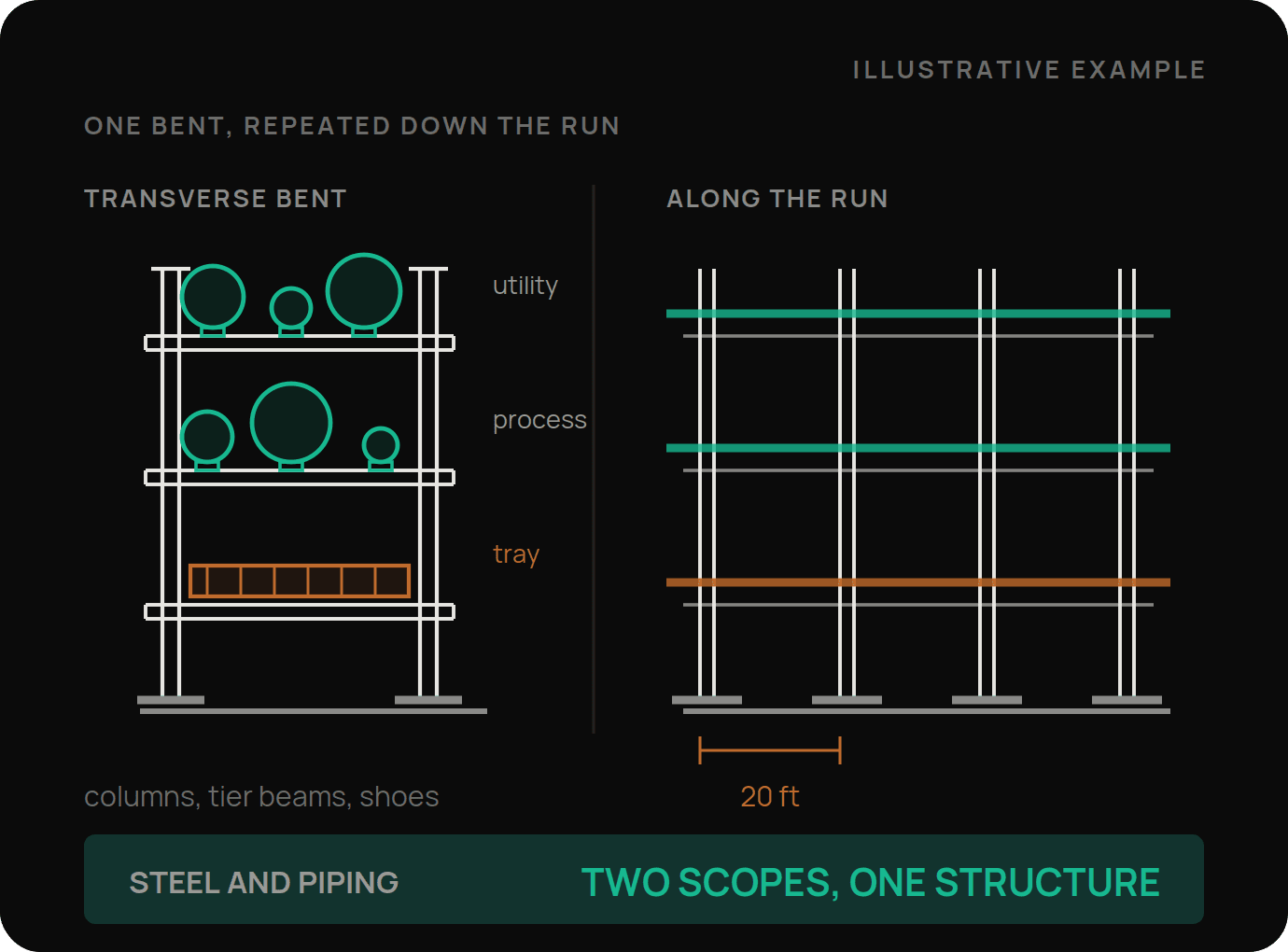
How a Pipe Rack Is Built
A rack is a repeating frame carrying layers of pipe, which is what makes it countable once you know the spacing and the tiers.
The Structure
A series of transverse beams runs along the length of the pipe system at uniform spacing, typically around 20 feet. Those transverse frames are usually moment frames, which keeps the space underneath clear for maintenance access, and they're tied together with longitudinal struts.
What Sits on It
Utility lines such as steam, cooling water, firewater and fuel share the rack with process lines, and instrument and electrical cable trays usually take their own tier. Equipment, vessels and valve access platforms are sometimes mounted over the top.
Where the Bid Splits
The steel is a structural scope of columns, beams, struts and connections, and the piping on it is a separate scope of pipe, supports, guides, anchors and shoe details. Both come off the same drawings and both get missed in different ways.
Pipe Rack, Pipe Track and Pipe Bridge
The terms get used loosely on drawings and in specs, and the difference matters because the steel scope changes completely between them. A rack is elevated and has a structure to count, while a track sits on grade with sleepers instead.
- Pipe racks are elevated steel or concrete structures
- Pipe tracks are grounded supports, usually on concrete sleepers
- Pipe bridge, pipe way and pipeline corridor all describe a rack
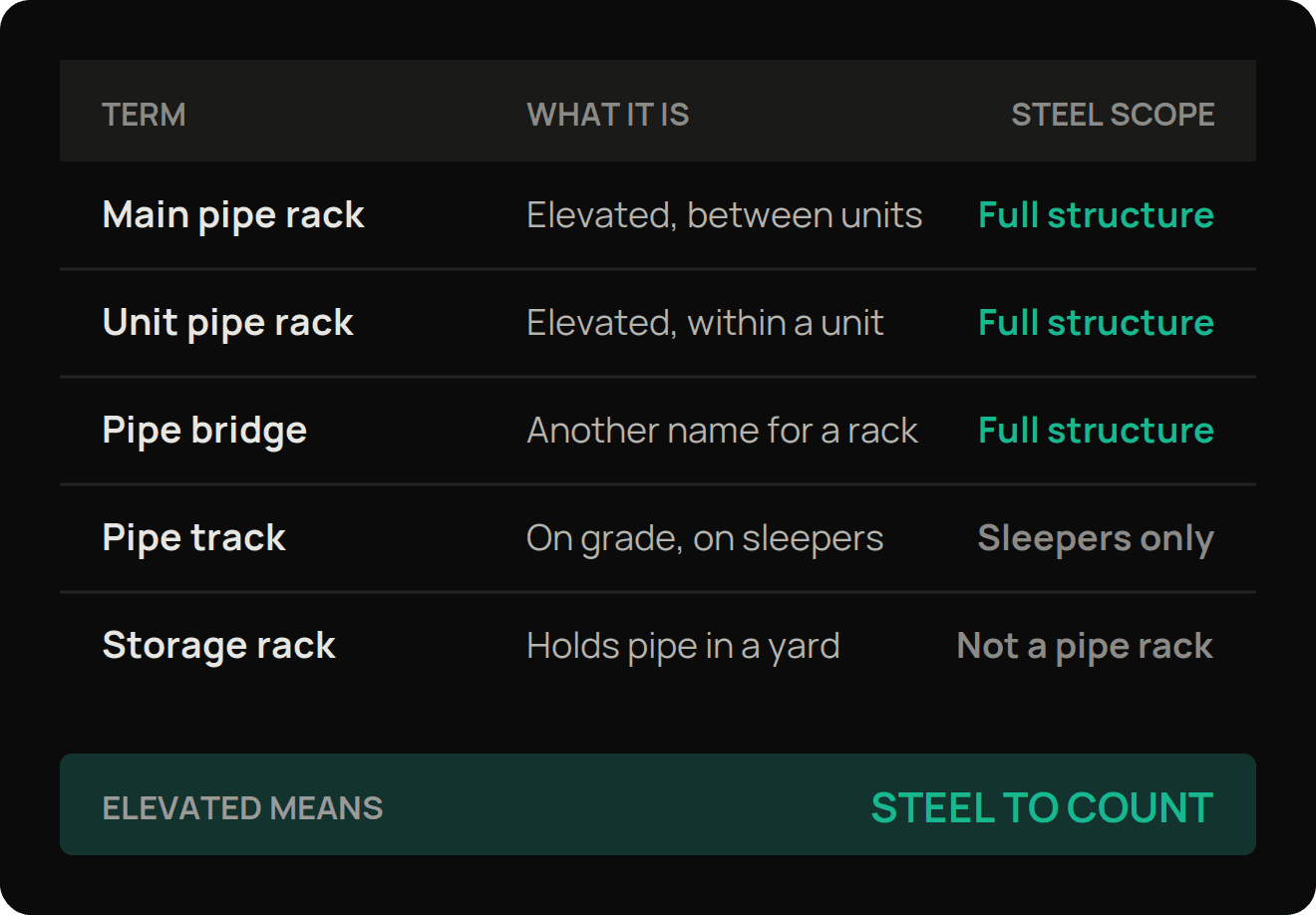
The terms and what each one means for the steel scope.
Why a Rack Is Countable and Still Gets Underbid
The repetition works in your favour, since one bent detailed once and repeated at a known spacing gives you a member count, a tonnage and a connection count for the whole run. What slips is everything that isn't the bent, including the longitudinal struts, the bracing, the base plates and anchor bolts, the pipe supports and shoes on each tier, and the cable tray supports that belong to a different trade's scope but still sit on your steel.
The Takeoff AI counts structural members by mark with tonnage off the schedule, and counts the piping on the rack as its own scope with sizes, supports and lengths, each line traced back to its sheet. Your estimator checks both against the drawings and applies your own rates, so the two scopes stay separate instead of being estimated as one lump.
- Steel counted by mark, piping counted as its own scope
- Every line traced to its sheet and priced off your rates
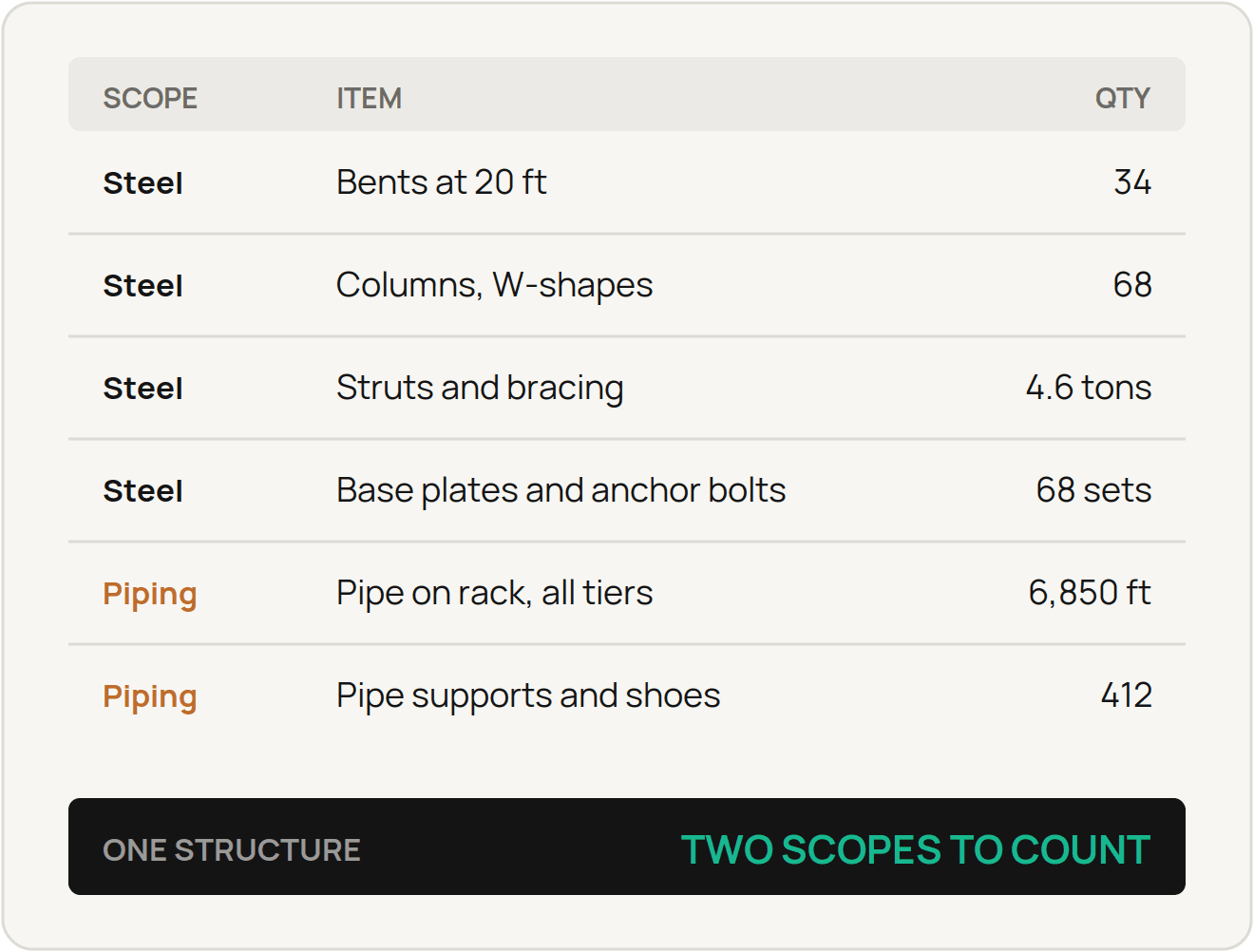
Illustrative example. Steel and piping counted from the same drawings, kept as separate scopes.
The Rack Is the First Thing Bid and the Easiest to Get Wrong
Racks go in early, carry the whole unit, and get estimated off drawings that show a typical bent plus a plan showing where it repeats. That format rewards anyone who counts carefully and punishes anyone working from an impression of the run, and with fewer estimators available to do the counting, more of these packages get priced on judgement than anyone would like.
Repetition makes a rack countable, and it makes the errors repeat too.
Trusted by 200+ enterprises across EPC, Infrastructure, and Energy











Reference The Estimating Library
Practical takeoff references, charts and workflow guides, built for working estimators.
Structural Steel Estimating Software
theTakeoff reads your steel drawings and returns a takeoff you can audit line by line. Count every member, measure every length, and reconcile the drawings against the schedule and the RFP package.
Piping Estimating Software
Piping estimating software that reads your drawings and returns an auditable count. See what the AI actually does, how the line number becomes a priced line item, and where the estimate still needs your estimator.
/handbook/material-takeoff-software
Pipe Rack: What It Is and How to Take One Off | The Takeoff AI
What is a pipe rack?
An elevated steel or concrete structure in a process plant that supports piping, electrical and instrument cable trays, and sometimes mechanical equipment, vessels and valve access platforms. It carries material between equipment, storage and utility areas.
What is the difference between a main pipe rack and a unit pipe rack?
A main rack runs between units and moves material to storage and utility areas, while a unit rack sits inside a unit and connects the equipment within it.
What is the difference between a pipe rack and a pipe track?
A rack is elevated on a structure, and a track sits on grade supported by sleepers. The steel scope is much smaller on a track, so the distinction changes the estimate considerably.
Is a pipe bridge the same as a pipe rack?
Yes, in a process plant. Pipe bridge, pipe way and pipeline corridor all describe the same structure. A pipeline bridge carrying a line across a river is a different thing, belonging to long-distance transportation rather than plant work.
What spacing are pipe rack bents at?
Commonly around 20 feet, with the transverse frames usually designed as moment frames so the area underneath stays clear for maintenance access. The project drawings set the actual spacing.