Piping Estimating Software
Piping estimating software that reads your drawings and returns an auditable count. See what the AI actually does, how the line number becomes a priced line item, and where the estimate still needs your estimator.
theTakeoff reads your piping drawings and returns the quantities with a source behind every line, so the estimate is built on a count your estimator can check rather than one they have to trust.
Every member tagged, measured, and traced back to the sheet it came from.
What Piping Estimating Software Does to a Drawing Set
Piping is the biggest count in an industrial bid and the one that decides the number, which is why it eats days that belong to scope and risk. theTakeoff runs the counting across every sheet in the package and leaves the judgement calls with your estimator.
Read the Set
Every sheet gets opened and read, including the scans and the late revisions. Line lists and any bill of material printed on the drawing are read as tables first, because those quantities were already counted by the engineer who drew them.
Decode and Quantify
Every line number is decoded into size, pipe class, service and insulation, runs are measured against the drawing scale, and bulk items like fittings, welds, bolts and gaskets are factored from line length against the specification the way an estimator factors them at bid stage.
Hand Over a Priceable Takeoff
The count comes out as a bill of materials, a material takeoff and a labor takeoff, each row carrying its sheet reference, ready to export into the pricing sheet you already use.
What "AI" Actually Means in a Piping Estimating Tool
theTakeoff follows the same sequence as a piping estimator: it reads line lists and drawing BOMs first, measures quantities against drawing scale second, and uses symbol recognition only for what remains. Line numbers then drive size, class, service, insulation, ratings, and dimensions, while spec breaks are flagged before they flow into the wrong material, labor, or examination scope. The result is a more reliable bid takeoff with critical class changes surfaced early instead of buried in the package. Scope still stays with the estimator: theTakeoff can tell you what is there, how much there is, and where it sits, but the estimator decides what actually belongs in the bid.
The Count Sets the Number, and the Clock Sets the Count
A process unit package can run past 300 piping and instrumentation diagrams and past 250 estimator hours before anyone prices a line, which means the last drawings get read against the deadline rather than against the specification. That is where missed scope enters a bid, and it surfaces after award when it is already eating the margin. Counting the package in hours gives your estimator the time back for the part that actually decides the job.
A bid is lost on the line nobody had time to read properly.
Trusted by 200+ enterprises across EPC, Infrastructure, and Energy











Piping Estimating Software
What does piping estimating software do?
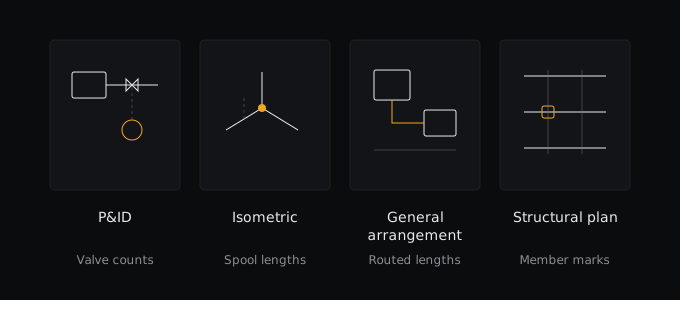
It reads the drawings in the bid package and produces the count the estimate is built on, instead of an estimator marking up prints and tallying by hand. theTakeoff returns pipe by size and class, valves, fittings, welds and supports, with the sheet reference sitting on every row.
Does it work from piping and instrumentation diagrams, or does it need isometrics?
Both, and the difference matters. A piping and instrumentation diagram gives line numbers, valve and instrument counts and tie-in points, and it gives no lengths, because it is a schematic rather than a scale drawing. Isometrics give spool lengths, fittings and welds. At bid stage you usually only have the former, so bulk quantities get factored from line length against the specification.
How does it handle spec breaks?
The line number is decoded rather than read as a label, so a change in pipe class shows up as a break rather than as a different string in a cell. Breaks are flagged for the estimator, because carrying the wrong class through a run moves material, welding and examination cost at the same time.
Can it read scanned and legacy drawings?
Yes. Bid packages arrive as flat PDFs with no model behind them, often scanned from paper, so theTakeoff reads what is printed on the sheet. A poor scan lowers confidence on the items it affects, and those get flagged for review rather than guessed at.
Can I check where a number came from?
Every count and length traces back to the item on the sheet it came from, along with the rule that produced it. That is the point of the output, because a bid number you cannot check is a bid number you end up recounting.
Does it replace the estimator?
No. It takes the counting, and your estimator keeps scope, exclusions, productivity and risk, which are the parts that decide whether the bid is any good.