ASME B31.3 for Estimators | The Takeoff AI
ASME B31.3, the American Society of Mechanical Engineers code for process piping, decides how much examination, testing, and heat treatment each line carries. This page covers the estimator's slice of it, the part that turns a line designation into cost before the isometric drawings are issued.
Free reference, no signup. The code itself is the authority, and the current edition is worth owning.
Every member tagged, measured, and traced back to the sheet it came from.
What The Takeoff AI Does With a Process Piping Line
The costs B31.3 attaches to a line follow from what the line carries and what it is made of, and both sit on the line list. Reading that off every line in a package is repetitive work, which is the part worth handing to a machine.
Read the Line List and Spec
Line number, size, material, pressure class, and service pulled off the line list and the piping specification, alongside the components on the piping and instrumentation diagrams (P&IDs).
Keep Every Quantity on Its Line
Pipe, fittings, valves, and derived items all stay tagged to the line they came from, so the service category and material on that line travel with them into your estimate.
Price It With Your Own Rates
Supply your labor and material pricing and the takeoff comes back priced, with every line still carrying its category, so examination and testing can be scoped to the lines that need them.
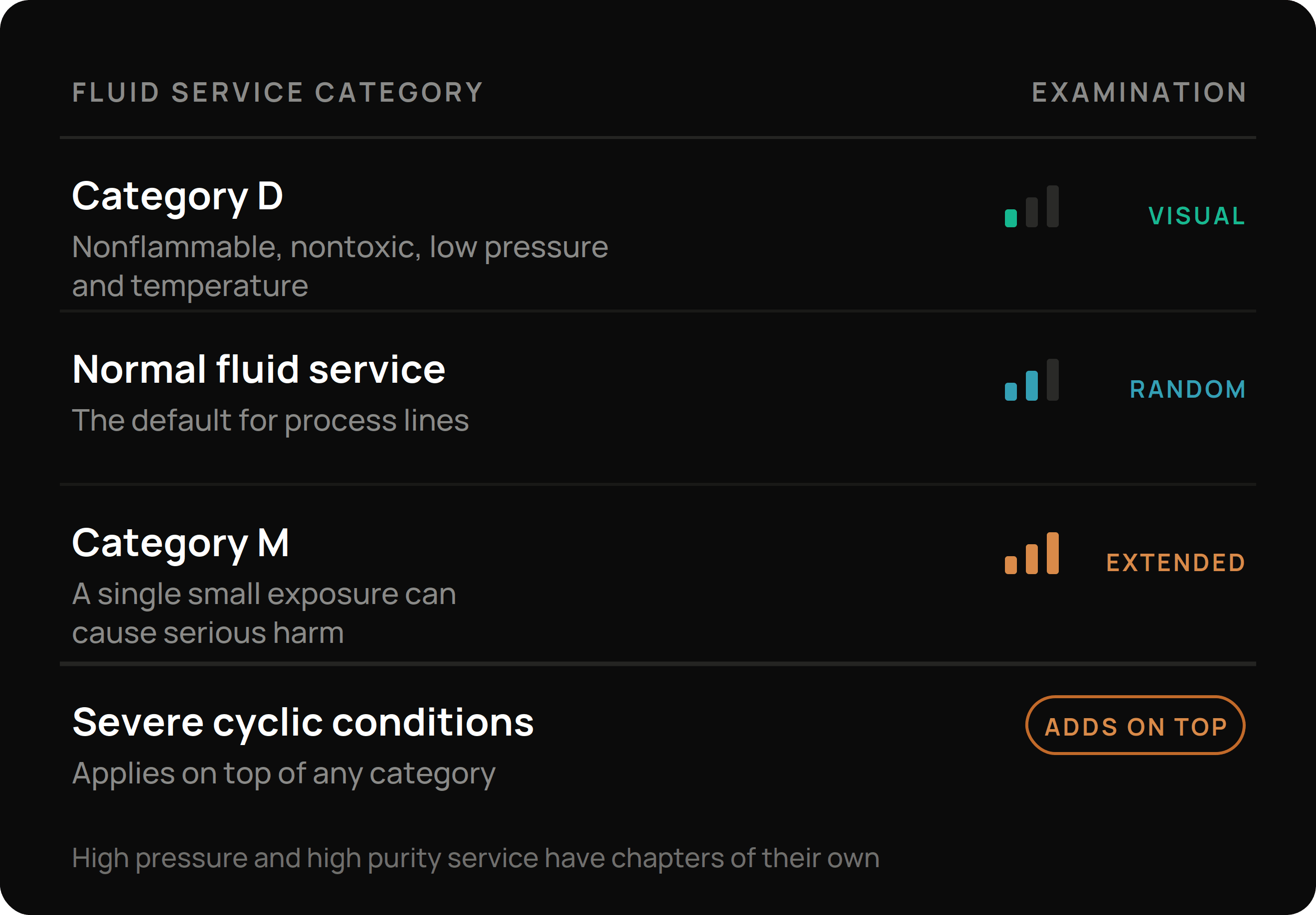
Which Fluid Service Category a Line Falls Under
B31.3 sorts every line by what it carries and the conditions it runs at. Normal fluid service is the default for process lines. Category D covers nonflammable, nontoxic fluids at low pressure and temperature, Category M covers fluids where a single small exposure can cause serious harm, and severe cyclic conditions can apply on top of any category. The category sets how much examination and testing the line needs, which is why it matters before you price a single weld.
- Normal fluid service is the default for most process lines CHECK 2
- Category D carries the lightest examination and Category M the heaviest
- Severe cyclic conditions add requirements on top of any category
Examination and Pressure Testing by Category
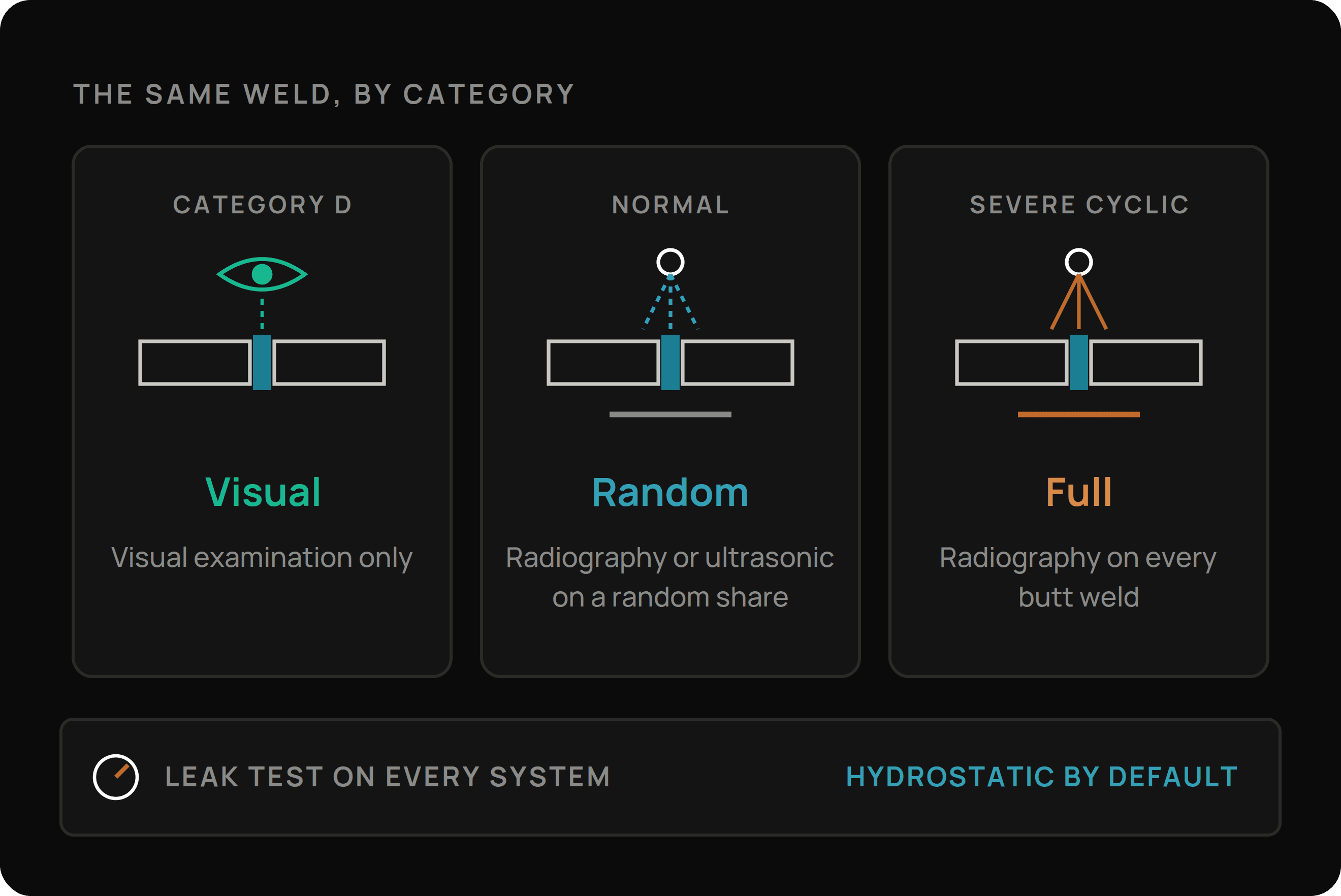
Normal fluid service calls for random radiographic or ultrasonic examination, meaning X-ray or sound-wave inspection, of a share of the circumferential welds. Category D is typically visual only, and severe cyclic conditions call for full radiography of butt welds. Every system also needs a leak test, usually hydrostatic, which brings labor, water handling, and temporary spools of its own.
- Radiographic testing (RT) and ultrasonic testing (UT) are the two volumetric methods
- The examination share follows the category, whatever the pipe size
- Hydrostatic testing is the default leak test, with pneumatic testing as the exception
When Post-Weld Heat Treatment Applies
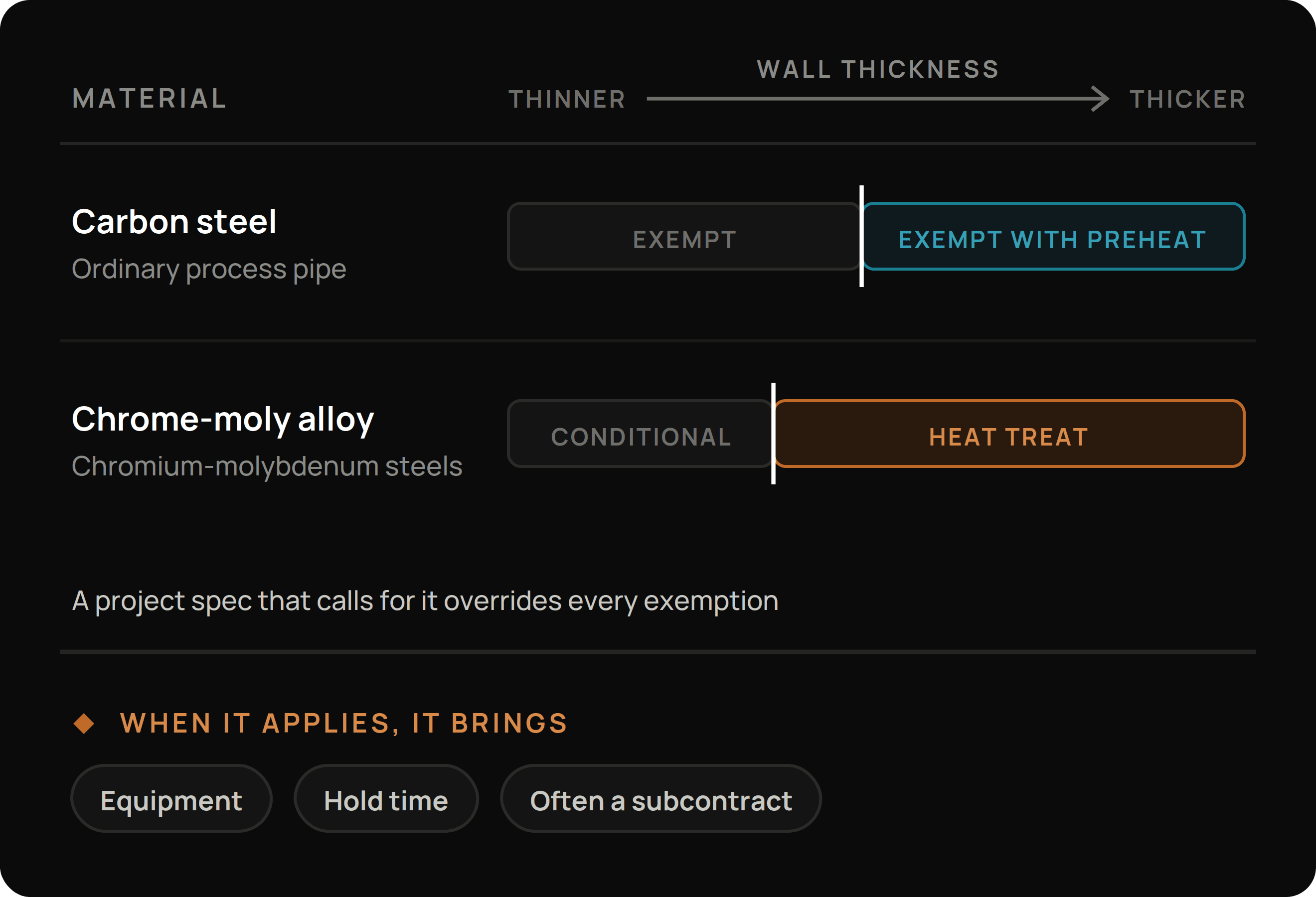
Post-weld heat treatment (PWHT) is the controlled reheating of a finished weld to relieve the stress welding leaves behind. B31.3 triggers it by material group and wall thickness, and chromium-molybdenum alloy steels, known as chrome-moly, pick it up at much thinner walls than carbon steel. It brings equipment, hold time, and often a separate subcontract, and the line's material and schedule tell you whether it applies before a single weld is made.
- Carbon steel can skip it at any thickness with the right preheat
- Chrome-moly only escapes it on thinner walls
- A project specification that requires it overrides the code's exemptions
The Costs B31.3 Adds Never Appear on a Drawing
Examination, testing, and heat treatment are real work with real hours, and none of them show up in a material takeoff. They get carried as percentages or lump sums, which is fine, or carried at zero, which is how a tight bid turns into a loss. The category and material on each line decide which of them apply, so everything needed to price them is sitting on the line list from the first day.
The line list tells you what the code will charge you, long before the welder does.
Trusted by 200+ enterprises across EPC, Infrastructure, and Energy











Reference the Estimating Library
Practical takeoff references, charts, and workflow guides, built for working estimators.
ASME B16.5 Pressure Classes for Bids | The Takeoff AI
What ASME B16.5 governs, which parts of it produce quantities you can take off, and how bolt and gasket counts get derived from a line spec at bid stage.
Flange Bolt Chart
ASME B16.5 and B16.47 flange bolt chart. Stud bolt diameter, quantity, and length by pipe size and pressure class, RF and RTJ, plus how theTakeoff derives every bolt set from the P&ID.
Weld Joint Types | theTakeoff
Piping labor is priced per weld, so the joint count is the number that carries the estimate. This page covers which connections produce a weld and which do not, how joints get derived at bid stage, and what moves the hours on two joints of identical diameter.
ASME B31.3 for Estimators | The Takeoff AI
What is ASME B31.3?
The American Society of Mechanical Engineers code for process piping, covering refineries, chemical and petrochemical plants, and similar facilities. It governs design, materials, fabrication, examination, and testing of the piping system. For an estimator it is the document that decides how much examination, testing, and heat treatment each line carries.
What are the fluid service categories?
Normal fluid service is the default. Category D covers nonflammable, nontoxic fluids with a design pressure up to 150 pounds per square inch gauge and a design temperature between minus 20 °F and 366 °F. Category M covers fluids where a single small exposure can cause serious harm. High pressure and high purity service have chapters of their own, and severe cyclic conditions can apply on top of any category.
How much weld examination does B31.3 require?
It depends on the category. Normal fluid service requires random radiographic or ultrasonic examination of at least 5 percent of circumferential butt welds, sampled so every welder's work is covered, which often pushes the real count higher. Category M raises that to at least 20 percent, Category D is visual only, and severe cyclic conditions require 100 percent radiography. The project specification can ask for more than the code, so check it before pricing.
What pressure test does B31.3 require?
A leak test on every system, usually hydrostatic at 1.5 times the design pressure, raised when the design temperature is above the test temperature. Pneumatic testing at 1.1 times the design pressure is the alternative where a hydrostatic test would be impractical or could damage the system, and Category D lines may use an initial service leak test instead, at the owner's option. A hydrostatic test brings labor, water handling, and temporary spools, so it belongs in the estimate as its own line.