ASME B16.5 for Estimators | Flange Classes and Derived Quantities | The Takeoff AI
What ASME B16.5 governs, which parts of it produce quantities you can take off, and how bolt and gasket counts get derived from a line spec at bid stage.
Free reference, no signup. The standard itself is the authority and worth owning.
Every member tagged, measured, and traced back to the sheet it came from.
What The Takeoff AI Does With a Line Spec
Bolt and gasket quantities are the rarest thing in a piping estimate, a number that is knowable before the isometrics exist. The spec already decided it. The work is looking it up on every line without getting bored. That's where The Takeoff AI comes in.
Read the Line List and Spec
Size, class, and facing pulled off the line list and the piping specification, alongside the components on the P&IDs that carry flanged connections.
Resolve Against the Standard
Each flanged joint resolved against B16.5 for its bolt count and stud diameter, producing the gasket, the stud bolt set, and the nuts that follow from it.
Export With the Rule Attached
Every derived line carries the component it came from and the rule that produced it, so a quantity nobody drew is still a quantity you can defend in a scope review.
What the Standard Actually Covers
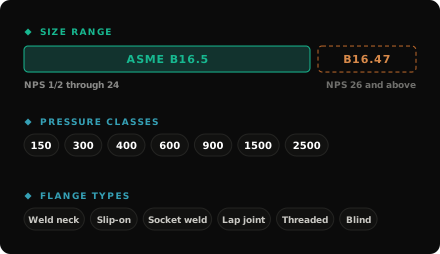
B16.5 governs pipe flanges and flanged fittings from NPS 1/2 through NPS 24, across pressure classes 150, 300, 400, 600, 900, 1500, and 2500. It sets the flange types, the facings, the dimensions including bolt circle and bolt hole count, the materials, and the pressure-temperature ratings by material group. Above NPS 24 the governing standard changes to B16.47, which is a distinction worth catching on a package with large-bore headers in it.
- NPS 1/2 through NPS 24, classes 150 through 2500
- Above NPS 24 the standard is B16.47, not B16.5
- Flange types include weld neck, slip-on, socket weld, lap joint, threaded, and blind
The Quantities That Fall Out of a Line Spec
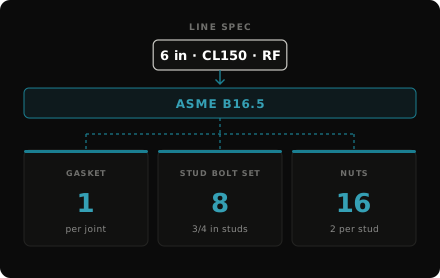
Size and class together determine the bolt count and the stud diameter for the joint, and the count is always a multiple of four because bolt holes straddle the flange centerlines. One joint takes one gasket and one stud bolt set, with two heavy hex nuts on every stud. Multiply by joints rather than by components, since a flanged valve carries two joints and a tee carries three.
- Bolt count and diameter are set by size and class together
- One gasket and one stud bolt set per joint, two nuts per stud
- Counts are always a multiple of four
What B16.5 Does Not Decide
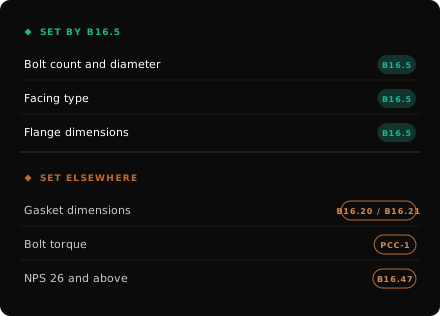
The facing changes the joint but not the count. Raised face is standard through the lower classes and ring type joint appears at higher ratings, and the two take different gaskets and different stud lengths at identical size and class. The gaskets themselves are a different standard: B16.20 covers metallic and spiral wound and ring joint gaskets, B16.21 covers non-metallic flat gaskets. Torque is not in B16.5 at all, and comes from the project bolting procedure with ASME PCC-1 as the methodology.
- Facing changes gasket type and stud length, not bolt count
- Gasket dimensions live in B16.20 and B16.21
- Torque belongs to the project bolting specification, never to B16.5
The Standard Is What Makes the Quantity Knowable
Almost nothing else in a piping estimate can be counted before the isometrics are issued. Bolts and gaskets can, because the line spec names a size and a class, and B16.5 fixes what follows from that. A six inch Class 150 raised face joint takes a known number of studs at a known diameter whether or not anyone has drawn the spool yet. That is why these are the items a machine should derive and an estimator should never be typing from memory.
The spec already decided the count. Somebody just has to look it up, every time, without getting bored.
Trusted by 200+ enterprises across EPC, Infrastructure, and Energy











ASME B16.5 for Estimators | Flange Classes and Derived Quantities | The Takeoff AI
What is ASME B16.5?
The standard for pipe flanges and flanged fittings from NPS 1/2 through NPS 24. It sets flange types, facings, dimensions including bolt circle and bolt hole count, materials, and pressure-temperature ratings by class and material group. For an estimator it is the document that turns a line spec into a bolt and gasket quantity before anything is drawn in detail.
What pressure classes does B16.5 cover?
Classes 150, 300, 400, 600, 900, 1500, and 2500. The class is a rating designation rather than a pressure in psi, since the actual allowable pressure at temperature depends on the material group. A Class 150 flange in one material and the same flange in another carry different allowable pressures at the same temperature.
What happens above NPS 24?
B16.47 takes over, in two series covering different bolting and dimensional conventions. This catches people out on packages with large-bore headers, where part of the line list falls under one standard and part under another, and the bolt counts do not continue the B16.5 pattern.
How many bolts does a B16.5 flange take?
It depends on size and class together rather than on either alone, and the count is always a multiple of four. A six inch Class 150 joint and a six inch Class 300 joint take different counts and different stud diameters. Use the tables on the stud bolts page and multiply by joints, not by components.