Jacketed Piping: What It Is and How to Take It Off | The Takeoff AI
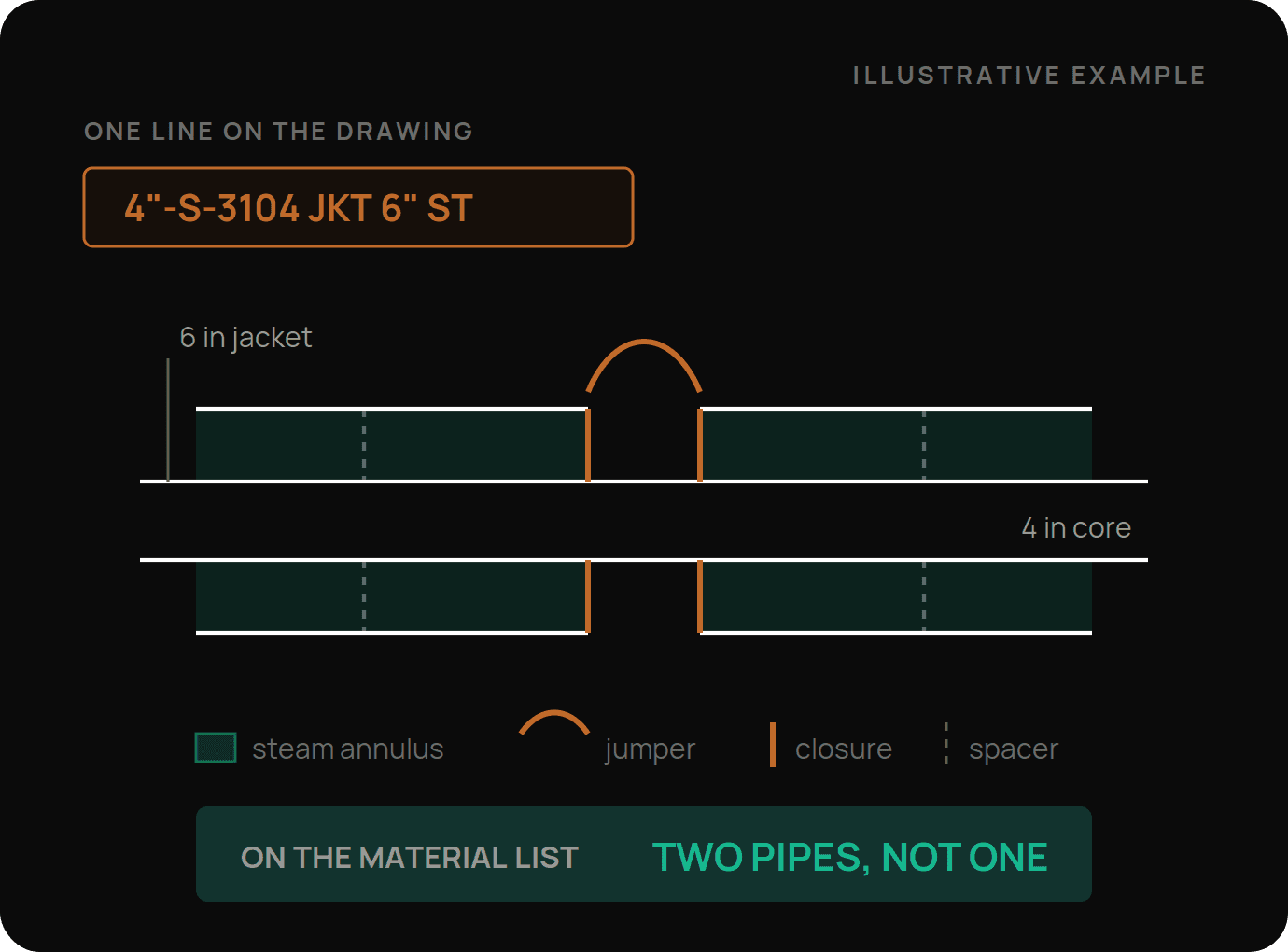
Jacketed piping runs a larger outer pipe around the process line so steam or hot oil can circulate between the two and hold the product at temperature. It shows on the drawing as one line, and it lands on the takeoff as two pipes, two sets of fittings, and a list of jacket-specific parts that nothing else on the job uses.
Common in sulphur, polymer, asphalt, food and chemical service, where the product solidifies or thickens if it cools.
How Jacketed Piping Is Built
The core pipe carries the product and the jacket carries the heating medium, and the parts that join the two are what make the takeoff different from a normal line.
The Core Pipe
The process line, sized and specified as usual, welded and tested before the jacket goes on. Once the jacket is closed, the core welds are no longer reachable, so the fabrication sequence and the inspection order are fixed.
The Jacket
A larger pipe around the core, typically one or two sizes up, carrying steam or hot oil. It's built in sections so the assembly can be fabricated and handled, which means each section brings its own ends and closures.
Jumpers, Closures and Supports
Jumpers carry the heating medium across fittings and between sections, end closures seal the annulus where the jacket terminates, and spacers hold the core centred inside the jacket. Each section also needs its own inlet and outlet connections.
What a Jacketed Line Adds to the Takeoff
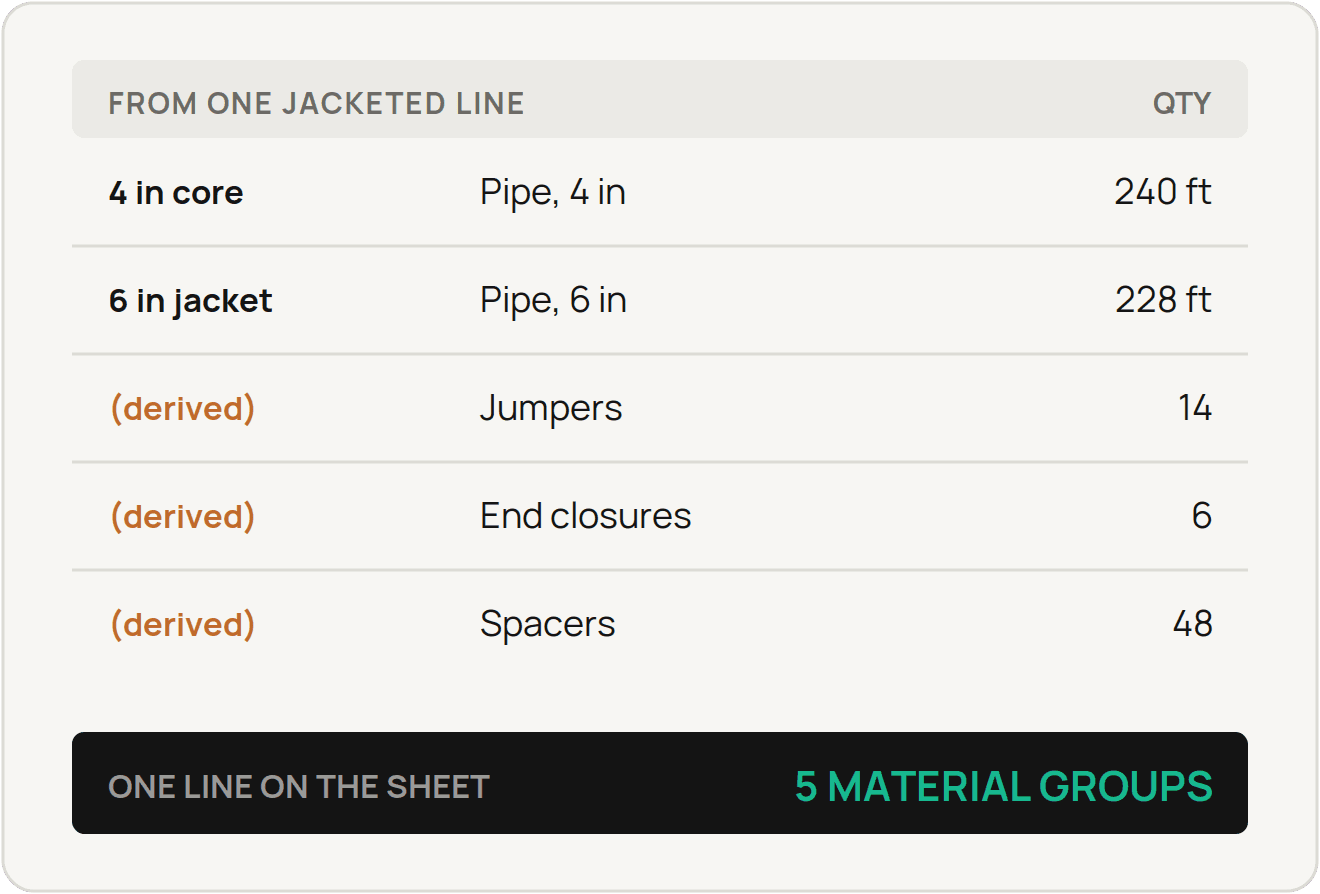
A straight run of jacketed pipe is roughly two takeoffs of the same line, and the count grows faster than that around fittings, because a jacketed elbow needs a jacketed elbow around it and a jumper to carry the medium past the turn. The parts that get missed are the ones with no equivalent on a normal line.
- Two pipe lines, two fitting counts, one drawing line
- Jumpers, closures and spacers have no equivalent on a bare line
- Core welds must be tested before the jacket closes, which fixes the sequence
Illustrative example. What one jacketed line carries against the same line bare.
Why Jacketed Lines Get Underestimated
The drawing shows one line, and a takeoff done at speed counts one line. The jacket usually gets caught, since it's called out in the line designation, and the jumpers, closures and spacers are the ones that slip, because nothing on the sheet draws them and they only exist on this kind of system. The labor slips with them, since a jacketed weld takes longer than a bare one and the sequence can't be reordered to catch up.
The Takeoff AI reads the line designation and the spec, counts core and jacket as separate lines of material, and resolves the jacket components from the spec rather than from memory. Every line traces back to the sheet it came from, so your estimator checks the jacket scope against the spec instead of rebuilding it by hand.
- Core and jacket carried as separate material lines
- Jacket components resolved from the spec and traced to the line PANEL TABLE CONTENT
Illustrative example. Core and jacket counted separately, both traced to the same line.
The Lines Most Likely to Be Underbid Are the Ones Least Often Counted
Most estimators see jacketed piping occasionally rather than daily, so the muscle memory that catches a missing gasket on a normal line isn't there for a missing jumper. On a package with a few hundred feet of jacketed service, the parts nobody drew add up quietly, and the error shows up in fabrication rather than at bid review.
The rarer the system, the thinner the memory that catches what's missing.
Trusted by 200+ enterprises across EPC, Infrastructure, and Energy











Reference the Estimating Library
Practical takeoff references, charts and workflow guides, built for working estimators.
Piping Estimating Software
Piping estimating software that reads your drawings and returns an auditable count. See what the AI actually does, how the line number becomes a priced line item, and where the estimate still needs your estimator.
/handbook/material-takeoff-software
https://www.thetakeoff.ai/pipe-schedule-chart
Jacketed Piping: What It Is and How to Take It Off | The Takeoff AI
What is jacketed piping?
A pipe within a pipe, where the inner line carries the product and the outer jacket carries steam or hot oil to keep the product at temperature. It's used where the product would solidify, thicken or crystallise if it cooled.
What is jacketed piping used for?
Sulphur, asphalt, molten polymers, heavy oils, food products such as chocolate and fats, and chemicals that crystallise. Anything that has to stay hot to keep moving.
What is a jumper on jacketed piping?
A short connection that carries the heating medium past a point where the jacket is interrupted, such as around a fitting or between two jacket sections, so the circuit stays continuous.
Is jacketed piping the same as traced piping?
No. Heat tracing runs a steam tube or an electric cable along the outside of the pipe under insulation, which is cheaper and simpler. A jacket surrounds the pipe completely and holds temperature more evenly, which matters for products that can't be allowed to cool anywhere along the run.
Why is jacketed piping more expensive to install?
Two pipes and two sets of fittings to buy, more welds per foot, a fixed fabrication sequence because the core has to be tested before the jacket closes, and jacket-specific parts with no equivalent on a bare line.