Bolt Torque Chart for Flange Bolting | ASME B16.5 | The Takeoff AI
Target torque for A193 B7 stud bolts on ASME (American Society of Mechanical Engineers) B16.5 flanges, worked from bolt size and target stress. Use it to check a bolting procedure or to size bolt-up work in an estimate, and take the final field value from the joint's own procedure.
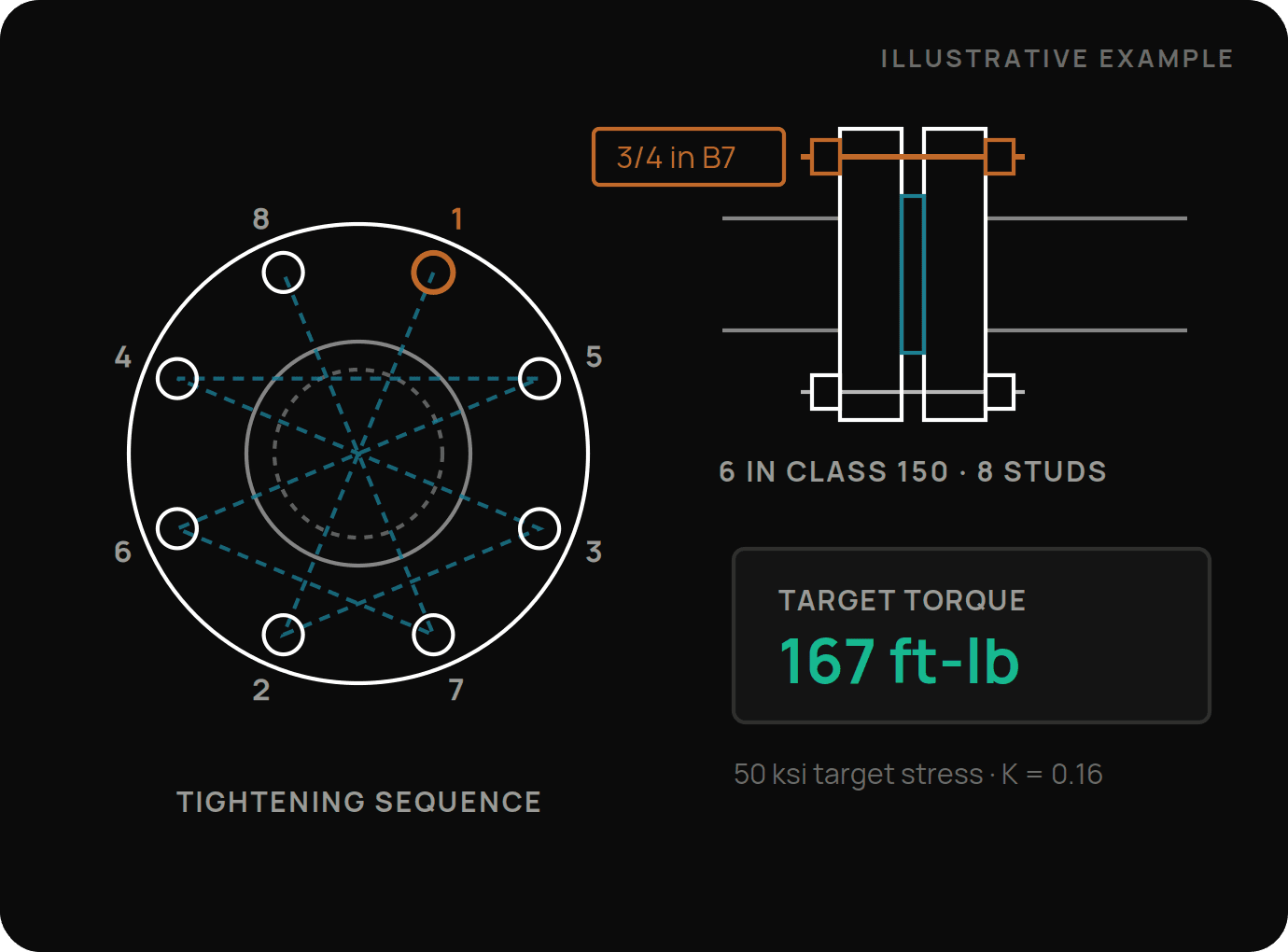
Worked values for B7 studs with 2H heavy hex nuts, at 50 ksi (thousand pounds per square inch) target stress and a nut factor of 0.16.
How to Calculate Bolt Torque
Torque is a way of reaching a target clamping force in the bolt, and most of the turning effort is lost to friction in the threads and under the nut. That is why the lubricant matters as much as the bolt size. The standard short-form equation is T = K × D × F ÷ 12, where T is torque in foot-pounds, K is the nut factor (friction), D is the nominal bolt diameter in inches, and F is the target bolt load in pounds. F is the target bolt stress multiplied by the bolt's tensile stress area.
Find the Bolt Size
Read the stud diameter off the flange class and pipe size. Bolts 1 inch and under use coarse thread (UNC), and larger B16.5 bolts use the 8-thread series (8UN).
Set the Target Load
Multiply the target bolt stress by the bolt's tensile stress area to get the load in pounds. For B7 studs, the target stress usually sits somewhere around 40 to 70 ksi, depending on the gasket and the procedure.
Calculate the Torque
Use T = K × D × F ÷ 12, where T is torque in foot-pounds, K is the nut factor, D is the bolt diameter in inches, and F is the target load in pounds. K runs about 0.16 to 0.20 with common lubricants and much higher on a dry thread. [
B7 Stud Bolt Torque Chart by Bolt Diameter BODY
These values come straight from the formula, using ASME B1.1 tensile stress areas, so every row follows the same assumptions and you can rework any of them for a different stress or lubricant. Treat them as a reference for estimating and checking, and let the bolting procedure set the number the crew actually pulls.
- Tensile stress areas taken from ASME B1.1 thread tables CHECK 2
- Coarse thread to 1 inch, 8UN above, as B16.5 flanges call for
- Assumptions stated on the chart so the numbers can be reworked
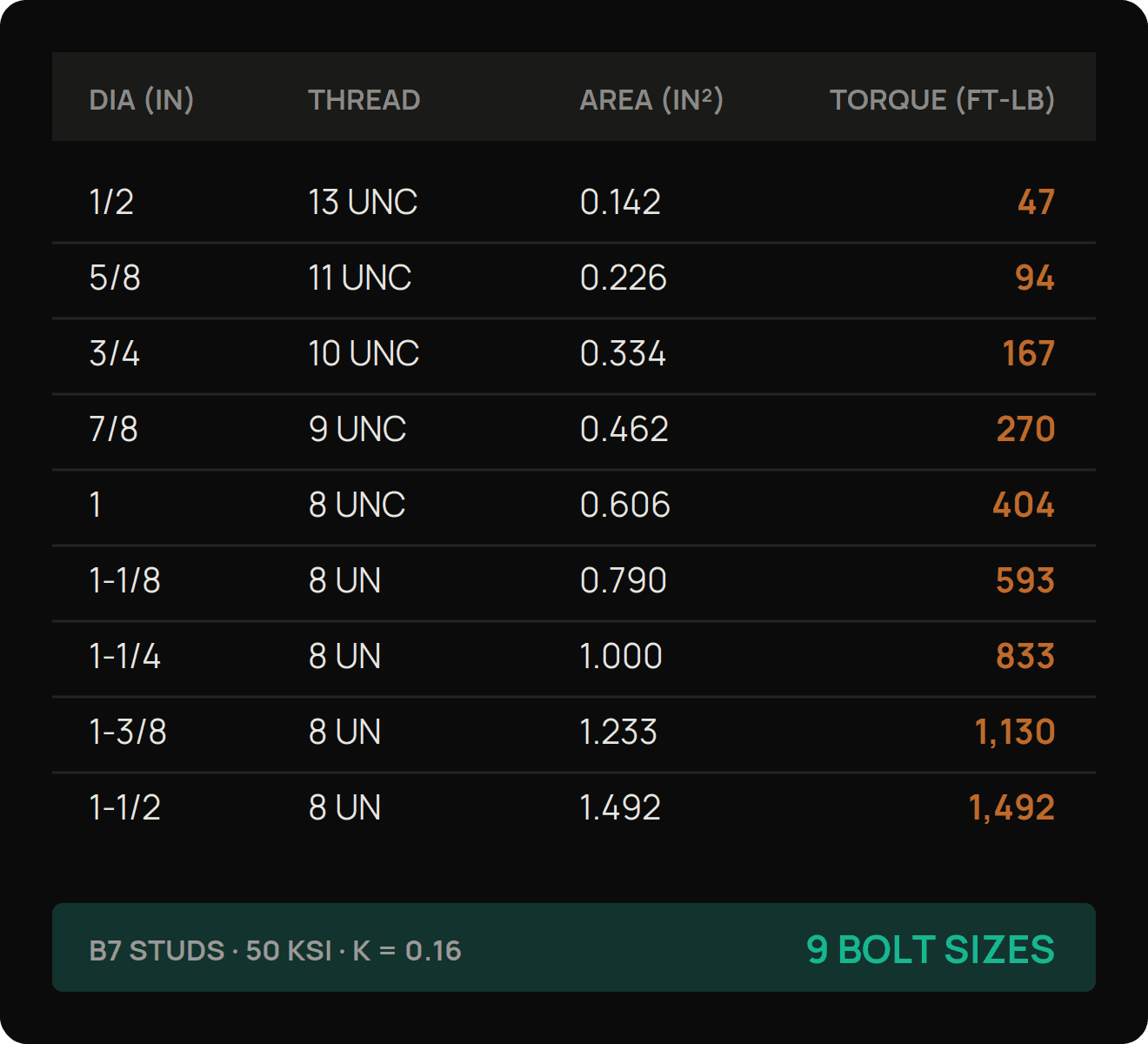
Worked at 50 ksi target stress and K = 0.16. Values rounded.
Why Bolt Torque Shows Up in Your Labor Number
Every flanged joint on the job gets made up, and every bolt set is a line of bolt-up labor. Small joints go on with a hand wrench, while large or high-pressure joints often need a hydraulic torque wrench or a tensioner, a trained crew and tooling on the equipment list, so the cost per joint climbs fast.
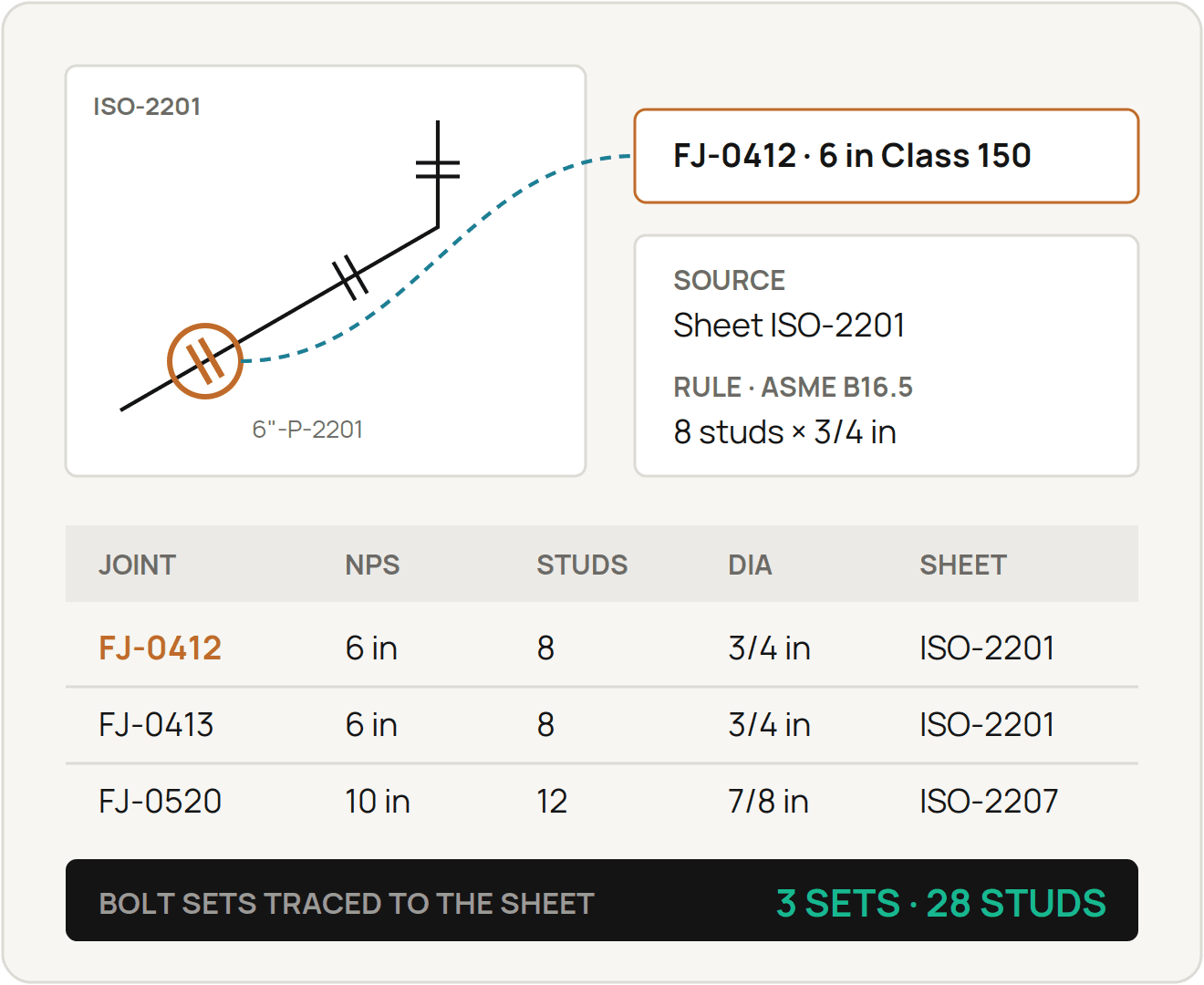
The Takeoff AI derives a stud bolt set for every flanged joint from the flange class and size, traces each one back to its joint on the sheet, and prices the bolt-up off your own labor rates. A joint missed in the takeoff is labor missing from the bid, so the trace is what lets your estimator check the count before it goes out.
- One bolt set per flanged joint, traced to the sheet
- Bolt-up priced off your labor rates
Every Joint Is Labor, and the Joints Add Up
A mid-sized piping package can carry thousands of flanged joints, and each one brings a bolt set to buy and a bolt-up to crew. Counting them by hand is slow, and the estimators who can do it well are harder to find every year. When the count takes days, you bid fewer packages and pass on work you could have won.
The number of bids you can count sets the ceiling on how many you can win.
Trusted by 200+ enterprises across EPC, Infrastructure, and Energy










Reference The Estimating Library
ASME B16.5 Pressure Classes for Bids | The Takeoff AI
What ASME B16.5 governs, which parts of it produce quantities you can take off, and how bolt and gasket counts get derived from a line spec at bid stage.
https://www.thetakeoff.ai/diameter-inch-calculator
Flange Bolt Chart
ASME B16.5 and B16.47 flange bolt chart. Stud bolt diameter, quantity, and length by pipe size and pressure class, RF and RTJ, plus how theTakeoff derives every bolt set from the P&ID.
Bolt Torque Chart for Flange Bolting | ASME B16.5 | The Takeoff AI
What torque should I use on a flange bolt?
It depends on the bolt size, the target bolt stress, the gasket and the lubricant, so no single number covers every joint. The chart gives worked values for B7 studs at common assumptions, and the joint's bolting procedure or the gasket maker's figure should set the final value.
Why does lubricant change the torque value?
Most of the torque goes into beating friction, and only a small share stretches the bolt. A good lubricant lowers the friction, so less torque reaches the same clamping load.
What is the difference between torquing and tensioning?
Torquing turns the nut to load the bolt. Tensioning stretches the bolt with a hydraulic tool and then runs the nut down, which gives a more even load across the joint and is common on large or critical flanges.
What is ASME PCC-1?
It is the ASME guideline for assembling bolted flange joints, covering tightening patterns, passes and target loads, and many plant owners write it into their bolting specs.