Introduction
What a takeoff is, why it decides the job, and why it was the last part of estimating anybody bothered to automate.
We named the company after the least glamorous word in the trade. Construction takeoff is not a phrase anyone puts on a billboard.
Nobody outside estimating has heard of a takeoff. Say it in a room of software people and half of them think aviation. Say it in a room of estimators and everyone knows exactly which two days of their week you're talking about.
What is a takeoff in construction
A takeoff is the step where you go through the drawings and pull out everything that has to be bought and built. Every valve, every linear foot of pipe, every weld, flange, bolt set, gasket, plate, member and nozzle. You count it, you measure it, you write it down in an organized list.
The takeoff meaning here has nothing to do with leaving the ground. It comes from taking the quantities off the drawing. That list is what everything downstream stands on. Attach material prices and labor units to it and you have a bid. Get the list wrong and every calculation after it is precise arithmetic performed on a wrong number.
Ask ten people in this industry what is a takeoff in construction and the estimators will answer instantly while everyone else guesses. Ask one of those estimators where bids are actually lost and almost nobody says the pricing. They say the count, the missed line, the item that was on the P&ID and never made it onto the sheet.

How the construction takeoff has been done
For most of the trade's history, on paper.
Drawings rolled out across a table. A scale rule, a wheel counter, colored pencils to mark what had been counted so it wouldn't get counted twice. Tally sheets filled by hand and totaled at the end. Senior estimators developed genuine craft in this way of working, and takeoffs done well were recognized as skilled output, a system of colors and marks personal enough that another estimator couldn't pick up a half-finished set and continue it.
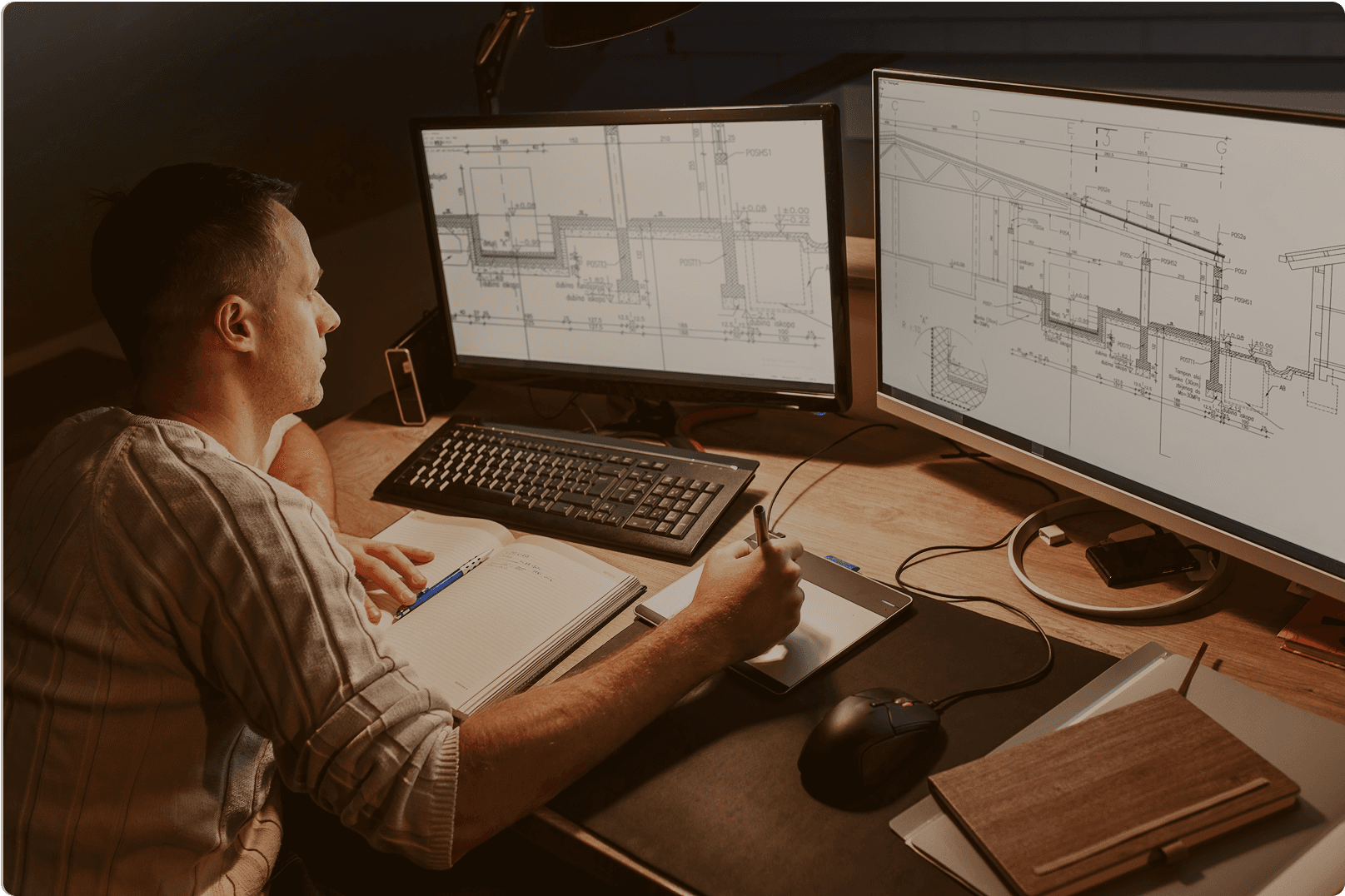
Then the drawings moved onto a screen and the method came with them. Load the PDF, calibrate the scale, click each item, and the software increments a counter and writes it to a list. Faster than pencils, and the arithmetic stopped being a source of error. But the fundamental motion stayed identical. A person looks at a drawing, decides what a symbol is, and clicks it. Then does it again. Then does it 800 more times.
Our survey of 312 estimators at US industrial contractors, fielded early in 2026, found roughly three-quarters still counting quantities by hand and 89% pricing in Excel. This is not a legacy corner of the industry. It's how the work is done right now.
What decades of construction tech actually built
Two things, both real, neither of them the reading.
The first was the surface. On-screen takeoff software replaced the paper table with a PDF viewer, and a generation of tools were built around clicking and measuring on a drawing. PlanSwift, Bluebeam, STACK and the rest gave estimators digital access to the sheet, with markup, scale calibration, area and length tools, and a tidy exportable list at the end. Good software. It made the counting cleaner without making it any less manual.
The second was the math. The estimating packages US mechanical contractors run carry catalogs of over 100,000 items with MCAA labor units built in. Give one a bill of quantities and it will explode it against a spec, price the material, apply the labor units and roll it into a submittable number. That problem was solved decades ago and solved well.
So the industry automated the arithmetic and it digitized the paper. In between those two achievements sits the part where a human being reads the drawing and decides what's on it, and that part was left exactly where it was in 1985. A dense P&ID still takes a senior estimator 30 to 60 minutes. A 300-drawing package still eats 250 or more estimator-hours before a single price gets attached. Full isometric takeoff on a refinery bid still runs around 875 hours, roughly $96,000 of estimating cost on a job you might not win.
Every hour of that is a skilled person doing data entry from a picture.

What Thetakeoff.ai does differently
We put the reading on the machine and left the judgement with the estimator.
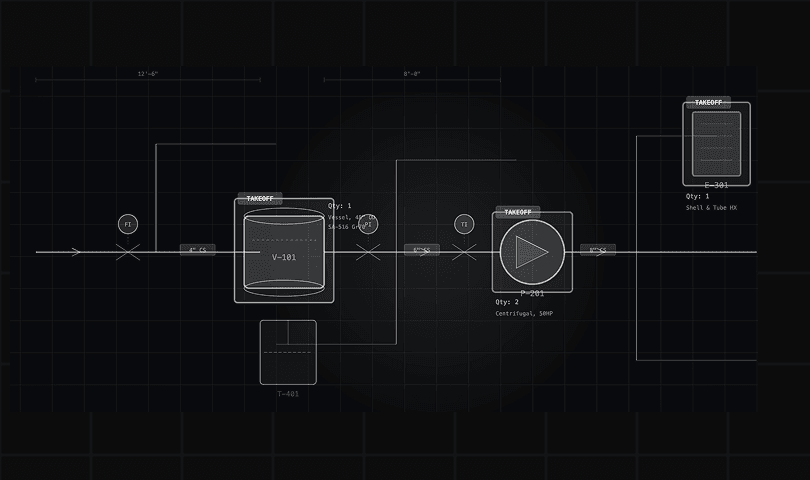
The engine opens the drawing set and reads both of the places meaning lives on an industrial sheet: the graphics, and the tables printed beside them. It pulls the schedule first, because a printed line list or bill of material is a more reliable source than any symbol detection, and treats visual recognition as the backstop rather than the starting point. Then it produces a first pass, with a link on every single number pointing back to the exact spot on the sheet it came from. Click a count and the drawing jumps to the item that produced it.
That click is the reason the product works at all. An estimator will not stake a bid on a count they cannot check, and they're right not to. So the review is built to move fast: high-confidence items grouped for bulk acceptance, uncertain ones sorted to the top of the queue, keyboard shortcuts instead of 200 individual mouse drags. What we removed is the blank sheet, and nothing else.
Starting with the drawings nobody wanted to touch
The AI takeoff tools that exist went at commercial buildings first, which makes sense. A floor plan is geometry. Walls have length, rooms have area, and the quantities fall out of shapes a model can already see.
We started with P&IDs and electrical instead. Both are the opposite problem. A P&ID is a schematic with no scale at all, where the information sits in symbols with local conventions and in line lists printed off to the side. Electrical and instrumentation drawings hide most of their scope in cable and panel schedules, with instrument work that can only be allotted rather than counted, because process taps and routing were never drawn in the first place.
These are the hardest drawings in the stack and the ones with the most money riding on them. They are also the ones nobody thinks about when they picture AI reading a construction drawing, which is exactly why they were still available.
Counts and measures across disciplines
A construction takeoff should not need four tools. One engine covers piping, structural steel, electrical and instrumentation, tanks and terminals, pressure vessels and exchangers, boilers and fired heaters, and the fabrication scope underneath them. The derived work rides along, since insulation, coating, fireproofing and heat trace all reduce to area math once the lengths and sizes exist.
Multi-craft industrial contractors get the most out of this, because those trades currently sit in separate takeoff software operated by separate people, reconciled against each other by hand and usually late at night.
Labor takeoff on your standards and the published ones
Quantities are half an estimate. What it costs your crews to install them is the other half.
The labor layer starts from what the industry agrees on, MCAA units, with ASME B31.3 and B16.5 underneath the quantity logic. Then it takes your side of it: the productivity factors your firm learned on jobs it actually built, your crew mixes, your rates. A weld in a congested pipe rack at height is not the same weld as one on a shop bench, and your own history knows that better than any published table.
Both layers stay visible and editable. You can see which factor produced which hour, the same way you can see which symbol produced which count.
Flagging contradictions across drawings, schedules and scopes
Counting is half the risk on a bid. A mismatch nobody caught is the other half.
The engine checks the drawing against itself, against the spec, and then against your written scope of work. That last check is the one most takeoff software skips entirely. A valve on the P&ID your scope doesn't cover is money you will spend and cannot invoice. A scope item with no drawing behind it is money you should have priced and didn't. Both get surfaced with both sides shown, and the call stays with you, before the number goes out.
That is the whole reason for the name. Takeoffs are where bids are won and lost, the takeoff meaning we care about is the one written on a tally sheet rather than the one on a runway, they were the last thing in estimating still done entirely by hand, and they are what we build.
Put a drawing through it
Take one sheet from a package you're bidding this month and bring it to a call. We'll run it on your own drawing type, work through the review queue, and you click the counts you don't believe. Bring the whole estimating team. Twenty minutes will tell you more than any demo video.