Introduction
A structural steel estimator tried an AI takeoff tool on a real package this year. It built the bill of materials well enough, then stopped, with no weld footage and no lengths to rate against. In a fab shop the labor is in the welds, so the tool had handed back the easy half and left the half the price depends on.
That is the AI takeoff software accuracy problem in one story. Every vendor quotes 90 to 99%, and none of the figures is made up. The trouble is what they were measured on. This article condenses the research report The AI Takeoff Accuracy Problem, published by The Takeoff AI in September 2026.
Where the 95 to 99% Figure Comes From
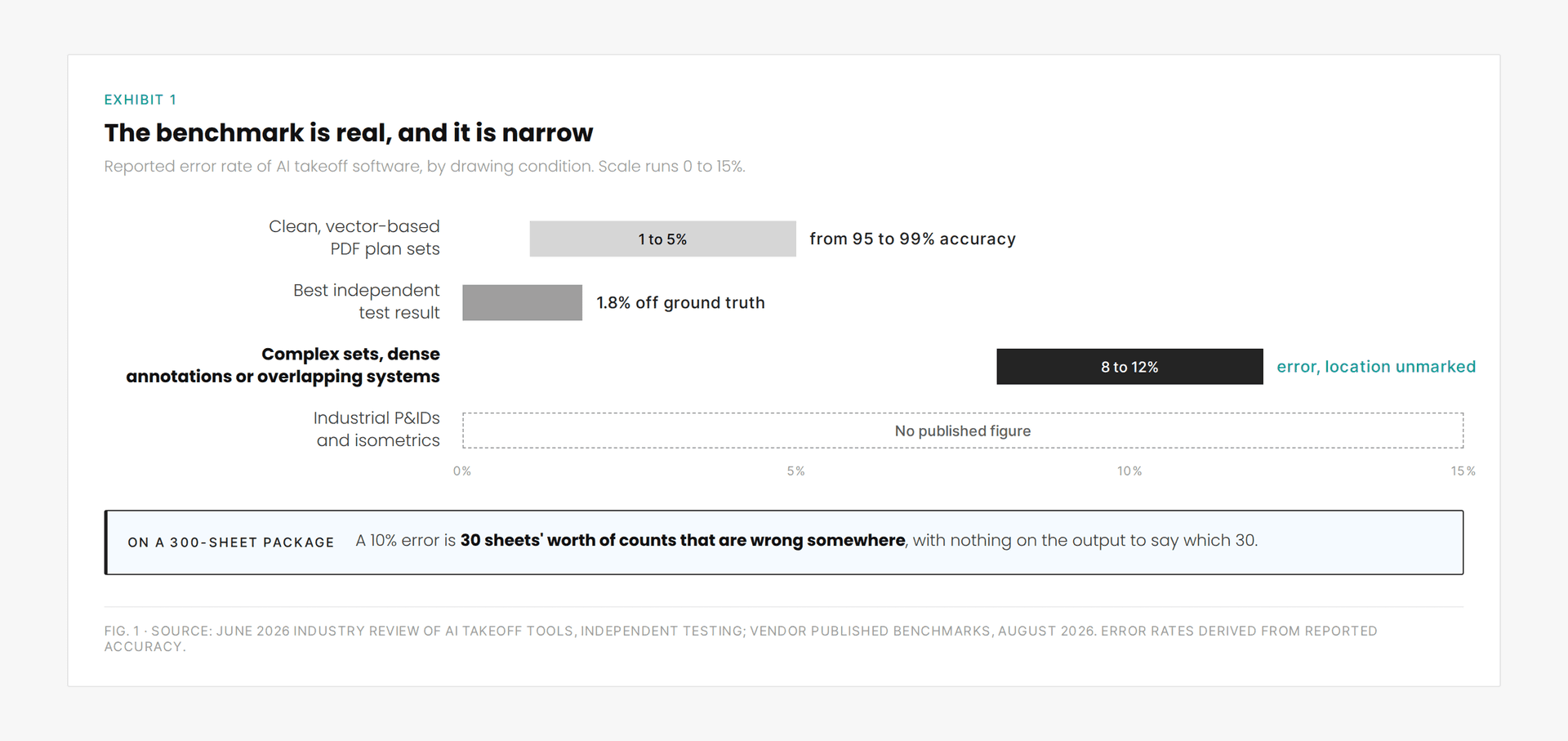
A June 2026 industry review of AI takeoff tools puts the top-tier platforms at 95 to 99% accuracy on clean, vector-based PDF plan sets, with independent testing placing the best platform within 1.8% of ground-truth quantities.
Read the conditions carried in those sentences, which are clean, vector-based, floor plans and standard plan sets. One of the largest commercial takeoff vendors, writing about its own product in August 2026, says the gains come from repeat work on clean sets, and lists what still needs a full review: complex geometry, unclear scope, low-quality scans and incomplete drawing sets.
So the benchmark is real and the benchmark is narrow. An accuracy figure describes the drawings it was measured on, and most industrial packages do not match the condition.
Why Industrial Packages Break the Benchmark
On discovery calls with The Takeoff AI this year, the estimating manager at a Houston instrumentation and electrical contractor put it plainly: they do not always get a nice set of drawings, they get a scope of work and an instruction to make it happen.
Sometimes the package has piping and instrumentation diagrams (P&IDs, the schematics that show every line, valve and instrument in a process unit) and no orthographic drawings. Sometimes it is a general arrangement drawing showing where equipment sits, and the runs have to be sketched in before anything can be counted.
A single dense P&ID takes a senior estimator 30 to 60 minutes to take off by hand. A process unit package can run past 300 of them, about 250 estimator-hours before a price is applied. A full isometric piping takeoff on a typical refinery bid runs roughly 875 hours, about $96,000 in loaded labor, and that cost lands whether the bid wins or not.
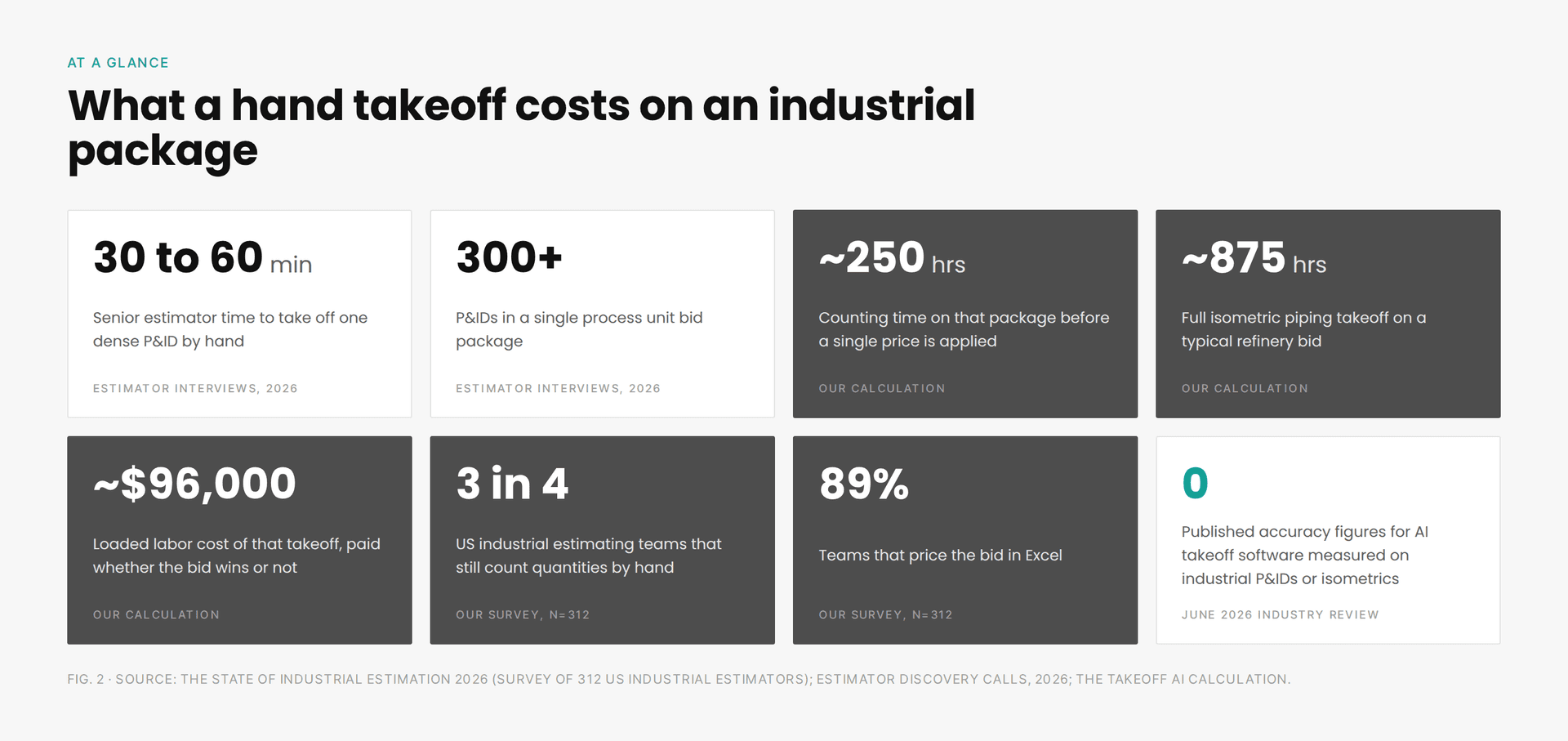
The Takeoff AI's survey of 312 US industrial estimators, published as The State of Industrial Estimation 2026, found roughly three in four teams still count quantities by hand and 89% price in Excel. That is the condition an accuracy claim has to survive.
Partial Output That Looks Finished
The same June 2026 review reports an 8 to 12% error rate on complex sets with dense annotations or overlapping systems. On a 300-sheet package, a 10% error is 30 sheets' worth of counts that are wrong somewhere, with nothing to say which 30. As one Gulf Coast fabricator said on a call this year, a 90% accurate takeoff does not help, because the team still has to find the 10%.
The survey found 24% of the estimating week already goes to rework, and 41% of teams had an estimate land more than 10% off actuals last year. A tool that saves ten hours of counting and adds an unmarked miss gives the ten hours back in rework, at the point in the schedule where there are none.
A Total With No Trail Only Moves the Work
Sage and IDC surveyed finance leaders in April 2026 and found that 71% would reject an AI output they cannot explain, even if it is accurate. The study puts 26% of the time AI saves as lost to verification and explanation work.
Estimating is finance with drawings. Somebody has to defend every quantity to a project manager and, on a change order, the client. A total with no trail forces the estimator to rebuild the trail, and on a 300-sheet package that can be all of the saving. It never shows up in the demo, only on bid day, when the number is challenged and the tool has no answer.
What Verification Should Look Like in AI Takeoff Software
A May 2026 buying guide from one AI estimating vendor states the minimum without hedging: an audit trail, so that you can click any number in the estimate and see the exact symbol on the plan. On an industrial set the mechanism needs three more parts, which are a reasoning trace showing which view and schedule the count was read from, an accept-or-reject queue so the estimator works through counts in order of doubt, and cross-reference resolution so that when a P&ID points to another sheet, the tool goes there and shows that it did.
On a structural demo this year, the tool counted three diaphragm plates on a connection. The estimator saw the count came from the plan view, which only shows the top plate, while the section view made it six. He caught it in seconds because he could see where the number came from, and with a total alone he would have caught it in the shop, or not at all.
Eight Questions to Ask Any AI Takeoff Vendor
- Can I run my own package, not your sample? A vendor who shows the sample first is the tell.
- Can I click any quantity and see where it came from on the sheet? A confidence score with no location is the tell.
- Does it read line numbers, or just shapes? On a P&ID the size and spec live in the line number.
- How are the bulks derived? Fittings, welds, supports and gaskets should be factored from line length and spec using ratios you can see and change.
- Does it handle an incomplete or mixed drawing set? It should flag missing sheets and leave the gap visible.
- What happens when a P&ID references another sheet? It should follow the reference and show both sheets in the trace.
- Where does my correction go? Accept and reject should be logged, with corrections carrying to the estimate and the next run.
- Where does the package live? Expect named certifications and a plain answer on who can access the files.
The checklist applies to any tool, including ours. Send the worst package on your desk and ask questions two and six first.
Where The Takeoff AI Fits
The Takeoff AI was built for the set an industrial desk actually receives: P&IDs, line lists, isometrics and instrument schedules, in whatever mix arrives. Click any count and it opens the exact valve, instrument, weld or steel member it came from, on the exact sheet. Line numbers are parsed for size, spec and service, and bulks are factored from line length and spec using ratios the estimator can see and change.
The honest limit is that it does not decide the number; the estimator still owns the scope read, the productivity factor and the price. Piping and P&ID, isometric, mechanical, electrical and instrumentation scopes are covered today. Send a package ahead and get your own accuracy number to check.
FAQs
How accurate is AI takeoff software?
On clean, vector-based PDF plan sets, the leading tools report 95 to 99% accuracy, and on complex sets with dense annotations the same review reports 8 to 12% error. No published figure covers industrial P&IDs or isometrics, so the only number that means anything for that work is one measured on your own package.
Can AI estimating software read P&IDs?
Most AI takeoff tools were trained on floor plans and will produce confident nonsense on a P&ID, which has no scale and carries size, spec and service in the line number rather than the geometry. A purpose-built industrial reader parses line numbers and follows tags to their schedules.
What is the best AI takeoff software for industrial piping?
The one that reads the documents your desk actually receives and can show that it did. Judge it on your own package, and start with whether every count opens the symbol it came from.
Conclusion
If your bottleneck is the count itself, run a real past package through any tool and compare it against the known takeoff. If the bottleneck is defending the number, the trace matters more than the accuracy figure, because the trace is what makes checking take an hour instead of a week. The full report, with the vendor checklist written to be forwarded, is at The AI Takeoff Accuracy Problem. Put The Takeoff AI through the eight questions on your own package.