Introduction
A miscount on the 10 inch XH lines is enough to move weld labor by tens of thousands of dollars, and on most desks the factors that turn dia-inches into hours sit in a spreadsheet only one estimator can explain.
The math itself is simple. What separates a defensible weld number from a guess is where your factors come from and what you carry outside them. The free Diameter Inch Calculator runs the arithmetic in your browser with every factor editable, and this post covers the judgment calls around it.
The Math in Four Lines
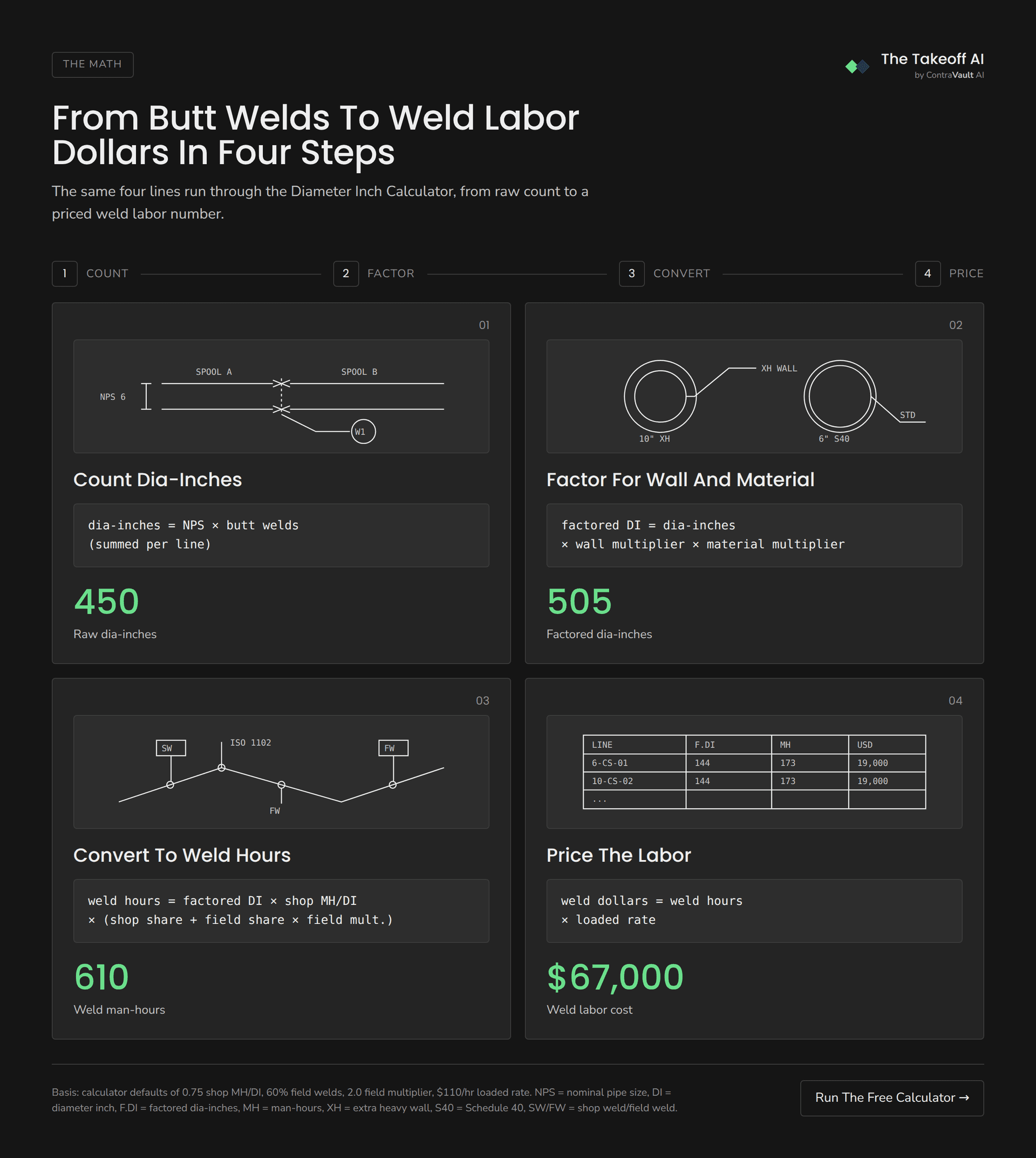
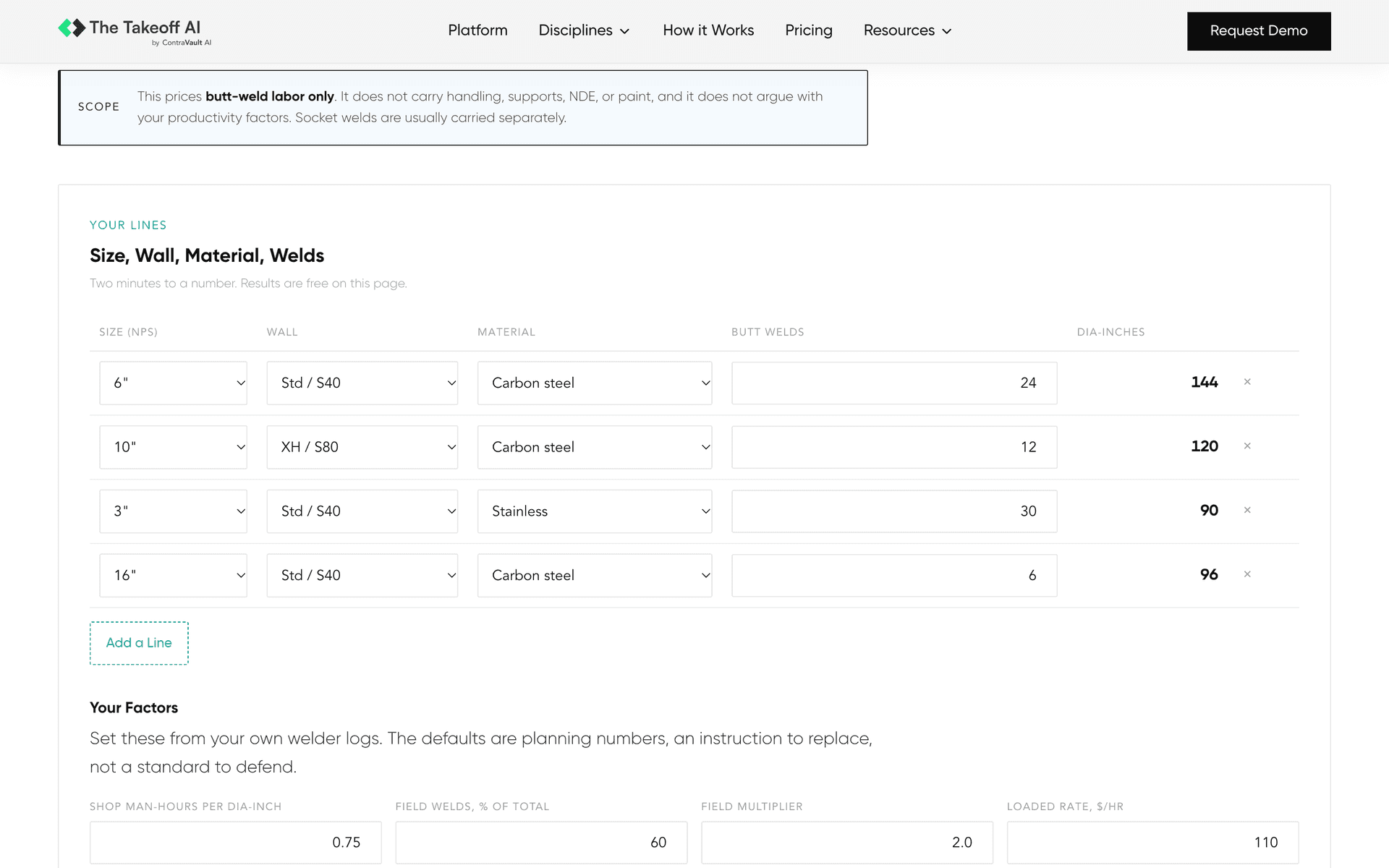
Run the calculator's four default lines through it (24 welds on 6 inch S40 carbon, 12 on 10 inch XH carbon, 30 on 3 inch S40 stainless, 6 on 16 inch S40 carbon) and you get 450 dia-inches, about 505 factored, roughly 610 weld man-hours and $67,000 in weld labor at $110 an hour loaded. That works out to about $132 per dia-inch all in.
Hours round to the nearest 10 and dollars to the nearest $1,000, because the factors are estimates, while the dia-inch count stays exact because it was counted.
Where the Factors Should Come From
The calculator ships with conservative planning values so it works on first load, and they are there to be overwritten.
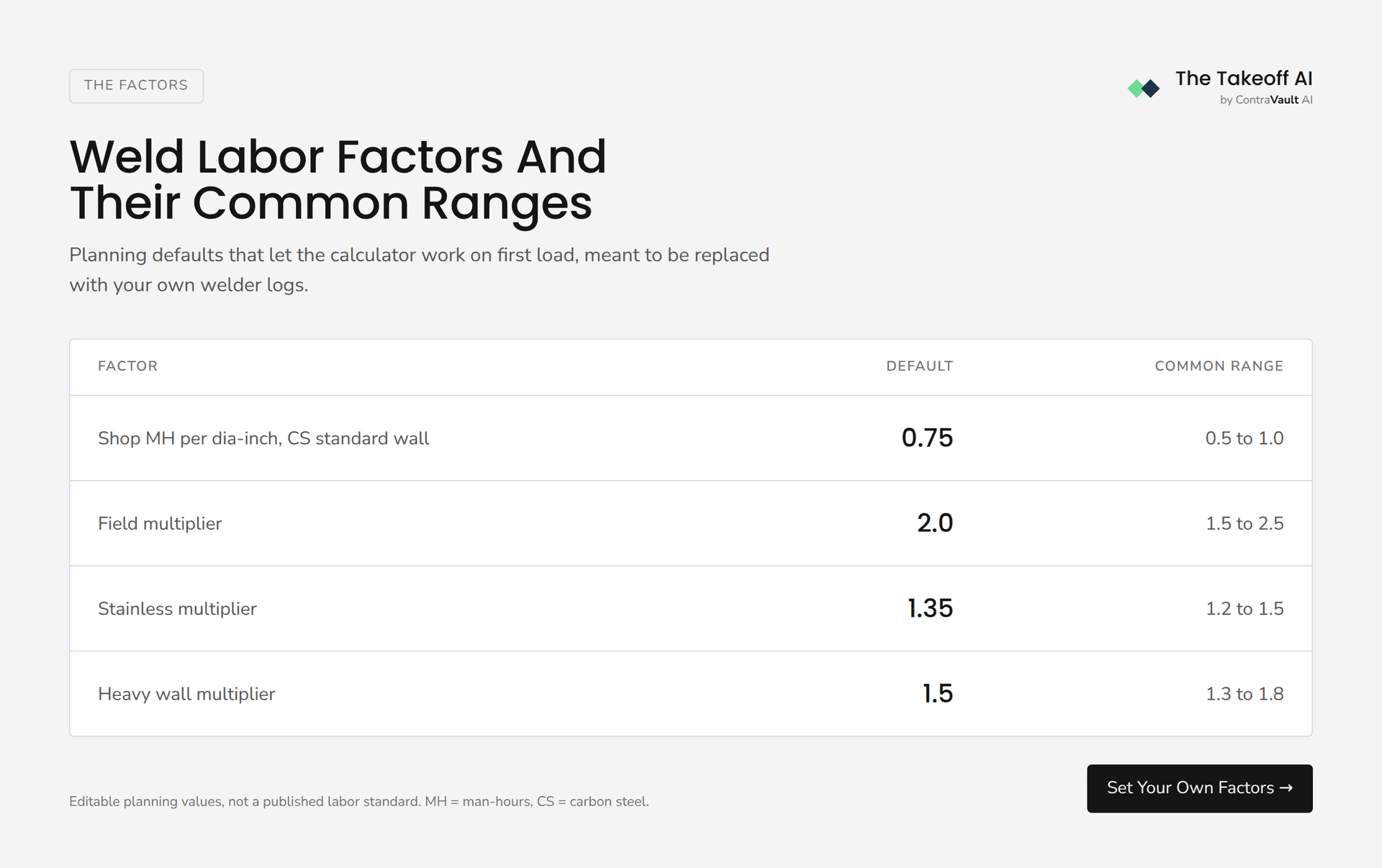
The field share is usually the number that gets guessed, and it swings weld hours more than the base rate does. Pull it from the isos on the job in front of you instead of carrying last year's split forward. Chrome-moly and S160 and up deserve their own multipliers for the same reason, since blending them into a general alloy factor hides exactly the lines most likely to need a cut-out.
What to Carry Outside the Weld Number
A dia-inch price covers butt-weld labor only. Handling, supports, NDE and paint sit outside it, and small-bore socket work is usually carried as its own factored line.
Fit-up and handling typically add 30 to 60 percent of weld time on field-heavy work, and repair rework on alloy and heavy wall compounds on top of that, because a cut-out is a new joint at the same dia-inches. Carry both as separate line items. When they get folded into a fatter weld factor, the bid stops being auditable and the next estimator inherits a number nobody can defend at bid review.
If you are pricing the same package for weight, the Pipe Schedule Chart and Metal Tonnage Calculator cover that side.
The Role of AI in Dia-Inch Counts
Pricing the welds takes minutes once the count exists, and getting the count is where the hours go. By our own calculation, a manual iso takeoff on a typical refinery bid runs around 875 hours, or about $96,250 of estimator time at loaded US rates.
The Takeoff AI reads P&IDs and isos, counts the joints, and lets you click any number to see the exact spot it came from, so you can check the count before it goes into your dia-inch total. Your factors stay yours. See how it works on the isometric takeoff page.
FAQs
How Do You Calculate Diameter Inches?
Multiply nominal pipe size by the number of butt welds on that size and sum across lines. Ten welds on 6 inch pipe is 60 dia-inches.
How Many Man-Hours Per Diameter Inch Should I Use?
For shop welds on carbon steel standard wall, 0.5 to 1.0 is a common planning range, with 0.75 a conservative midpoint. Your own welder logs should replace it as soon as you have enough jobs to trust them.
Why NPS and Not Actual OD?
Dia-inch factors were built against nominal size, so switching to OD without rebuilding every factor would move the numbers without making them any more accurate.
Do Diameter Inches Include Socket Welds and Olets?
Most desks count butt welds only and carry small-bore socket work and olets as a separate factored line, which is the convention the calculator follows.
How Do I Calculate Piping Weld Labor Cost?
Multiply factored dia-inches by your MH per dia-inch adjusted for field share, then by your loaded rate. The Diameter Inch Calculator does it in one pass and exports a PDF worksheet with the math shown per line.
Conclusion
If your factors hold up but the count takes days, the counting is where your time is going. If every estimator on the desk prices the same package differently, write the multipliers down and make them the standard. If you just want to sanity-check a bid already out the door, put the lines in and compare.