The document we started with
ContraVault AI began in 2024 with one narrow question: should you bid this job at all?
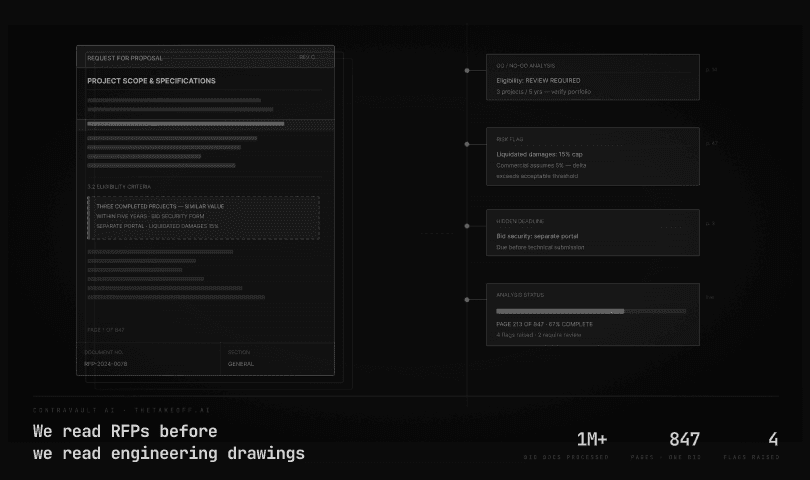
The first product was a Go/No-Go Analyzer. It read the RFP, all several hundred pages of it, and surfaced the things that should stop a contractor before they commit a team. An eligibility criterion demanding three completed projects of similar value inside five years. Liquidated damages capped at fifteen percent when the commercial team assumes five. A bid security form due ahead of the technical submission, on a different portal, in a format the cover letter never mentioned.
None of that is exotic. It's ordinary, and it stays ordinary because reading a thousand pages properly costs more than most bid teams have. So people skim, decide on instinct, and find out in month seven.
That product worked. Infrastructure and energy contractors put their bid packages through it, and more than a million bid documents have now passed through the platform. We got good at the paperwork around the bid.
Then the second question arrived
Customers who used the analyzer kept coming back with something we couldn't answer.
Fine, we're bidding it. Now what is actually in it?
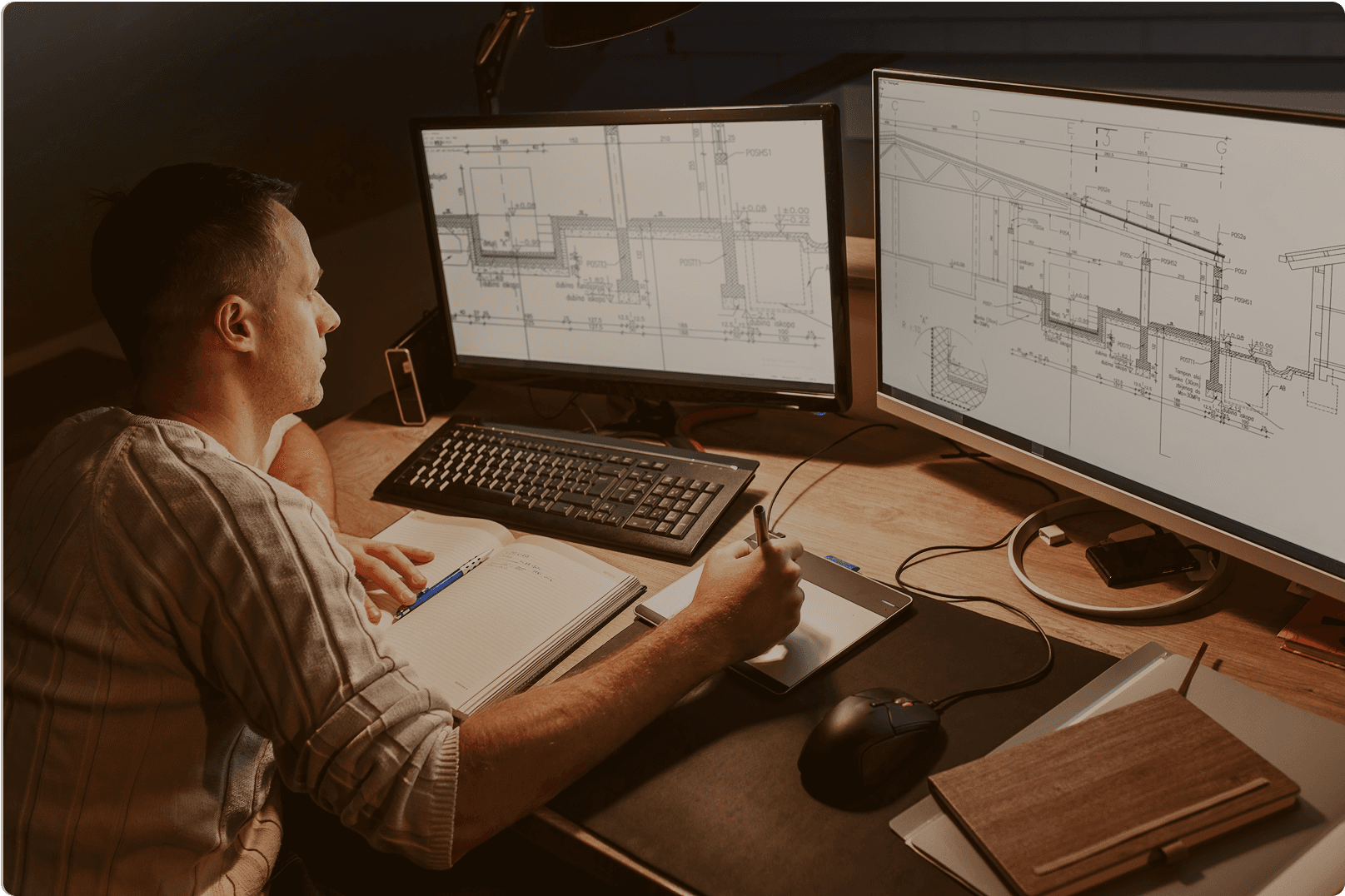
That answer doesn't live in the RFP text. It lives in the drawing set attached to it, and our software couldn't read a single sheet of it. The document that decides whether you make money on the job was the one document we had walked straight past.

How big the estimation problem actually is
We went looking for the size of it. In Q1 2026 we surveyed 312 estimators at US industrial contractors and published the results as The State of Industrial Estimation 2026. The numbers are worse than the anecdotes suggested.
Bid volume per estimating team is up 24% over five years. Estimator headcount is up 4%. That gap is the whole story, and it shows up everywhere downstream.
The median team prices 45% of the work it qualifies. The top quartile prices 68%. Same market, same drawings, same week. Compound that coverage against win rate and the difference stops being academic: out of 100 qualified jobs, a typical team wins around 10 while the top quartile wins around 26. The work is on the table. Most teams cannot physically reach it, and 63% told us they had turned down jobs they were qualified to win, for capacity reasons rather than any judgement about the job.
Process piping and mechanical is the heaviest scope in the survey at 38 estimator-hours for a mid-size package, more than any other trade. And the method underneath those hours is almost entirely manual. 89% of teams still price in Excel. Roughly three-quarters count their quantities by hand. About 24% of the estimating week disappears into rework, and 41% of teams report estimates landing more than 10% off actuals.
Then the part that keeps chief estimators awake. 64% say their hardest scope depends on one or two people whose method was never written down anywhere.
Zoom out and the demographics make it structural. Our own analysis of Census and BLS figures puts roughly $10M of annual construction value behind every working cost estimator in the country, and puts about 76% of those seats turning over by 2034 through retirement and exit. The load per estimator has already risen 19% in five years. McKinsey's read of the sector is the same one from a different angle: construction spends 1% to 2% of revenue on technology against 3% to 5% across other industries, and posted productivity growth of 0.4% a year between 2000 and 2022.
A shrinking group of people, each carrying more, working in a spreadsheet, counting by hand.
Why engineering drawings are the hardest document in the stack
An engineering drawing is a document. It just happens to be drawn instead of written, and that single fact is why the software industry solved arithmetic decades before it touched the reading.
Meaning sits in two places on the sheet at once. The graphics, which are the valves and instruments and lines and members. And the printed tables beside them, which are the line lists, valve schedules, nozzle schedules and bills of material. Read one and miss the other and you have half the information. Construction drawings for industrial work stack this further, because an isometric prints its bill of material on the sheet while a vessel drawing hides most of the count in a TEMA sheet.
The arithmetic is genuinely handled. The estimating packages US mechanical contractors already run carry catalogs of over 100,000 items with MCAA labor units built in, and they price a bill of quantities properly. They automated the math and left the reading alone. So a dense P&ID still takes a senior estimator 30 to 60 minutes by hand. A 300-drawing process-unit package still eats 250 or more estimator-hours before anyone has priced anything. Full isometric takeoff on a typical refinery job runs closer to 875 hours, which at loaded US rates is about $96,250 of the estimated cost on a bid you might lose.
On an RFP clause, a reading error costs you an argument later. On a drawing, a reading error becomes a dollar error immediately, because the count feeds the quantity, the quantity feeds the hours, and the hours feed a number you submit and then live with for eighteen months.

What we built second
Thetakeoff.ai reads the drawing set and the schedules printed on it. It counts and measures across piping, structural steel, electrical and instrumentation. It runs the labor takeoff against MCAA units and your own crew productivity. It checks the drawing against the schedule and against your written scope of work, and flags where the three disagree.
The rule we carried over from the first product is the one that matters most. Next to every number sits a link back to the exact spot it came from. Click a count and the sheet opens on the item that produced it. An estimator who cannot trace a number cannot defend it in a bid review, and a number nobody can defend has no business being in a submission.
That's also the honest answer to the capacity gap in the survey data. The 38 hours on a piping package aren't 38 hours of judgement. Most of it is transcription, and the estimator's actual expertise gets spent on the wrong half of the job. Move the first pass to the machine and leave the checking with the person, and a team that prices 45% of what it qualifies can start reaching for the 68% the top quartile is already hitting.
Where that leaves ContraVault AI
In June 2026 ContraVault AI raised $3.1M in a pre-Series A round led by Chiratae Ventures, with participation from existing investor Titan Capital Winners Fund. Most of it is pointed at the US market and at the reading engine underneath Thetakeoff.ai.
Two years ago we were reading the paperwork around the bid. Now we read what the bid is made of.
Put a drawing through it
Take one sheet from a package you're bidding this month and bring it to a call. We'll run it on your own drawing type, work through the review queue, and you click the counts you don't believe. Bring the whole estimating team. Twenty minutes will tell you more than any demo video.