Takeoff and Estimating Software
Takeoff and estimating software covers two jobs that most tools only do one of. This page separates them, shows what each half needs on an industrial package, and says plainly which half theTakeoff does today and which one you will still run in your own price book.
Live today for P&ID and piping. Structural steel is next, pipe racks first. Runs in the browser, so there is no installer.
Every member tagged, measured, and traced back to the sheet it came from.
What Takeoff and Estimating Software Does to an Industrial Package
An industrial bid runs through six steps, and the software market splits down the middle of them. The first steps are mechanical and repetitive, which is where a machine earns its place. The last ones need what your own completed jobs taught you. Knowing which is which tells you what to buy.
Read the Set
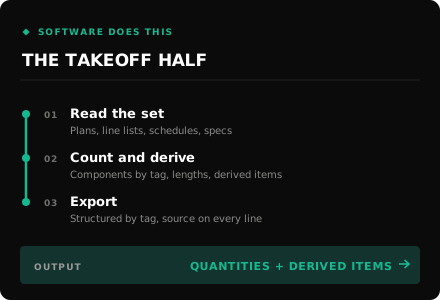
Plans, line lists, schedules, and specs ingested together, so the engine works from the same package your estimator does. Vector PDFs, scanned sheets, and the revision somebody dropped into the folder without telling anyone.
Count, Measure, and Derive
Components counted by tag, lengths measured off the geometry, and derived items resolved from the spec. A 6 inch CL150 flanged valve is one line on the drawing and five lines on the material list once gaskets and stud bolts are in.
Export Into Your Pricing
Quantities come out structured by tag with descriptions, sizes, and units, exported to Excel and ready for your labor units and price book. Every row keeps a link back to the spot on the drawing it was read from.
Where the Takeoff Half Ends and the Estimating Half Begins
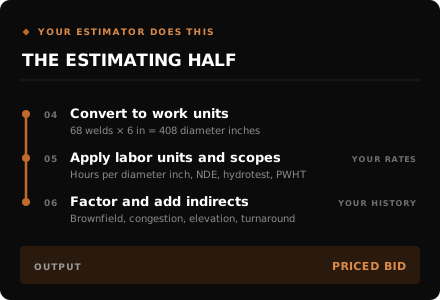
The takeoff half answers how much of each thing the drawings contain. The estimating half answers what it costs to buy and install, which on industrial work means converting quantities into welds and diameter inches, applying labor units, pricing the scopes that appear on no drawing, and factoring for the conditions the job is actually built in. Those are different problems and very few products are strong at both. Catalog systems like FastPIPE and Trimble Accubid nailed the estimating half years ago and still make you click out every component by hand. AI readers do the opposite.
theTakeoff does the takeoff half, including the derived items that follow from the spec rather than from anything drawn. Labor units and catalog pricing are the next build, so today the output lands in the price book you already maintain rather than replacing it. We would rather tell you that here than let you find it in week three of an evaluation. If you need one system that carries quantities all the way to a priced bid this quarter, the catalog systems above are ahead of us and worth the call.
- Quantities and derived items are mechanical, so software should own them
- Labor units are a lookup once the work units are right
- Productivity factoring and margin are judgement drawn from your own jobs
- No tool should hand you a bid number without showing the factors it applied
Where one half ends
The takeoff half answers how much of each thing the drawings contain. The estimating half answers what it costs to buy and install, which on industrial work means converting quantities into welds and diameter inches, applying labor units, pricing the scopes that appear on no drawing, and factoring for the conditions the job is actually built in. Those are different problems and very few products are strong at both. Catalog systems like FastPIPE and Trimble Accubid nailed the estimating half years ago and still make you click out every component by hand. AI readers do the opposite.
theTakeoff does the takeoff half, including the derived items that follow from the spec rather than from anything drawn. Labor units and catalog pricing are the next build, so today the output lands in the price book you already maintain rather than replacing it. We would rather tell you that here than let you find it in week three of an evaluation. If you need one system that carries quantities all the way to a priced bid this quarter, the catalog systems above are ahead of us and worth the call.
- Quantities and derived items are mechanical, so software should own them
- Labor units are a lookup once the work units are right
- Productivity factoring and margin are judgement drawn from your own jobs
- No tool should hand you a bid number without showing the factors it applied
The bids keep coming. The estimators to price them do not.
A 300-sheet P&ID package eats more than 250 estimator hours before anyone has priced a thing, and a full isometric takeoff on a typical refinery bid runs about 875. Nearly all of that sits in the takeoff half, counting and measuring rather than judging. The bench of people who can do that work by hand gets thinner every year, so the ceiling on how many jobs you chase drops while the bid volume does not.
Capacity, not opportunity, sets the ceiling on how much you can bid.
Trusted by 200+ enterprises across EPC, Infrastructure, and Energy











Reference The Estimating Library
/handbook/quantities-to-priced-bid
/handbook/material-takeoff-software
Piping Estimating Software
Piping estimating software that reads your drawings and returns an auditable count. See what the AI actually does, how the line number becomes a priced line item, and where the estimate still needs your estimator.
/handbook/takeoff-software-comparison
Takeoff and Estimating Software
What is takeoff and estimating software?
Software that turns a drawing set into a priced bid. The takeoff half reads the drawings and produces quantities. The estimating half converts those quantities into work units, applies labor units and material pricing, adds indirects, and returns a number. Most products in the market do one half well. Buying the wrong half means you are still doing the expensive part by hand.
What is the difference between takeoff software and estimating software?
Takeoff answers how much of something there is. Estimating answers what it costs to buy and install. On industrial piping the gap between them is wide, because quantities have to become welds and diameter inches before any labor unit applies, and then get factored for congestion, elevation, and turnaround conditions. Teams commonly run a takeoff tool and a separate estimating package and reconcile between them by hand.
Does theTakeoff produce a priced bid?
Not today. theTakeoff produces quantities and the derived items that follow from the spec, exported so they drop into whatever labor units and price book you already run. Catalog pricing and labor units are the next build. If a single system carrying quantities through to a bid number is a requirement this quarter, FastPIPE and Trimble Accubid do that today, with manual click-by-click takeoff attached.
Is this takeoff and estimating software for contractors, subcontractors, or general contractors?
Self-performing specialty contractors doing industrial process work. A general contractor mostly assembles and levels sub quotes rather than counting components, so bid management solves their problem and a takeoff tool does not. If your estimator opens the drawings and counts, this fits.