AI Estimating Software
AI estimating software covers three different things that get sold under one phrase, and the accuracy numbers attached to them are close to meaningless without knowing which. This page separates them, explains why a machine read is worth having at less than perfect accuracy, and says what ours measures.
theTakeoff reads your drawing set and returns the quantities with a source behind every line, so you verify the read rather than repeat it.
Every member tagged, measured, and traced back to the sheet it came from.
Three Different Products Are Sold as AI Estimating Software
The phrase has been stretched across products that work nothing alike. Sorting them tells you what a demo is actually showing you, and what an accuracy figure attached to it could possibly mean.
Pattern matching that speeds up your clicking
You still identify every component. The software recognises repeats of something you have already marked and offers to find the rest. Useful, and genuinely faster than manual, but the reading is still yours and so are the hours.
The software produces the count and you verify it
The engine identifies components across the set, measures what is drawn, derives what the spec requires, and hands back a list. Your work moves from counting to checking. This is where the hours actually come back, and where accuracy claims start to matter.
Their people finish what the model started
The output looks like software and arrives on a turnaround, priced per page, because engineers reviewed the last stretch before it reached you. That can be the right purchase. It is not the same purchase, and its accuracy number describes their staff rather than their model.
A Single Accuracy Percentage Tells You Almost Nothing
Three different things get called accuracy and they fail in different ways. Precision asks how much of what the software marked was right. Recall asks how much of what exists on the sheet it found. Localization asks whether clicking the number lands you on the actual component. A tool can score well on one and badly on another, and a blended figure hides exactly that. Recall is the one that costs you money, because a wrong count gets caught in review and a missing item does not.
Then there is the question of which components the number describes. Accuracy on ball valves and accuracy on hand-annotated specialty items are not the same problem, and averaging them produces a figure that flatters the easy classes. Ask any vendor for their numbers broken out by component class and by which of the three measures they mean. If the answer is one percentage for everything, you have learned something about the vendor rather than the product. We do not publish a headline figure for the same reason, and we will show you ours per class on your own package instead.
- Precision, recall, and localization are three problems with three different fixes
- Recall failures cost more than precision failures, because nothing flags a missing item
- A number averaged across component classes flatters whichever class is easiest
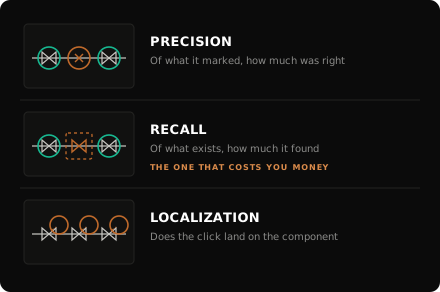
Illustrative example. The same sheet, three different failures.
How a First Pass Becomes a Number You Can Use
Every item the engine produces carries a confidence, and the queue is sorted by it rather than by sheet order. What the engine is least sure about reaches you first: a tag it could not read, a specialty item with no spec match, a reducer whose size is ambiguous. Those are the lines worth an estimator's attention, and they sit at the top instead of buried on sheet forty at six in the evening.
Classes it reads reliably go the other way. Twenty-eight CL150 gate valves are confident about getting accepted together rather than clicked one at a time. Nothing is dropped along the route: an item it cannot tag becomes a flagged line rather than a silent omission, because a wrong count gets caught in review and a missing one does not. Every accept, correction, and rejection feeds the next package.
- Uncertain items sort to the top, confident classes accept in bulk
- An untagged item becomes a flagged line, never a silent omission
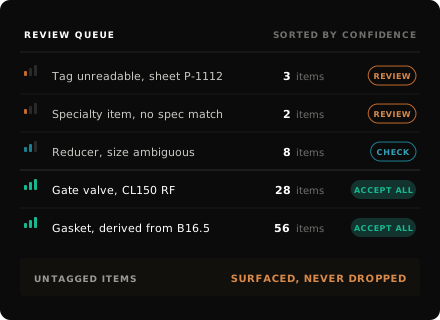
Illustrative example. The least certain lines reach you first.
Click Any Line and See Where It Came From
A count you cannot check is a count you cannot use, so the checking is the whole design. Every count and every length traces back to the component on the sheet it was read from, with the source sheet, the location, and the rule that produced the line sitting right next to it. A derived gasket shows the flange it came from and the class that set the count.
Uncertain items sort to the top of the queue rather than hiding in the middle of a list, so your attention goes where the risk is. High-confidence classes can be accepted in bulk. Anything the engine could not tag is surfaced as a problem rather than dropped, because an untagged item cannot become a line and will not be missed by anyone until it is too late.
- Every line links to its component and its source sheet
- Correct a quantity in one click and the audit trail keeps the change
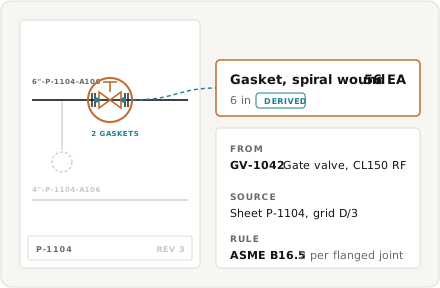
Illustrative example. Click a line, land on the exact component.
The bids keep coming. The estimators to price them do not.
A 300-sheet P&ID package eats more than 250 estimator hours before anyone has priced a thing, and a full isometric takeoff on a typical refinery bid runs about 875. Nearly all of that is counting and measuring rather than judging. The bench of people who can do that work by hand gets thinner every year, so the ceiling on how many jobs you chase drops while the bid volume does not. That pressure is why this category filled up so quickly, and why so much of the marketing arrived at the same three claims.
Capacity, not opportunity, sets the ceiling on how much you can bid.
Trusted by 200+ enterprises across EPC, Infrastructure, and Energy











Reference The Estimating Library
Takeoff references, reference tables, and workflow guides, written for working estimators.
/handbook/takeoff-software-comparison
/handbook/quantities-to-priced-bid

Industrial Estimating Software
Industrial estimating software built for process work, where components are specified against codes and a missed spec break costs six figures. This page covers what industrial estimating needs that building-trade tools do not provide, which disciplines theTakeoff reads today, and where your own price book still does the work.
Piping Estimating Software
Piping estimating software that reads your drawings and returns an auditable count. See what the AI actually does, how the line number becomes a priced line item, and where the estimate still needs your estimator.
AI Estimating Software
What is AI estimating software?
Software that reads drawings and produces quantities without a person identifying each component first. The phrase gets applied to three different products: assisted measuring that speeds up your clicking, machine reading that produces the count for you to verify, and managed services where the vendor's engineers finish the job. Only the middle one changes what an estimator does all day, and the three cannot be compared on a single accuracy figure.
Is AI estimating software accurate enough to trust?
Not accurate enough to accept unchecked, and any vendor telling you otherwise is describing a service with people in it rather than a model. What makes it worth buying is that checking a machine's first pass is far faster than building the count from scratch, provided every number links back to the drawing so checking is quick. Treat any tool you cannot audit line by line as unusable regardless of its claimed accuracy.
Will AI replace estimators?
It replaces counting, which is most of the hours and none of the judgement. Deciding the productivity factor for a congested brownfield unit, reading what a spec implies rather than states, and knowing which subcontractor quote is optimistic are not drawing-reading problems. The constraint on industrial contractors is estimator capacity, so tools that remove the counting mean the same team bids more work rather than a smaller team bidding the same.
Does AI takeoff work on scanned or poor-quality PDFs?
Vector PDFs read best. Scans read well enough to be worth checking, and quality varies with the scan rather than with the drawing. This matters more in industrial work than in new construction because brownfield packages routinely include sheets that were drawn decades ago and photocopied since. The useful question in a demo is not whether a tool handles scans but whether its output tells you which sheets it was least confident about.
Does the software learn from our corrections?
Yes, and that is the main reason a self-serve product beats a managed service over time. Every accept, reject, and correction is labelled data about a real drawing, produced as a by-product of work your estimator was doing anyway. A vendor whose own engineers do the reviewing collects that same signal at the speed of their payroll instead of at the speed of their customers.