Introduction
A single liquid-cooled hall can carry more than $20 million of construction value per megawatt, and the mechanical scope inside it is priced by one estimator working to the same two-week deadline they had five years ago. That is where most of the money in this boom is won or lost, well before anyone pours a foundation.
US data center construction spend hit a $50.7 billion annual rate in April 2026, the first month above $50 billion since the Census Bureau began breaking the category out. It passed general office construction, and it passed airports, ports and mass transit put together. Contractors want to know what a megawatt costs, what sits inside that number, and whether their desk can price the package at all. We pulled the figures together in The Data Center Boom Has A Problem, our September 2026 report. This post covers the cost side of it.
What Data Center Construction Costs In 2026
The working unit is dollars per megawatt of IT capacity, not dollars per square foot. JLL puts shell-and-core cost at $10.7 million per megawatt in 2025, up from $7.7 million in 2020, with another 6% rise expected through 2026. AI-optimized halls, the ones built around high-density racks and liquid cooling, run past $20 million per megawatt.
Two numbers explain most of the variance between one project and the next: rack density, which decides the cooling system, and whether the scope includes fit-out or stops at the shell. A 100 MW campus at $10.7 million per megawatt is a billion-dollar program before a single server arrives.
How Much Does It Cost To Build A Data Center, By Discipline
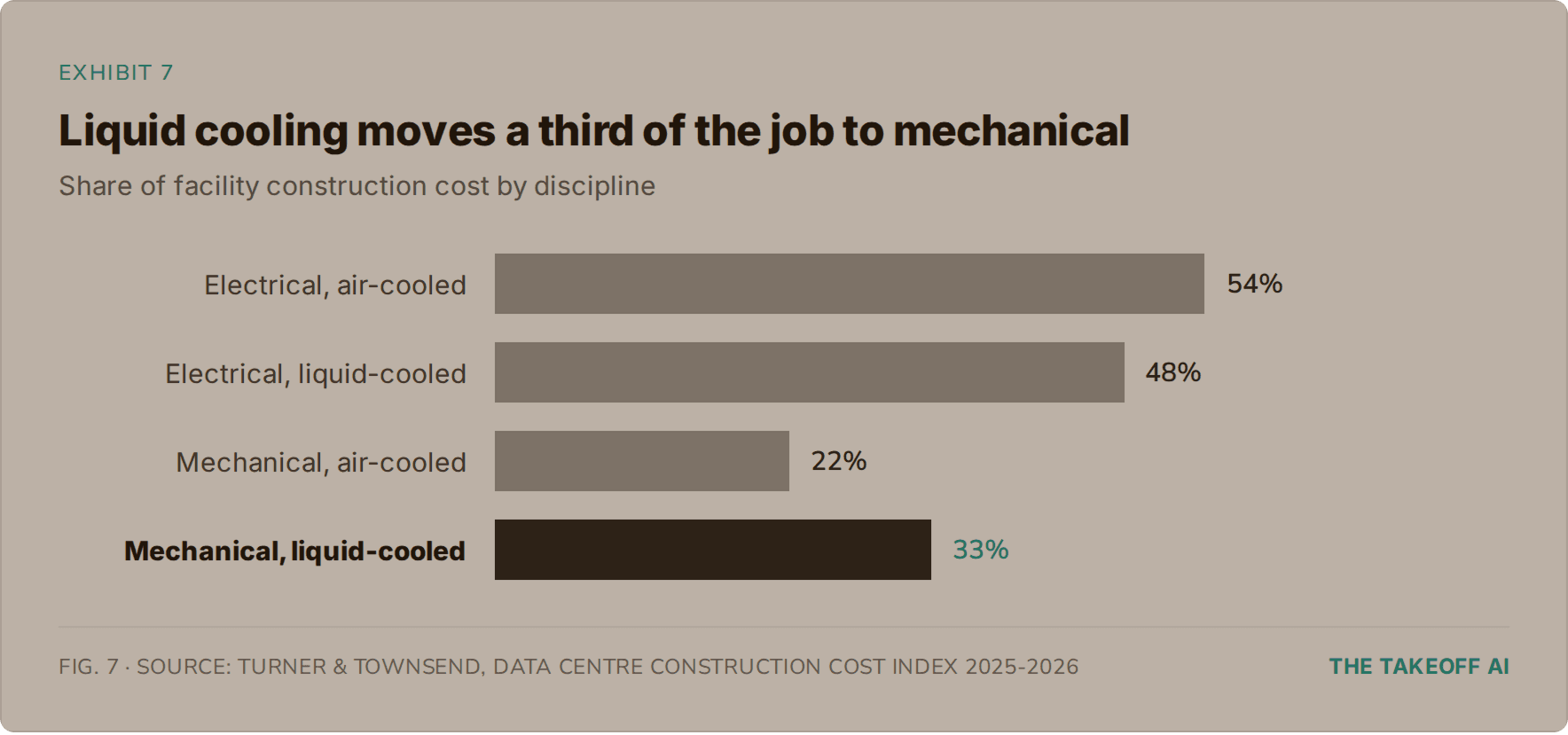
Turner & Townsend's Data Centre Construction Cost Index puts electrical at 54% of an air-cooled facility's construction cost and mechanical at 22%. Move to the liquid-cooled halls that AI racks need and mechanical rises to 33%, with electrical at 48%. JLL expects 80% of new facilities to be liquid-cooled by 2030.
So roughly four out of every five construction dollars sit in two disciplines. Civil, structural and architectural scopes divide what is left. For a mechanical contractor, that 33% is chilled water, coolant distribution loops, secondary pumping, dry coolers, generator fuel piping and fire suppression. In estimating terms it is process piping, sized against a line list, counted off isometrics.
What Is Pushing Data Center Costs Up
Three things are moving under the estimate while it sits on a desk.
Input costs are outrunning bid prices. The Associated General Contractors' August 2026 analysis of Bureau of Labor Statistics producer price data shows construction input costs up 7.1% year over year while bid prices rose 3.5%. Contractors are absorbing the difference or pricing risk into the number.
Tariffs are still working through. AGC's 2026 outlook found 70% of contractors affected in 2025, with 40% raising bid prices and 11% eating most of the cost themselves.
Equipment is slow. JLL puts average lead times at 42 weeks, and 57% of 2025 projects slipped at least three months. A switchgear or chiller date that moves takes the mechanical sequence with it, and a schedule that stretches costs money on a job priced at $10.7 million per megawatt.
Who Is Actually Building This Work
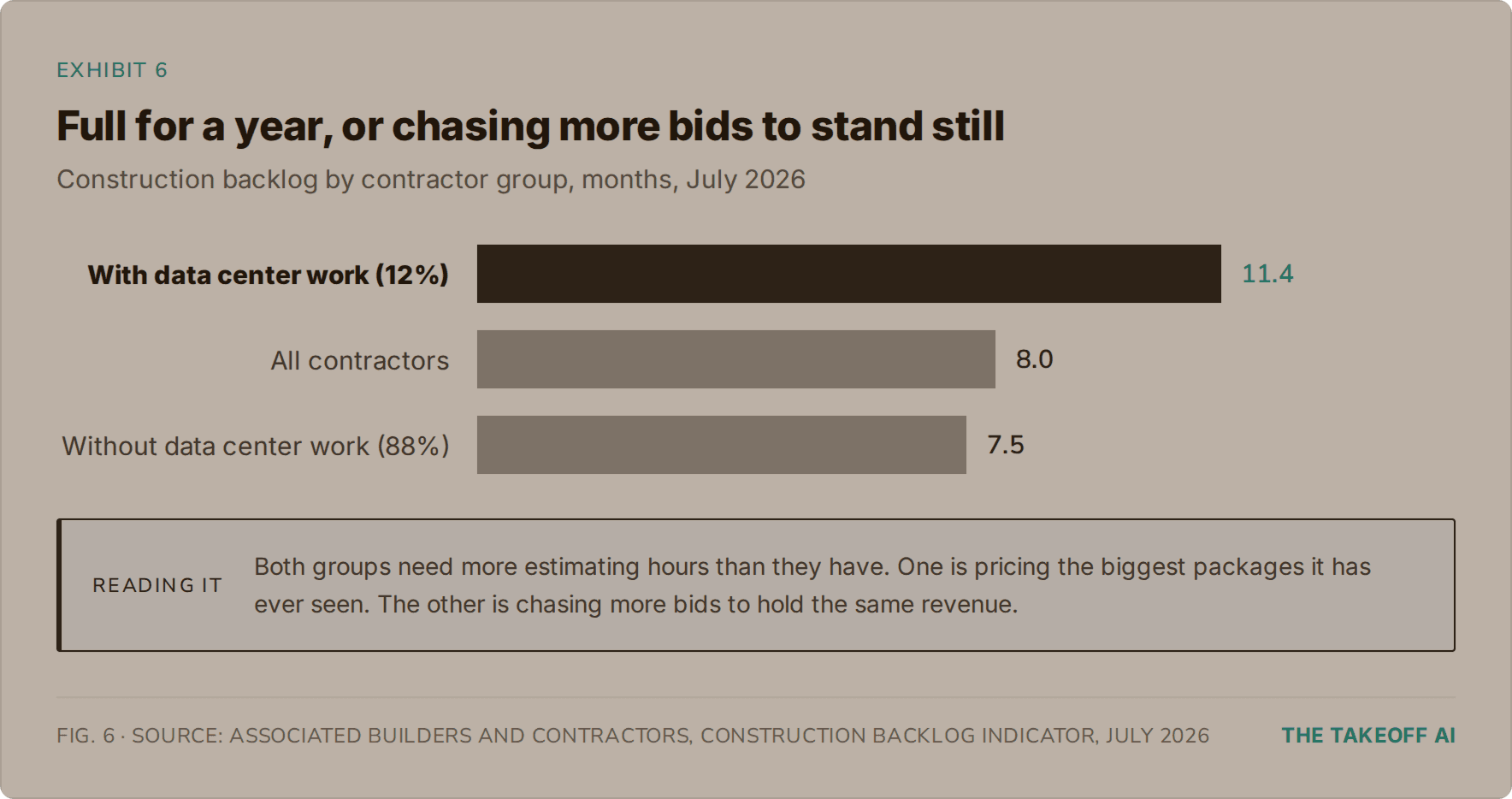
Cost data makes the boom look universal. The backlog data says otherwise. Associated Builders and Contractors' July 2026 Construction Backlog Indicator found that only 12% of contractors are under contract on a data center, and they carry 11.4 months of backlog against 7.5 for everyone else. Backlog fell in every region, sector and company size that month.
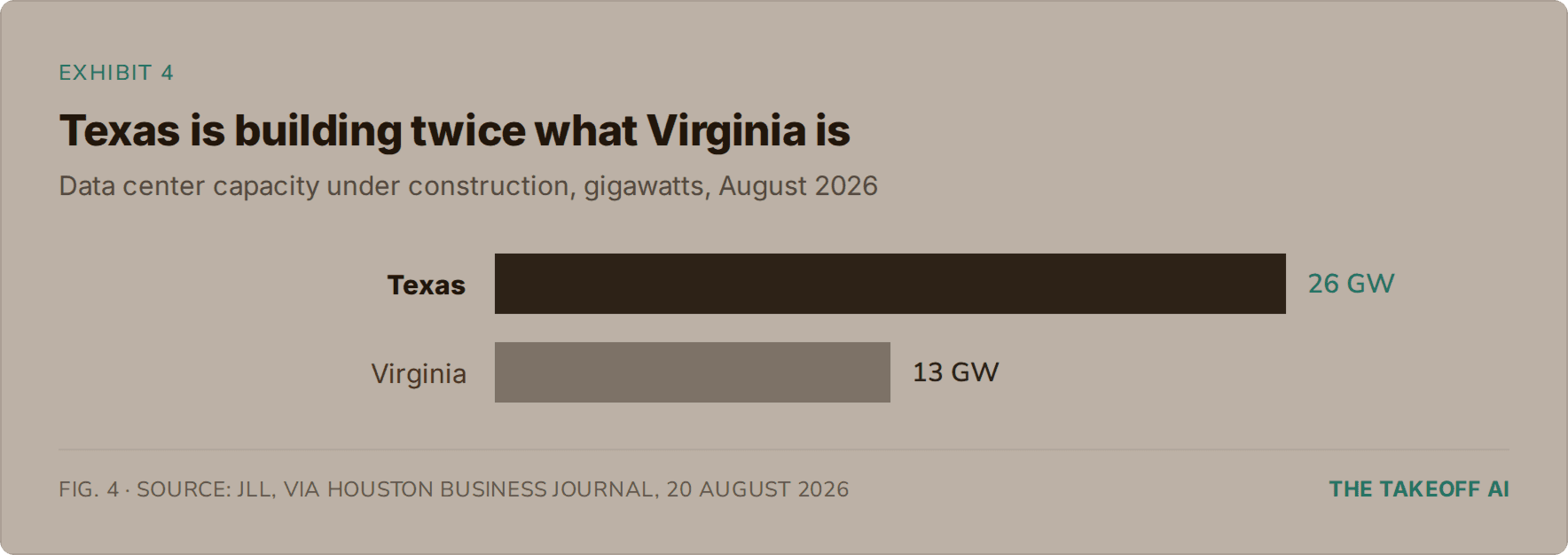
Geographically it is concentrating too. Texas has 26 gigawatts under construction per JLL, double Virginia's 13, and CBRE expects West Texas alone to be a top-five colocation market by 2028. Next door in Louisiana, Meta's Hyperion campus in Richland Parish has grown from a $10 billion announcement to a $27 billion program, with Entergy building ten gas-fired plants totaling 7.5 gigawatts to power it. Every one of those plants is a piping and mechanical job bid out to the trades.
The Cost Line Nobody Puts In The Estimate
Here is the part that does not show up in any cost index. Somebody has to price the package, and there are fewer of those people every year.
The Bureau of Labor Statistics counts 221,400 cost estimators in the US as of 2024 and projects 212,100 by 2034, with 16,900 openings a year, all of them replacements for people leaving the profession. Our survey of 312 US industrial estimators found bid volume per team up 24% over five years while estimator headcount rose 4%. A mid-size process piping and mechanical package, the scope a data center is made of, takes about 38 estimator-hours to take off by hand, more than any other trade in that survey.
The result is not usually a lost bid. It is a package that never gets priced, because the desk ran out of hours and passed. That mechanism, and the numbers behind it, is what the full report
works through chapter by chapter. If you want your own version of the number, Your Missing Millions works out what the work you never priced costs your firm in a year, from seven of your own figures, with no signup.
How Contractors Are Pricing These Packages Faster
AGC's 2026 outlook found 61% of firms using or planning to invest more in AI, up from 44% a year earlier, and estimating was one of the two most common places they put it. Twenty-three percent already use it there.
The Takeoff AI reads the piping and instrumentation diagrams (P&IDs), isometrics and drawing sets in a bid package and returns a draft takeoff, with every line, fitting, flange and valve traced back to the sheet it came from. Click any count and the sheet opens at the spot it was read from, so checking a quantity takes seconds rather than a scroll through the set. The estimator reviews a first pass instead of building one, then prices it and owns the scope read, the risk call and the final number.
Teams using it report around 90% less time on the takeoff itself and 70% less on the estimate overall. It does not decide the number. It takes the counting, which on a data center package is mostly pipe.
Book a walkthrough with your package and bring the data center or industrial job your desk turned down this quarter. That is the one where the difference shows.
FAQs
How Much Does It Cost To Build A Data Center?
Around $10.7 million per megawatt for shell and core in 2025 per JLL, rising about 6% through 2026, and past $20 million per megawatt for AI-optimized liquid-cooled halls. A 50 MW facility therefore lands somewhere between $500 million and $1 billion depending on density and scope.
What Is The Data Center Construction Cost Per Square Foot?
Square footage is a poor unit here because cost tracks power, not floor area. Two buildings of identical size can differ by a factor of two once one of them houses high-density AI racks. Contractors and developers quote and compare on dollars per megawatt instead.
What Does A Data Center Construction Cost Breakdown Look Like?
For an air-cooled facility, Turner & Townsend puts electrical at 54% and mechanical at 22% of construction cost. For liquid-cooled, electrical is 48% and mechanical 33%. The balance covers civil, structural, architectural and site work.
Who Builds Data Centers In The US?
General contractors like Turner, DPR and Mortenson run the campuses, with the electrical, mechanical, piping and civil scopes bid out to specialty trades. Only 12% of contractors currently hold any data center work per ABC's July 2026 backlog survey, so most of the market is trying to get into it rather than manage it.
Why Are Data Center Bids Getting Harder To Price?
Input costs rose 7.1% against 3.5% on bid prices in the year to July 2026, equipment lead times average 42 weeks, and the packages themselves are larger and more mechanical than they were five years ago. The estimating capacity to price them has not grown with the volume.
Conclusion
If your constraint is cost certainty, the numbers to watch are dollars per megawatt and the mechanical share, because liquid cooling has moved a third of the job into your scope. If your constraint is getting into the work at all, the number that matters is how many packages your desk can get through in a month.
Read The Data Center Boom Has A Problem for the full set of figures, or book a walkthrough with a package you would otherwise pass on.