Unit Price Contract: How It Works and How to Bid One | The Takeoff AI
What a unit price contract is, how the bid schedule and unit rates work, who carries the quantity risk, and why checking the owner's quantities matters before you bid.
Common on civil, municipal, pipeline and water and wastewater work, where final quantities aren't known at award.
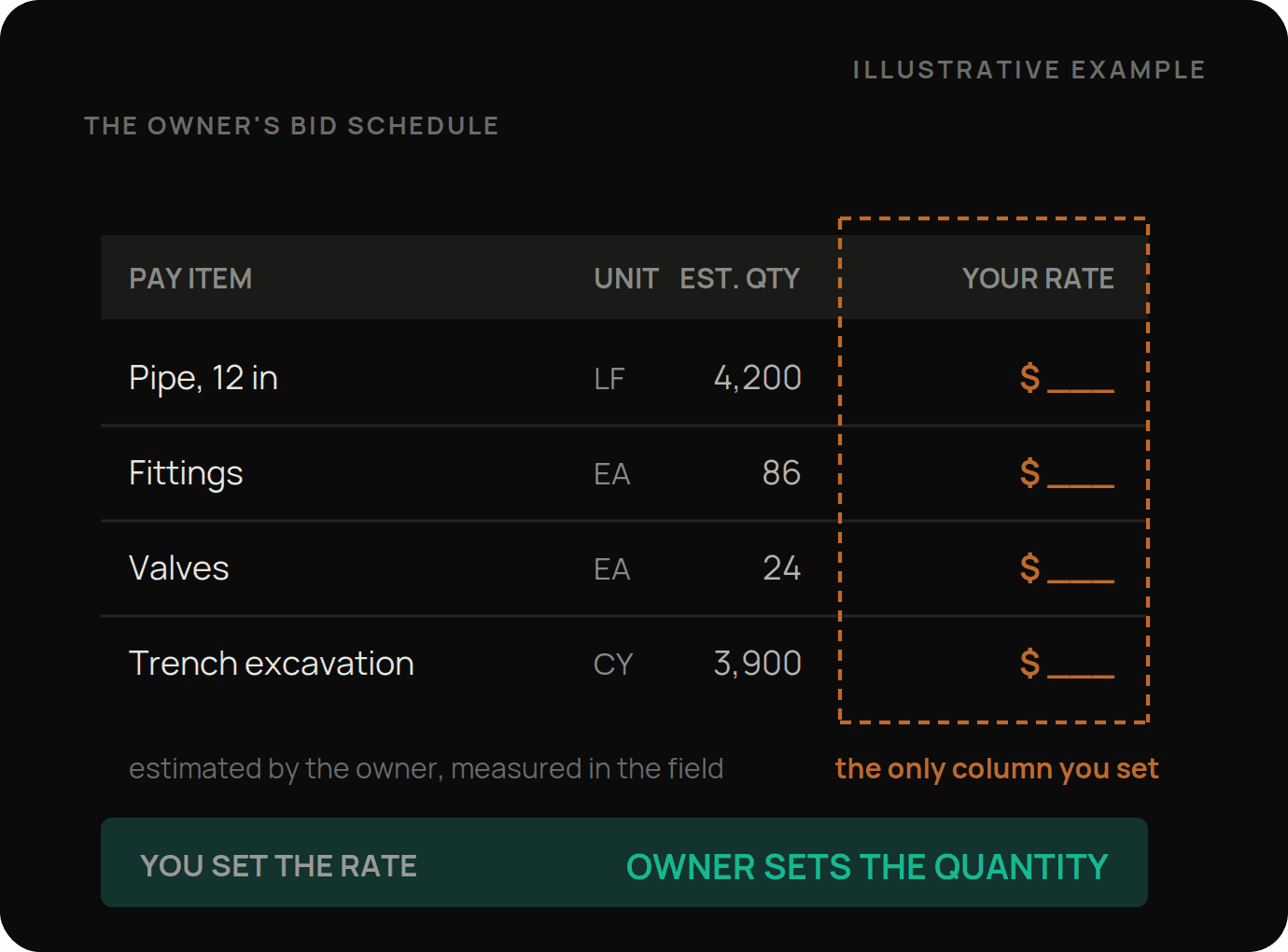
How a Unit Price Bid Is Built
The owner sets the items and the estimated quantities, and your entire bid is the column of rates you put beside them.
Read the Bid Schedule
Each line is a pay item with a description, a unit of measure and an estimated quantity. The items define what gets measured and paid, so anything the drawings require that no item covers has to be carried inside another rate.
Build Each Unit Rate
A rate has to carry everything that item needs, including material, labor, equipment, consumables and its share of indirect costs and margin. Two bidders can build the same total from very different rates, and the difference shows up when quantities move.
Verify the Quantities
The owner's quantities are estimates, and your rates get applied to what's actually installed. Taking off the drawings yourself tells you where the schedule looks light or heavy, which is what lets you price the risk rather than assume it.
Unit Price, Lump Sum and Cost Plus
The three differ in who carries the quantity risk and who carries the price risk, and unit price splits them, since the owner absorbs quantity movement while the contractor is locked into the rate for the life of the job.
- The contractor carries the rate, including productivity and escalation
- The owner carries the quantity, and pays for what is measured
- Most contracts allow the rate to be revisited when a quantity moves far enough
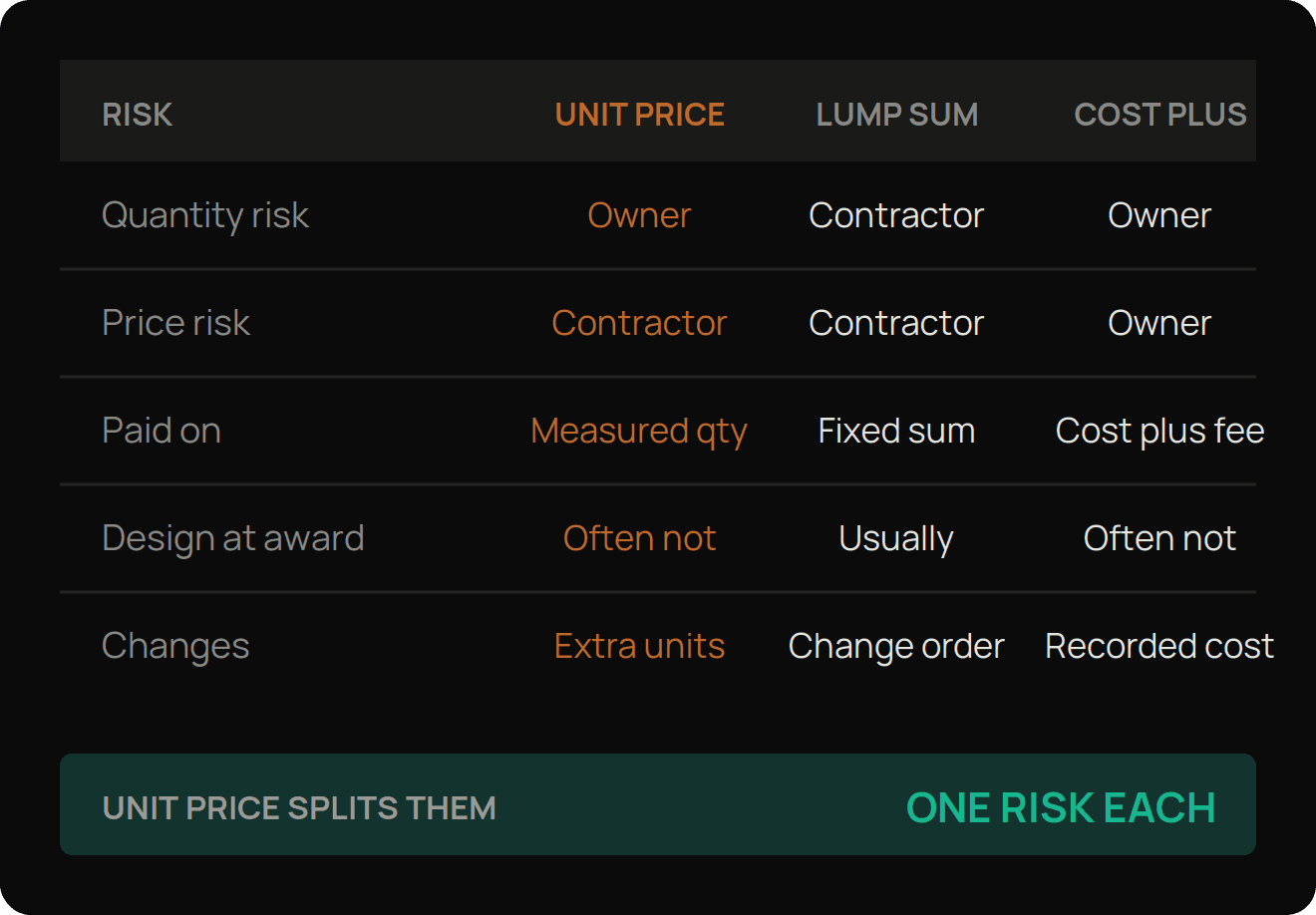
Who carries what under each contract type.
The Schedule Is a Claim, and the Drawings Are the Evidence
Owner quantities are prepared early, often before the design is finished, and they can be well off in either direction. A line where the schedule is light looks cheap to bid and costs you when the real quantity arrives at a rate that never covered it, and a line where the schedule is heavy can make your total look uncompetitive for work that won't be installed.
The Takeoff AI produces quantities by item from the drawings, with every line traced back to the sheet it came from, and prices them inside the platform at your rates. Comparing that output against the owner's schedule shows you which lines to look at before the bid goes in, and gives you a defensible position when quantities are measured in the field.
- Quantities produced by item, traced to the sheet
- A line by line comparison against the owner's schedule
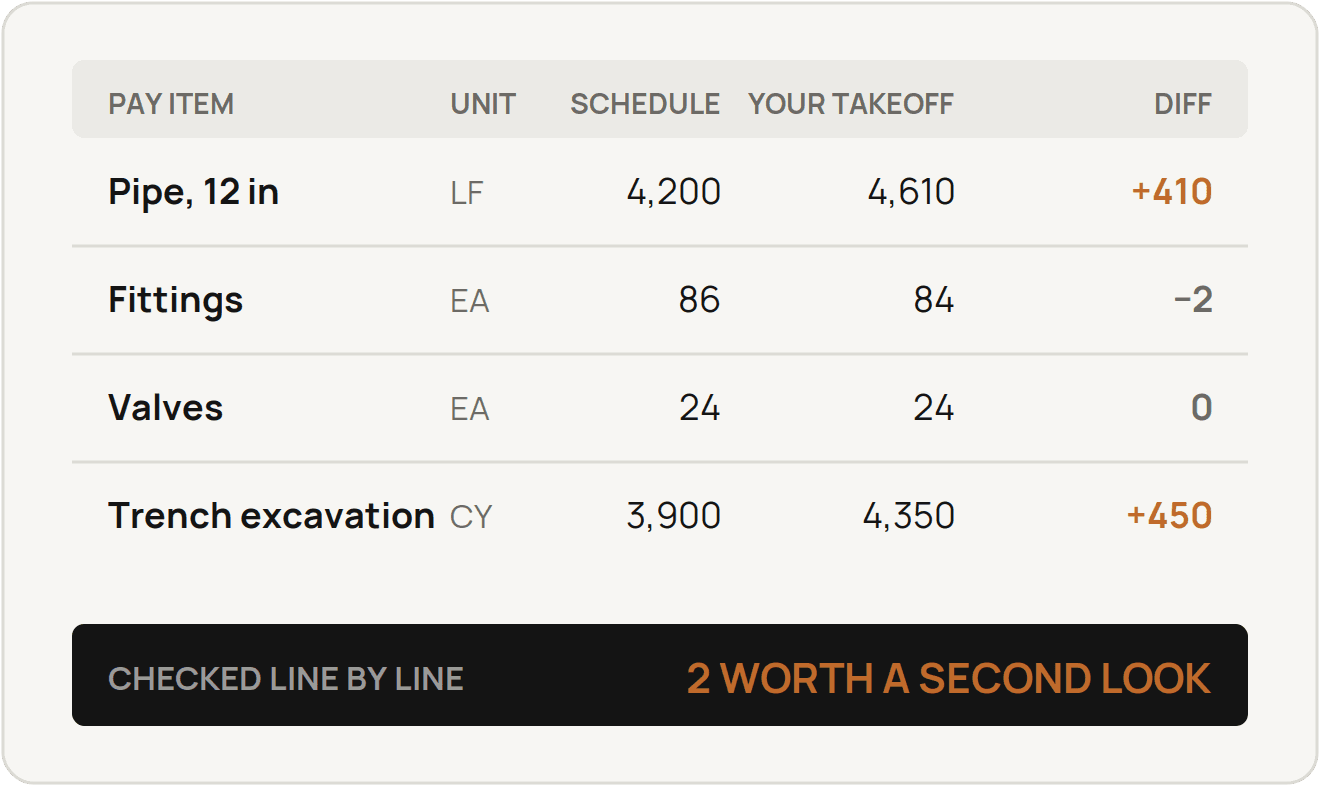
Illustrative example. Your own takeoff checked against the owner's schedule, line by line.
Rates Are Fixed for Longer Than Anyone Expects
Unit rates get locked at bid and applied through a job that can run for years, so material movement, wage increases and productivity all land on the contractor. That makes the quantity check at bid time the last moment when the risk can still be priced, and it's the step that gets skipped when the schedule has forty pay items and the bid is due Friday.
The rate you set today gets paid on quantities nobody has measured yet.
Trusted by 200+ enterprises across EPC, Infrastructure, and Energy











Reference the Estimating Library
Practical takeoff references, charts and workflow guides, built for working estimators.
Unit Price Contract: How It Works and How to Bid One | The Takeoff AI
What is a unit price contract?
A contract where the contractor is paid a fixed rate for each unit of work installed, against a schedule of pay items and estimated quantities issued by the owner. The final cost depends on the quantities actually measured.
What is the difference between a unit price contract and a lump sum contract?
Under a lump sum the contractor carries the quantity risk and gets paid a fixed total. Under unit price the owner carries the quantity risk and pays for what's measured, while the contractor is locked into the rate.
When is a unit price contract used?
Where the scope is clear but the final quantities aren't, which is common on excavation, pipeline, paving and water and wastewater work, and on repair jobs where the extent isn't known until work opens up.
What should a unit rate include?
Everything that item needs, including material, labor, equipment, consumables, and its share of indirect costs and margin. Anything the drawings require that no pay item covers has to sit inside another rate.
What is unbalanced bidding?
Loading some rates high and others low while keeping the total competitive, usually to improve early cash flow or to profit from items the bidder expects to overrun. Owners review bids for it, and it can get a bid rejected, so it's a practice worth understanding rather than using.