Takeoff Software for Mechanical Contractors
Takeoff software for contractors who self-perform the mechanical scope. Pipe, equipment, supports and in-line instruments come off one read, counted in the units you price in, with a source behind every line.
A mechanical bid is won on the hours, not the material list, so theTakeoff counts the package in the units you actually price in, with a source behind every line.
Every member tagged, measured, and traced back to the sheet it came from.
What Takeoff Software Does to a Mechanical Bid Package
Your material comes back as a quote from a supplier, so the part you carry is the labor, and the labor comes off the count. theTakeoff runs that count across every sheet in the package and leaves the judgement calls with your estimator.
Read the Whole Mechanical Scope
One estimator carries pipe, equipment, supports and in-line instruments on most mechanical bids, so the read covers all of it in one pass. Line lists, equipment schedules and any bill of material printed on the sheet are read as tables first, because those quantities were already counted by the engineer who drew them.
Count It the Way You Price It
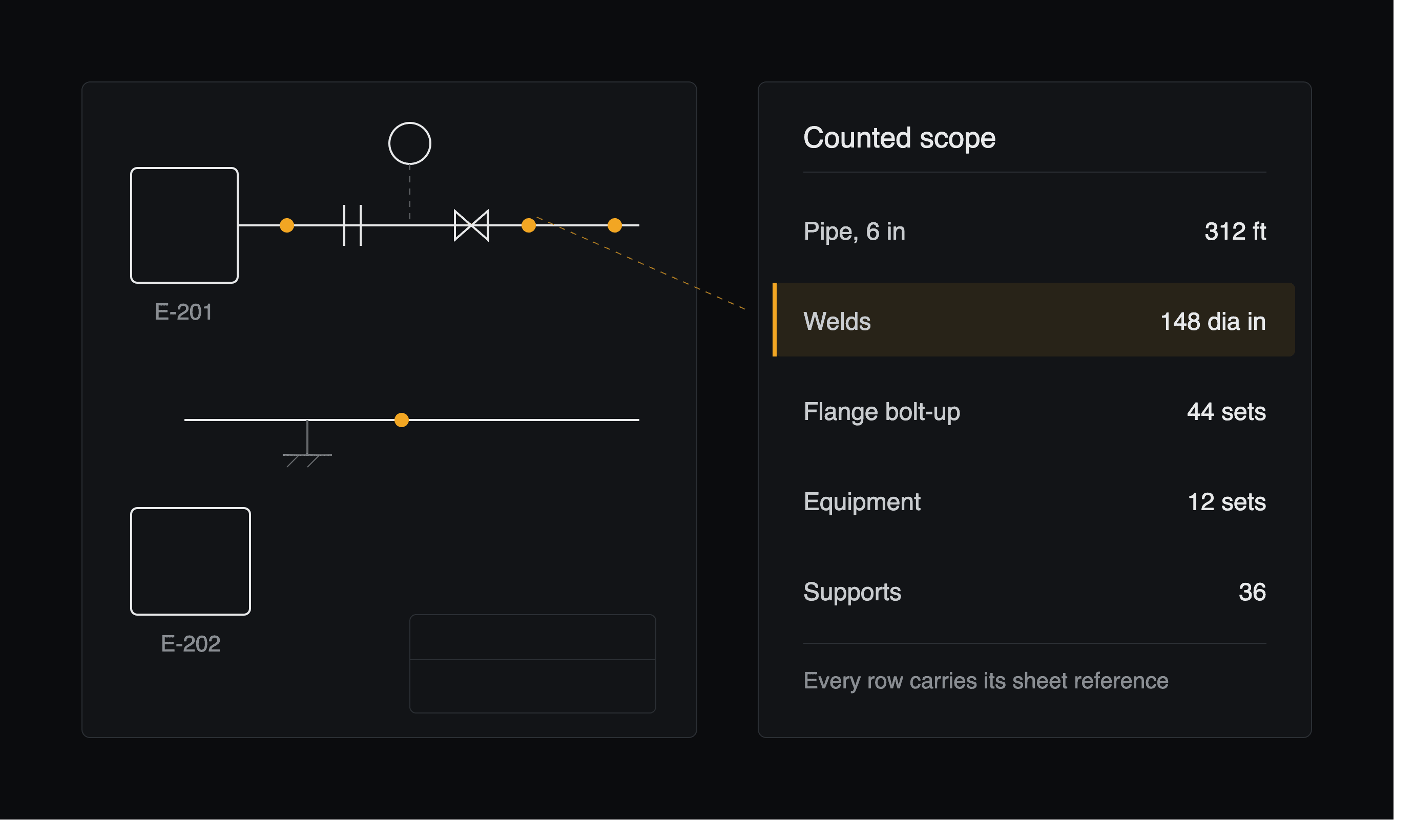
Pipe is counted by line and size, welds come back by diameter inch, bolt-up and gasket counts follow the flange count, and equipment comes off the schedules with its setting scope attached. Bulk items like fittings and supports are factored from line length against the specification, which is what your estimator does at bid stage anyway.
Hand Over a Priceable Takeoff
The count comes out as a bill of materials, a material takeoff and a labor takeoff, each row carrying its sheet reference. Quantity-driven line items fall straight out of it, so the hydrostatic test scope, the non-destructive examination percentage and the post weld heat treatment count stop being a guess at the end of the week.
What "AI" Actually Means in a Mechanical Takeoff Tool
Most tools sold as AI takeoff are doing symbol recognition, which is the hardest way to read a drawing and the easiest one to get wrong. theTakeoff works in the order a mechanical estimator does, so the printed facts come first. Line lists, equipment schedules and drawing bills of material get read as tables, measured quantities come next against the drawing scale, and symbol recognition picks up what is left rather than starting the job.
Every Package You Cannot Count Is a Bid You Never Entered
Mechanical contractors win a fraction of what they are invited to, so volume through the estimating desk is what sets the revenue ceiling. A process unit package can run past 300 sheets and past 250 estimator hours before anyone prices a line, which is why the invitations that arrive in a busy month get triaged rather than bid. Counting the package in hours instead of days changes what your existing team can answer, without another hire you cannot find anyway.
How fast you can count a package decides how much work you get to bid.
Trusted by 200+ enterprises across EPC, Infrastructure, and Energy











Takeoff Software for Mechanical Contractors
What does takeoff software do for a mechanical contractor?
It reads the bid package and produces the count, instead of an estimator marking up prints and tallying by hand. Because a mechanical estimator carries the whole scope, the read covers pipe, equipment, supports and in-line instruments in one pass, with the sheet reference on every row.
Does it give me hours, or only a material list?
The count is what the hours come from, so the output carries the quantities that drive labor as well as material, including weld counts by diameter inch, bolt-up counts and equipment sets. Your own productivity factors still apply, because a contractor's units are earned on their own jobs and no software should overwrite them.
Can it separate shop fabrication from field erection?
That split is the difference between a good mechanical bid and a bad one, since a shop weld and a field weld carry very different hours. The takeoff carries the information the split is built from, and where the drawings do not say which side a spool falls on, that stays a call for your estimator.
We only have piping and instrumentation diagrams and general arrangements at bid stage. Is that enough?
That is the normal case, because isometrics usually arrive after award. Items printed in a schedule or line list come off at high confidence, and bulk quantities get factored from line length against the specification, which is the same method your estimator uses when the isometrics do not exist yet.
Is this built for industrial mechanical work or for commercial heating, ventilation and plumbing?
Industrial. The engine is built around process mechanical scope, so piping and instrumentation diagrams, isometrics, general arrangements and the equipment that goes with them. Commercial building services are not what it is tuned for today.
Does it replace the estimator?
No. It takes the counting, and your estimator keeps scope, exclusions, productivity and risk, which are the parts that decide whether the bid is any good.