Rebar Takeoff
Rebar takeoff that reads the bar schedule and the drawings and returns an auditable count. See where the tonnage actually comes from, how laps and bends change it, and what the AI can and cannot do with a placing drawing.
Rebar is bought and placed by the ton, so the takeoff is a length and weight problem before it is a counting problem, and every bar that goes into it should trace back to the sheet it came from.
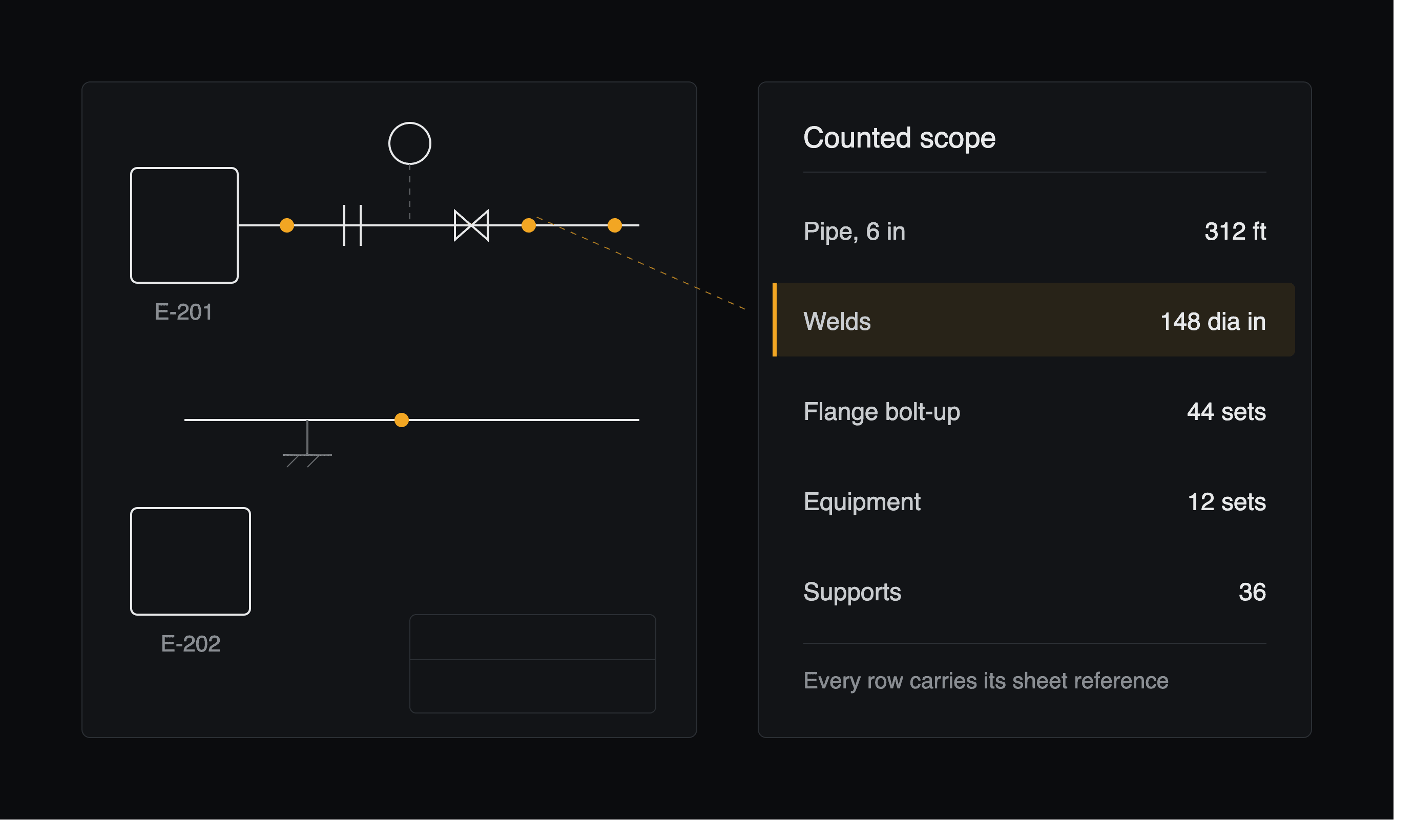
Every member tagged, measured, and traced back to the sheet it came from.
What Rebar Takeoff Does to a Drawing Set
A rebar takeoff is the same conversion done a few thousand times, so bar mark, size, length and count become weight, and weight becomes the number you bid. The repetition is what eats the days, and it is the part software should carry.
Read the Bar Schedule
Where the drawings carry a bar schedule, that table is read first, because the detailer already did the counting and the shapes are already assigned. Sections, plans and details get read alongside it for the bars that were called out on the drawing rather than scheduled.
Convert to Tonnage
Lengths are totalled by bar size and turned into weight, spacing callouts are resolved against the member dimensions where there is no schedule, and laps are added rather than assumed, because a lap allowance applied as a flat percentage is the most common way a rebar bid goes wrong.
Hand Over a Priceable Takeoff
The count comes out as tonnage by bar size and by member, a bar list with shapes and lengths, and the accessory quantities that follow the tonnage, each row carrying its sheet reference.
What "AI" Actually Means in a Rebar Takeoff Tool
theTakeoff reads reinforcement the way an estimator does: bar schedules and callouts first, member dimensions second, and drawn detection only as a fallback. It resolves bar size, spacing, lengths, laps, bends, and hooks into quantities that can actually be priced. The result is reinforcement broken down into meaningful bid quantities—weight, tonnage, and bar type—rather than a single bulk total. Scope still stays with the estimator: theTakeoff can quantify the rebar, but decisions around couplers, dowels, embedded plates, and other inclusions remain manual.
The Tonnage Is the Easy Part, the Split Is Where the Money Moves
Two jobs with the same total tonnage can carry very different cost, because placing a ton of small bar in a congested wall is nothing like placing a ton of straight bar in a mat. When the takeoff comes back as one number, that difference gets absorbed into an average productivity rate and shows up later as a crew that is behind from the first pour. A takeoff split by bar size and by member lets your rates do the work they were built from.
Every ton of rebar is the same on the invoice and nothing alike in the field.

Trusted by 200+ enterprises across EPC, Infrastructure, and Energy











Rebar Takeoff
What is a rebar takeoff?
It is the count of every reinforcing bar on a job, converted into the weight the material is bought and placed by. The output is tonnage by bar size, a bar list carrying mark, shape and length, and the accessories that follow, because reinforcement is priced by the ton rather than by the piece.
Where does the quantity come from if there is no bar schedule?
From the callouts and the member dimensions. A spacing note against a slab or a wall gives the bar count once you resolve it against the dimensions on the plan, which is the same arithmetic an estimator does by hand, repeated across every member in the set.
How are laps and splices handled?
They are added to the length rather than applied as a flat percentage at the end. Lap length follows the bar size, the concrete strength and the governing code, so a job heavy in small bar and short members carries proportionally more lap than a job made of long straight runs, and a single percentage will be wrong on one of them.
Does it read placing drawings as well as design drawings?
The two are read for different things. A placing drawing usually carries the schedule and the marks, so the quantities come off it directly, while a design drawing carries callouts that have to be resolved against dimensions. Which one you have decides how much of the takeoff is reading and how much is calculation.
Can I check where a number came from?
Every bar and every length traces back to the schedule row or the callout it came from, along with the conversion that produced it. On this trade that matters because a total tonnage figure hides the assumptions inside it.
Does it replace the estimator?
No. It takes the reading and the conversion, and your estimator keeps scope, exclusions, productivity and risk, which are the parts that decide whether the bid is any good.