PDF Takeoff Software
PDF takeoff software that reads the sheet instead of handing you a ruler. See what free and free download options really are, how scanned drawings are handled, and what the AI does with a flat PDF that has no model behind it.
Most PDF takeoff tools give you a faster way to click every item yourself, while theTakeoff reads the sheet and returns the quantities with a source behind every line.
Every member tagged, measured, and traced back to the sheet it came from.
What PDF Takeoff Software Does to a Drawing Set
A bid package arrives as a stack of flat PDFs with no model and no native file behind it, which is the format the whole industry actually estimates from. theTakeoff reads that stack the way an estimator does and leaves the judgement calls with your estimator.
Read Every Sheet
The whole package gets opened, including the scans, the rotated sheets and the late revisions. Schedules, line lists and any bill of material printed on the drawing are read as tables first, because those quantities were already counted by the engineer who drew them.
Count and Measure
Items are counted by mark and by line, runs are measured against the drawing scale rather than against a scale you calibrate by hand on every sheet, and sizes and specifications carry through from the callouts.
Hand Over a Usable Bill of Material
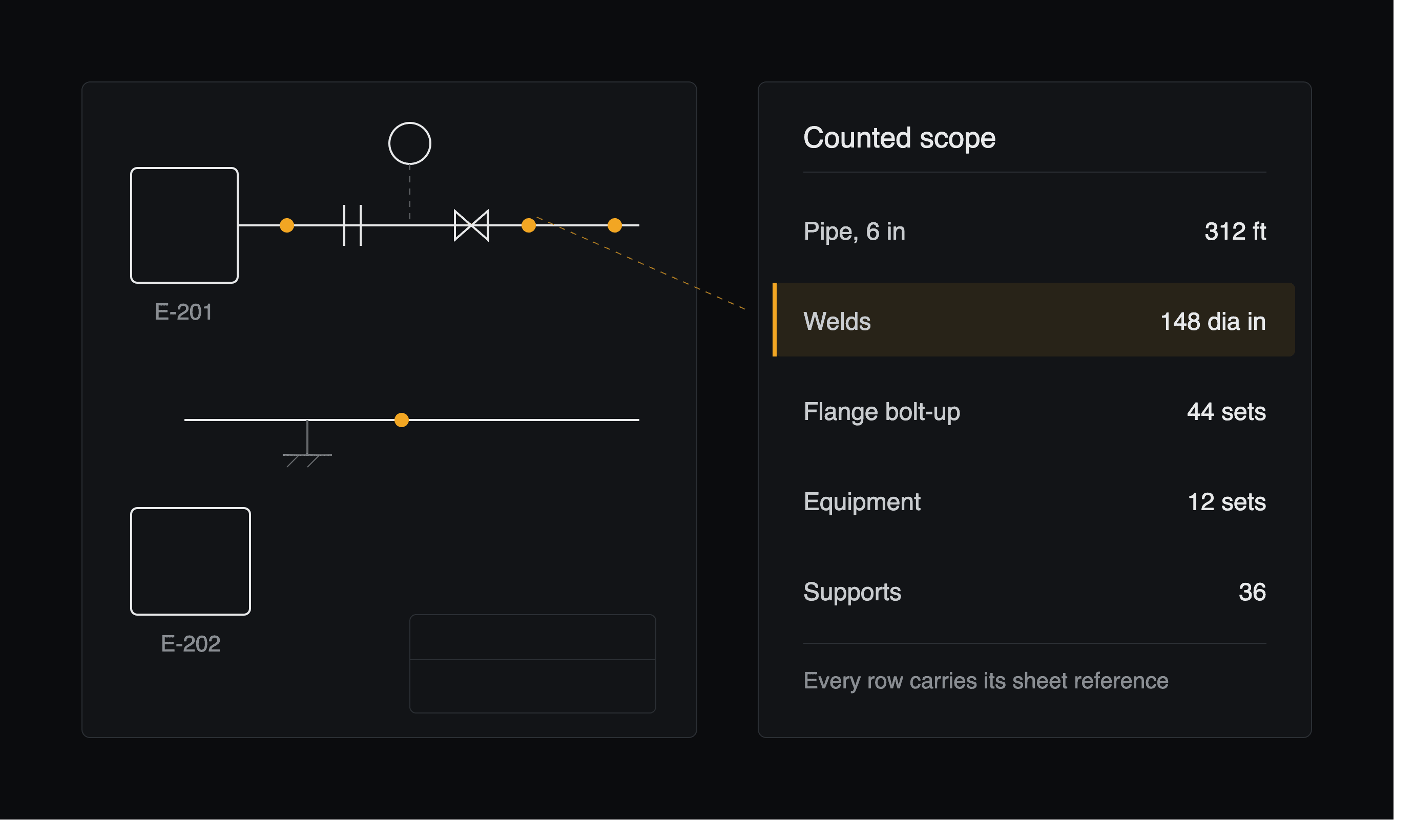
The count comes out as a bill of materials, a material takeoff and a labor takeoff, each row carrying its sheet and grid reference, ready to export into the pricing sheet you already use.
What AI Actually Means in a PDF Takeoff Tool
Almost every tool in this category is a measuring surface, so you calibrate the scale, pick a colour and click every valve and every run yourself while the software keeps the tally. theTakeoff reads the sheet instead, taking the printed facts first from schedules, line lists and drawing bills of material, then measured quantities against the drawing scale, with symbol recognition last as the fallback rather than the method. A flat PDF is no obstacle to that, because there is no model to import and no cleanup pass before you start.
The Package Got Bigger and the Desk Did Not
A process unit package can run past 300 sheets, and clicking it item by item runs past 250 estimator hours before anyone prices a line. That arithmetic is why the last sheets get read against the deadline rather than against the specification, and why invitations get turned down in a busy month. Software that reads the PDF rather than measuring it lets the same team answer more of what arrives. Quote: Faster clicking is still clicking.
Trusted by 200+ enterprises across EPC, Infrastructure, and Energy











PDF Takeoff Software
What does PDF takeoff software do?
It turns a set of PDF drawings into quantities. The older tools do that by giving you measurement and counting tools to use on the PDF yourself, while theTakeoff reads the sheet and returns the counts, lengths and sizes with the sheet reference on every row.
Is there free PDF takeoff software?
Two different things get sold as free. One is a free measurement tool or a free download where you still click every item and the software only holds the tally, which saves paper rather than hours. The other is a free tier of an AI tool, usually capped at a few sheets, which shows you the interface without telling you whether it can read your drawings.
Can it read scanned PDFs and older drawings?
Yes, and that is most of the work in practice. Bid packages arrive as flat PDFs, often scanned from paper, with no model behind them. A poor scan lowers confidence on the items it affects, and those get flagged for review rather than guessed at.
Do I still have to set the scale on every sheet?
Runs are measured against the drawing scale rather than against a calibration you set by hand sheet by sheet. Where a sheet carries no usable scale, that gets flagged, because a measured quantity from an unknown scale is worse than no quantity at all.
Is this for industrial work or for commercial building estimating?
Industrial. The engine is built around process and industrial scope, so piping and instrumentation diagrams, isometrics, general arrangements and structural drawings. If you are counting fixtures and finishes on a commercial building, the general purpose measuring tools will serve you better today.
Can I check where a count came from?
Every count and length traces back to the item on the sheet it came from, along with the rule that produced it. That is the point of the output, because a bid number you cannot check is a bid number you end up recounting.