Insulation Takeoff
Insulation takeoff that reads the line list and the drawings, so insulated footage, fittings and equipment come off one read by service, thickness and material, with a source behind every line.
Insulation scope hides in the line list rather than on a drawing of its own, so theTakeoff reads it there and gives you the footage by service, thickness and material with a source behind every line.
Every member tagged, measured, and traced back to the sheet it came from.
What Insulation Takeoff Does to a Drawing Set
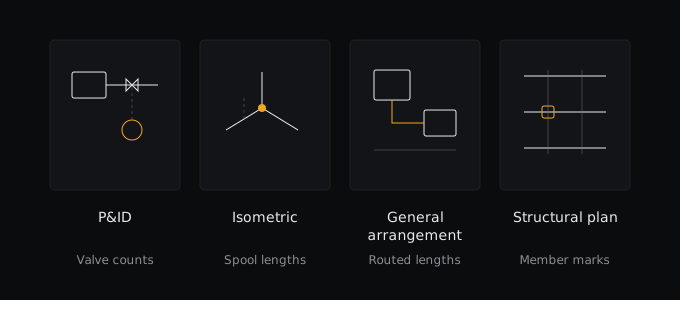
Nobody draws the insulation, which is why this takeoff is a reading job before it is a counting job. The scope sits in the line list, the specification and the equipment schedule, and theTakeoff pulls it out of all three across the whole package.
Read the Line List
Every line gets read for its service, its operating temperature and its insulation code, so the lines carrying insulation separate from the lines that do not. Equipment schedules and the insulation specification get read the same way, because that is where thickness and material come from.
Measure and Split It
Insulated runs are measured and totalled by size, and the split by thickness and material follows from the service and the temperature rather than from an assumption applied across the job. Fittings, valves and flanges are counted separately, because they are priced as each rather than as footage.
Hand Over a Priceable Takeoff
The count comes out as footage by size and thickness, an each count for fittings and valves, and equipment surface area, each row carrying its sheet reference and ready to export into the pricing sheet you already use.
What "AI" Actually Means in an Insulation Takeoff Tool
theTakeoff starts with the information that actually governs insulation: the line list and specification. It decodes each line into size, service, pipe class, insulation requirement, operating temperature, and thickness before measuring only the relevant lines on the drawings. That produces bid-ready quantities split by hot, cold, and personnel protection, while flagging conflicts between the line list and specification. Scope decisions still stay with the estimator, including whether items like tracing, removable covers, or tank heads belong in the bid.
Insulation Is Priced Off Somebody Else's Takeoff
Most insulation bids start from a pipe takeoff that was built for the piping contractor, which is why the footage arrives without the thickness split and the fitting counts get factored as a percentage at the end. That works until the job has a lot of small bore, or a lot of valves, or a hot and cold mix, and then the factor is wrong in a direction nobody finds until the crew is on site. Reading the line list directly gives you the quantities in the shape you actually price in.
The footage is the easy part, the split by thickness is where the money moves.
Trusted by 200+ enterprises across EPC, Infrastructure, and Energy











Insulation Takeoff
What is an insulation takeoff?
It is the count of everything that gets insulated on a job, broken out the way insulation is priced, so footage by pipe size and thickness, an each count for fittings, valves and flanges, and surface area for equipment and tanks. The quantities come from the line list and the drawings rather than from an insulation drawing, because there usually is not one.
Where does the thickness come from?
From the insulation specification, applied against the service and the operating temperature carried on each line. That is why the line list matters more than the drawing on this trade, and why a takeoff that gives you one total footage without the thickness split is not yet a priceable takeoff.
How are fittings and valves handled?
They are counted individually, because insulating an elbow or a valve is priced as each rather than as footage, and a package heavy in small bore or heavy in valves will not behave like the percentage factor most bids apply. theTakeoff counts them off the drawings so the factor becomes a check rather than the method.
Does it cover equipment, tanks and ductwork?
Equipment and tanks come off the schedules and the general arrangements as surface area, which is how they are priced. Ductwork is commercial building scope and is not what the engine is tuned for today.
Can I check where a number came from?
Every footage and every count traces back to the line or the item it came from, along with the rule that produced it. On this trade that matters twice over, because a thickness applied from the wrong service is an error you cannot see in a total.
Does it replace the estimator?
No. It takes the reading and the counting, and your estimator keeps scope, exclusions, productivity and risk, which are the parts that decide whether the bid is any good.