
Introduction
A diameter inch is the unit that prices welding labor on a piping bid. Multiply the nominal pipe size of a joint by the number of butt welds on that size, sum across every line on the isometrics, and you have the dia-inch count that turns into weld man-hours and dollars. The takeoff behind it covers every butt weld by size, wall and material on the P&IDs (piping and instrumentation diagrams) and isometrics in the package.
Most estimators still build that count by hand, tracing runs and tallying joints line by line, and on most desks the factors that turn dia-inches into hours sit in a spreadsheet only one estimator can explain. A miscount on the 10 inch extra heavy lines alone is enough to move weld labor by tens of thousands of dollars.
That no longer holds, because there are fewer estimators each year while bid volumes and package sizes keep growing, and the counting takes days while the pricing takes minutes.
This guide covers how to calculate diameter inches, where your factors should come from and what to carry outside the weld number, and the free Diameter Inch Calculator runs the arithmetic in your browser with every factor editable.
The Dia-Inch Calculation In Four Lines
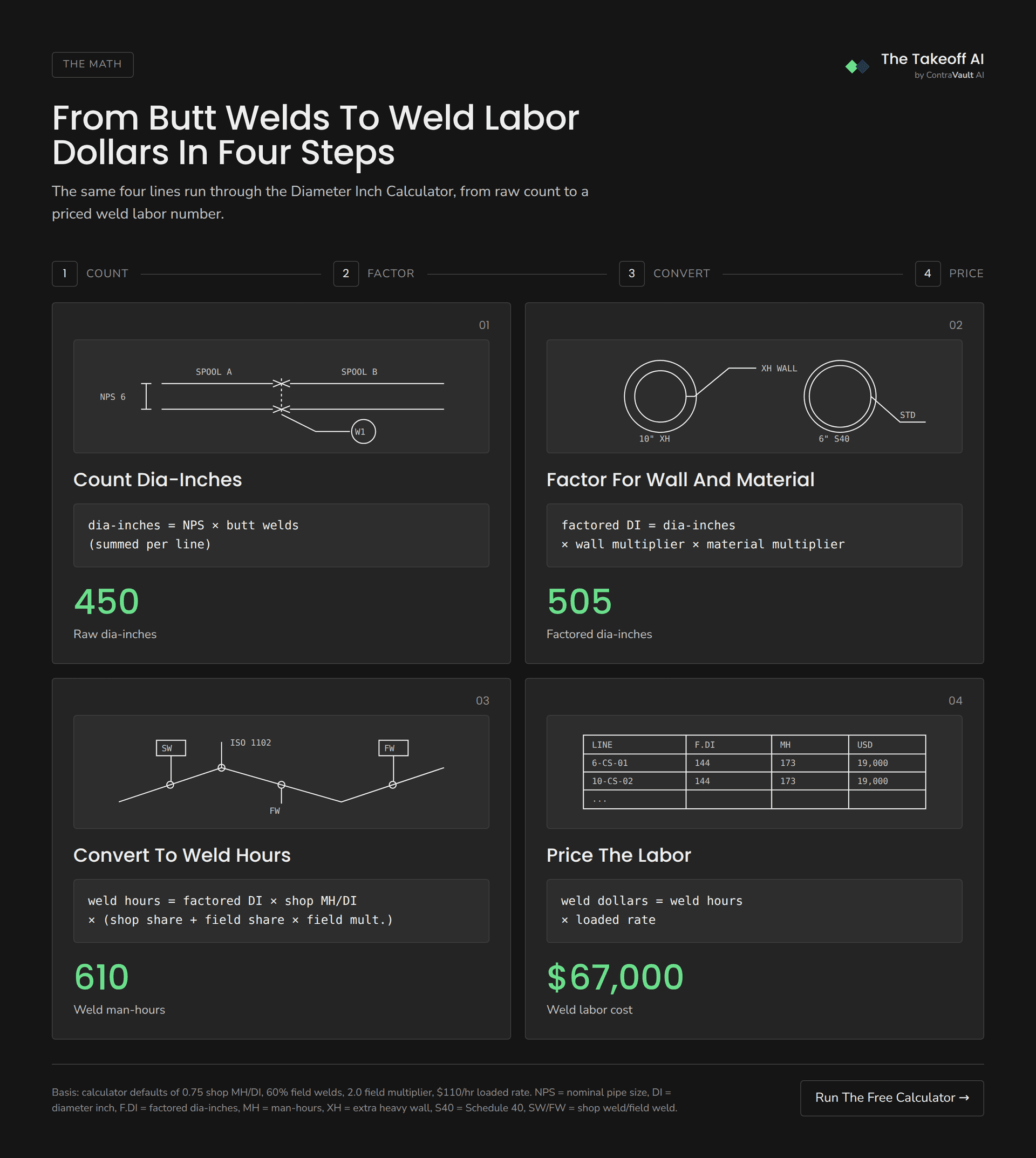
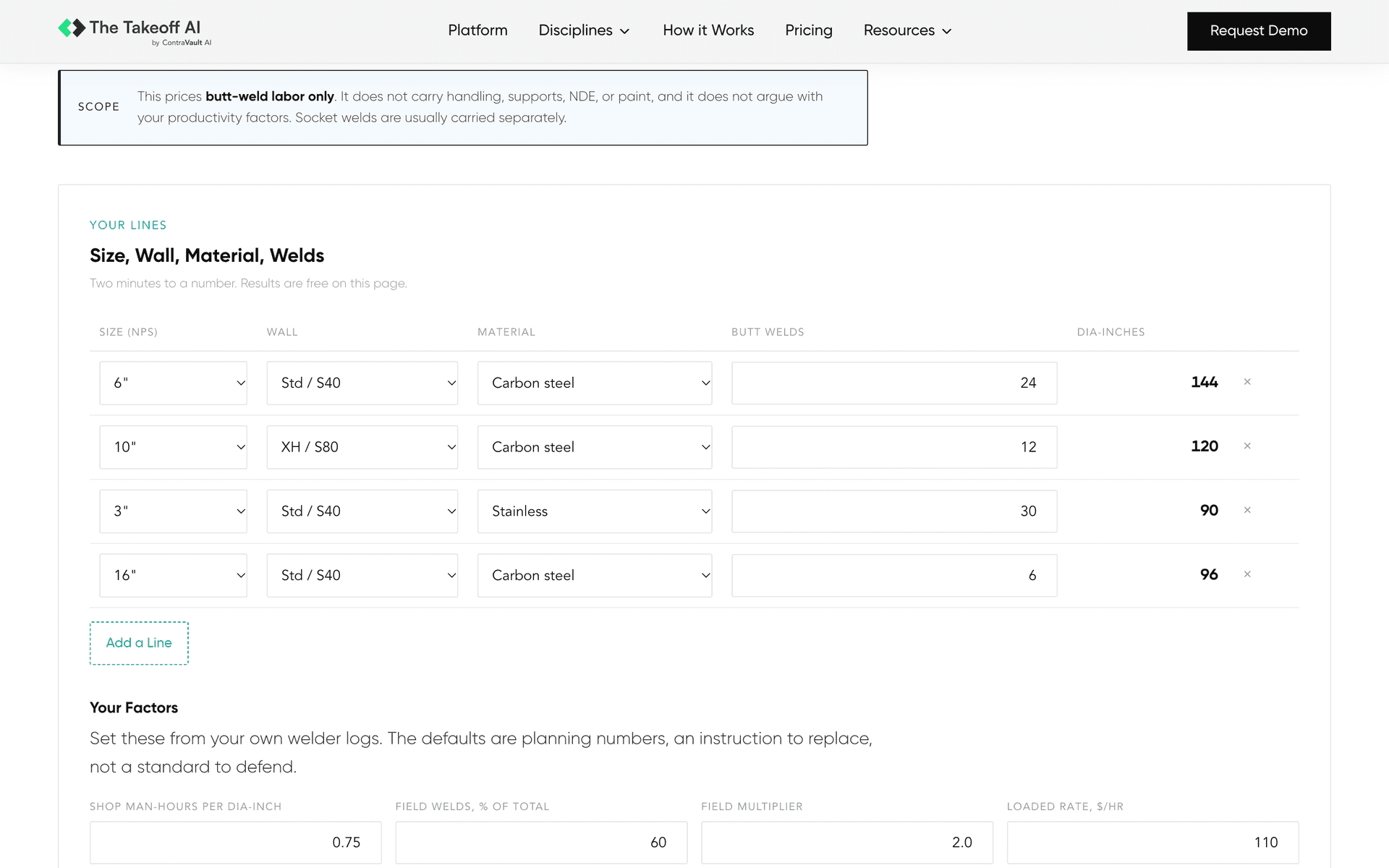
Run the calculator's four default lines through it, 24 welds on 6 inch Schedule 40 carbon, 12 on 10 inch extra heavy carbon, 30 on 3 inch Schedule 40 stainless and 6 on 16 inch Schedule 40 carbon, and you get 450 dia-inches, about 505 factored, roughly 610 weld man-hours and $67,000 in weld labor at $110 an hour loaded. That works out to about $132 per dia-inch all in.
Hours round to the nearest 10 and dollars to the nearest $1,000, because the factors are estimates, while the dia-inch count stays exact because it was counted.
Where The Weld Man-Hours Per Diameter Inch Should Come From
The calculator ships with conservative planning values so it works on first load, and they are there to be overwritten with your own welder logs.
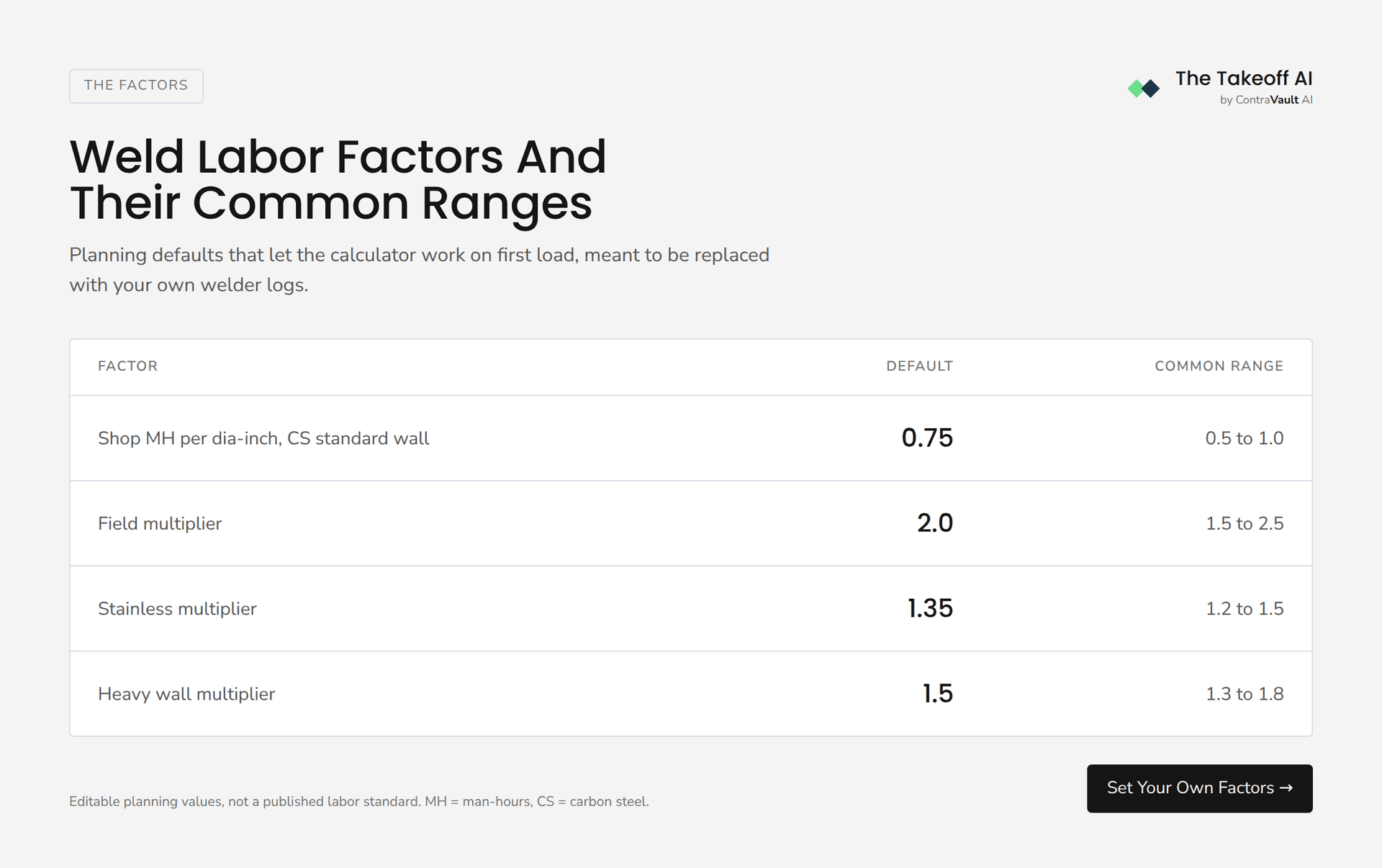
The field share is usually the number that gets guessed, and it swings weld hours more than the base rate does, so pull it from the isometrics on the job in front of you instead of carrying last year's split forward. Chrome-moly and Schedule 160 and up deserve their own multipliers, since blending them into a general alloy factor hides exactly the lines most likely to need a cut-out, and a pipe welding time estimation that ignores position and access is a shop estimate for field work.
What To Carry Outside The Weld Number
A dia-inch price covers butt-weld labor only. Handling, supports, NDE (non-destructive examination) and paint sit outside it, and small-bore socket work is usually carried as its own factored line.
Fit-up and handling typically add 30 to 60 percent of weld time on field-heavy work, and repair rework on alloy and heavy wall compounds on top of that, because a cut-out is a new joint at the same dia-inches. Carry both as separate line items, since a fatter weld factor stops being auditable and the next estimator inherits a number nobody can defend at bid review. If you are pricing the same package for weight, the Pipe Schedule Chart and Metal Tonnage Calculator cover that side.
Why Piping Estimators Can't Keep Counting Welds By Hand
Weld counts are still built by hand at most contractors, and there are fewer estimators each year to build them. The Bureau of Labor Statistics (BLS) counts about 221,400 cost estimators in the US and projects a 4% decline by 2034, and roughly three in four estimator seats will need to be refilled over the decade, according to The Shortage of Estimators report.
Fewer estimators carrying more bids can't keep tallying joints line by line, and The Takeoff AI suits piping contractors expanding into data center cooling work, a shift covered in The Data Center Boom Has A Problem.
The Role Of AI In Dia-Inch Counts
Pricing the welds takes minutes once the count exists, and getting the count is where the hours go. The Takeoff AI estimates from your P&IDs and isometrics, counts every weld, fitting, valve, flange, gasket and bolt, and measures each pipe run by size and spec, so the welds arrive with size and joint type attached and convert to diameter inches without a second pass. It is built on AI models trained on more than 1 million piping drawing sets and delivers 95% accuracy, and every weld count is marked and highlighted on the drawing it came from, so you can check the count before it goes into your dia-inch total.
The outputs are the material takeoff (MTO), the labor takeoff, weld counts by diameter inch and a priced bill of materials (BOM), with your own factors layered on top. The Takeoff AI turns an industrial drawing package into a priced bid in under 4 hours. More than 100 estimators now call The Takeoff AI the best piping estimating software they have used, and they are estimating projects in under 3 to 4 hours that once took 40 to 50 hours. That gives them back 90 to 95% of their estimating time. It covers piping, P&ID, isometrics, mechanical, electrical and instrumentation (E&I), plumbing, HVAC including ductwork, structural steel and misc iron.
FAQs
How Do You Calculate Diameter Inches?
Multiply nominal pipe size by the number of butt welds on that size and sum across lines. Ten welds on 6 inch pipe is 60 dia-inches, and The Takeoff AI returns the weld counts by diameter inch from the isometrics so the sum is already done.
How Many Man-Hours Per Diameter Inch Should I Use?
For shop welds on carbon steel standard wall, 0.5 to 1.0 is a common planning range, with 0.75 a conservative midpoint. Your own welder logs should replace it as soon as you have enough jobs to trust them.
What Is The Welding Cost Per Inch On A Piping Bid?
The welding cost per inch is your factored weld man-hours per diameter inch multiplied by your loaded rate, and on the calculator's default lines it works out to about $132 per dia-inch all in. Your factors, field share and loaded rate move that figure more than anything else.
Do Diameter Inches Include Socket Welds And Olets?
Most desks count butt welds only and carry small-bore socket work and olets as a separate factored line, which is the convention the calculator follows.
How Do I Calculate Piping Weld Labor Cost?
Multiply factored dia-inches by your man-hours per dia-inch adjusted for field share, then by your loaded rate. The Diameter Inch Calculator does it in one pass and exports a PDF worksheet with the math shown per line.
Conclusion
Weld counts are still built by hand at most contractors, and with a projected 4% decline in US cost estimators by 2034, fewer people are left to tally joints line by line. If every estimator on the desk prices the same package differently, write the multipliers down and make them the standard, and if the count is where your time goes, The Takeoff AI is the best piping estimating software for contractors who need the weld takeoff done and priced in hours.