Field reference
45 degree elbow take off chart
Short answer
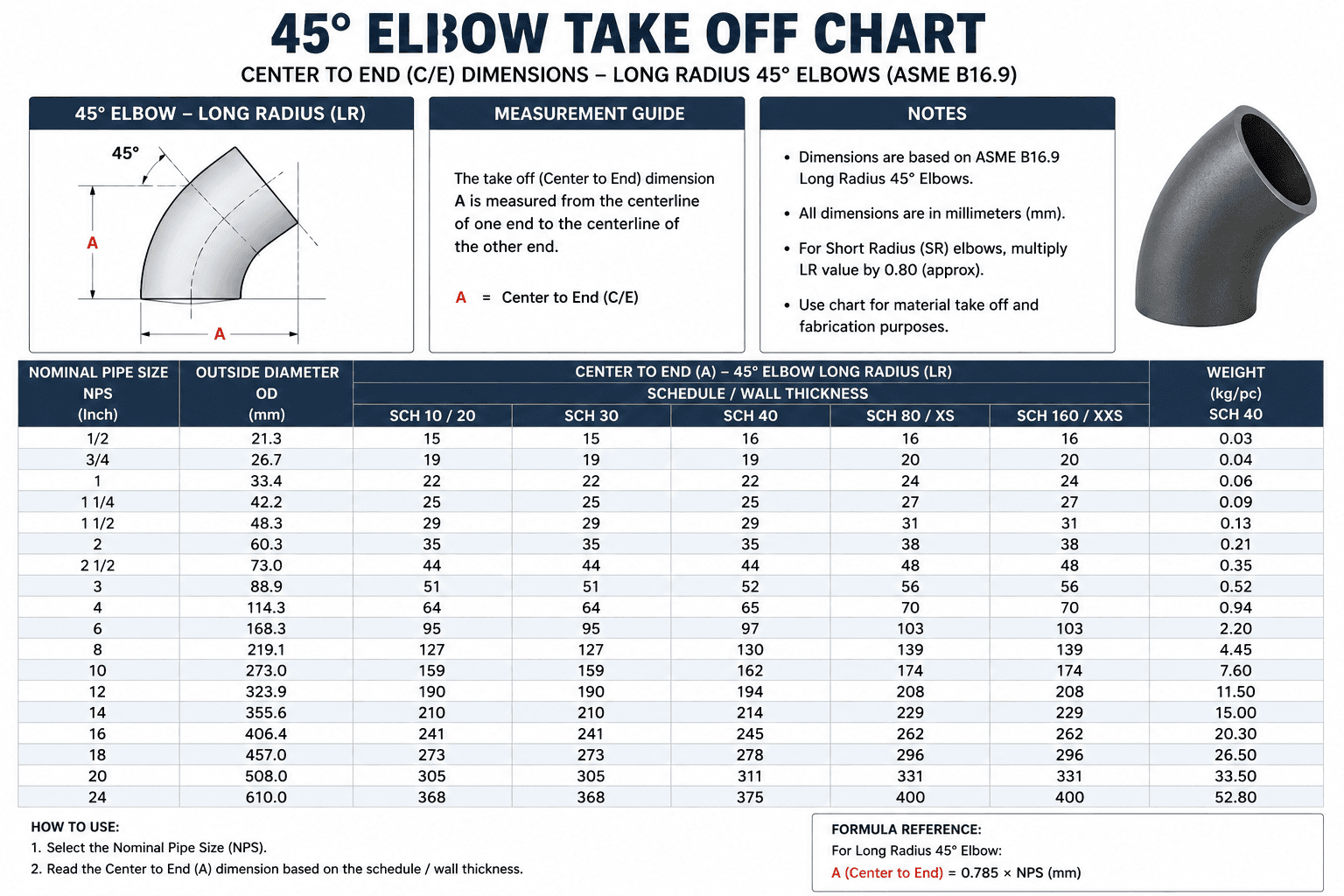
The take-off of a 45 degree elbow (often called the 45 degree elbow take-off) is its center-to-end dimension, the distance from the centerline intersection to the face of the fitting. On a long radius butt-weld elbow it runs from 5/8 inch on 1/2 inch pipe to 7-1/2 inch on 12 inch pipe. Subtract two take-offs from the center-to-center travel and you have your cut length.
- Measured to
- the face of the fitting, not the far centerline
- 45 LR rule
- about 0.414 times the 90 long radius take-off
- 45 offset travel
- the offset times 1.414
- 6 inch 45 LR
- 3-3/4 inch take-off
What is the take-off on a 45 degree elbow?
The take-off is how much the fitting eats into your measurement. You dimension a run to the centerline where two pipes cross, and part of that length is the elbow, not pipe. The take-off is the distance from that centerline point to the face where the pipe welds on. Subtract it and what is left is the steel you actually cut.
For butt-weld elbows this is the center-to-end dimension in ASME B16.9, consistent with ASME B16.9 elbow dimensions. It is fixed by the fitting size and by whether the elbow is long radius or short radius. Once you know those two things, the number is not a judgment call.
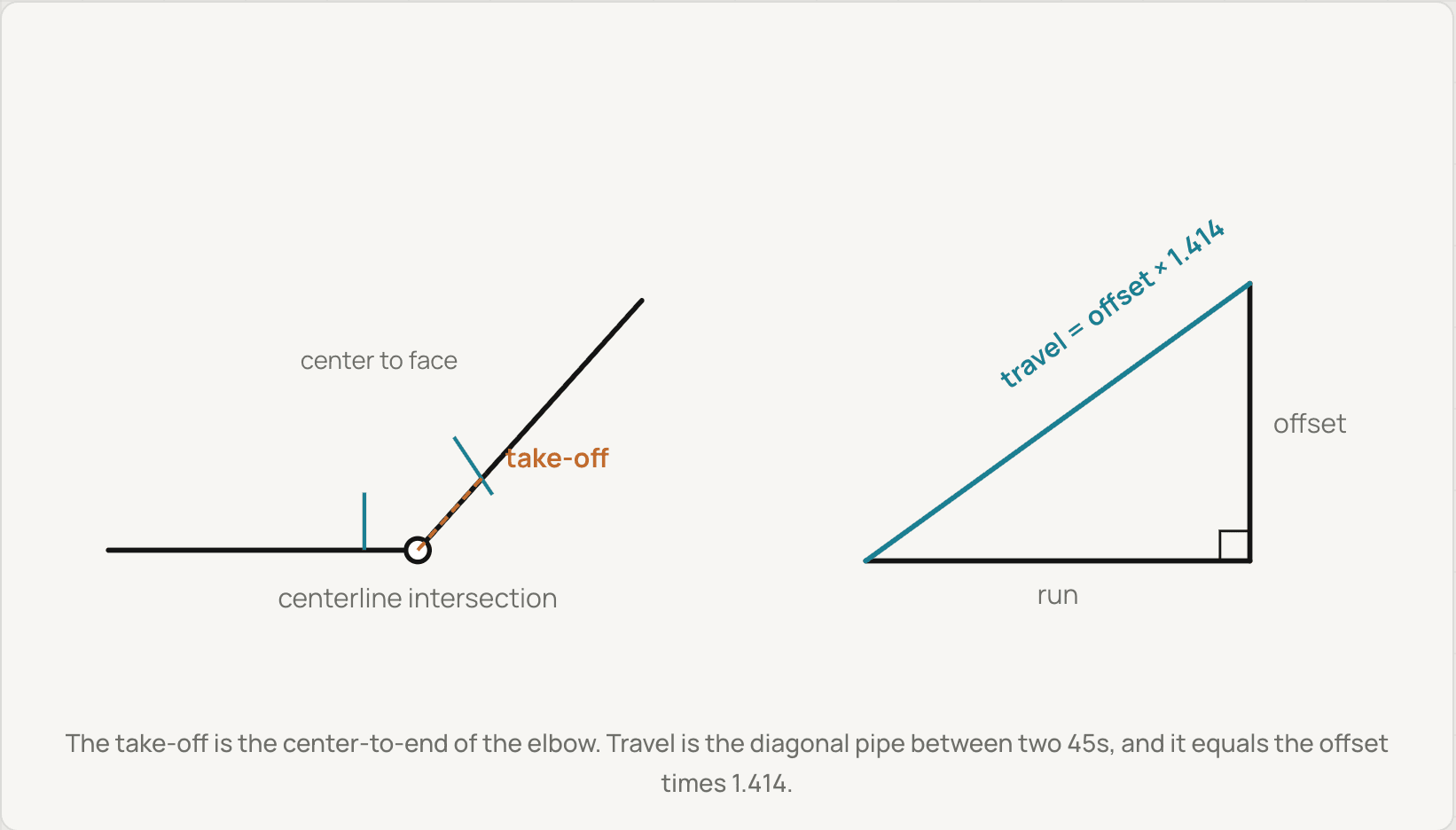
45 degree elbow take off chart (long radius, ASME B16.9)
Center-to-end dimension in inches, rounded to the nearest common fraction. The 90 column is here because most fitters carry both. Values align with ASME B16.9 elbow dimensions.
| Pipe size (NPS) | 45 LR take-off | 90 LR take-off |
|---|---|---|
| 1/2 | 5/8 | 1-1/2 |
| 3/4 | 3/4 | 1-1/2 |
| 2 | 1-3/8 | 3 |
| 4 | 2-1/2 | 6 |
Confirm against ASME B16.9 elbow dimensions before you fabricate. Shop standards and heavy-wall fittings vary.
How do you use the take-off to cut pipe?
Read the center-to-center between the two fittings. Subtract the take-off at each end. What is left is the face-to-face pipe you cut.
Cut length = center-to-center distance minus (take-off end one plus take-off end two)
If you are butt welding, add your root gap back per weld, because the chart gives you steel to steel and your weld needs a gap. That number lives in your WPS.
The 45 degree offset constants
If you are wondering how to calculate 45 degree offset, a 45 offset is a right triangle with two equal legs, so the constants fall out of the geometry.
| To find | Take | Multiply by |
|---|---|---|
| Travel | the offset | 1.414 |
| Run | the offset | 1.000 |
| Offset | the travel | 0.707 |
Travel is the center-to-center length of the diagonal pipe between your two 45 elbows. That travel is the number your two take-offs come out of.
Worked example: a 10 inch offset in 6 inch pipe
You need to jog a 6 inch line over by 10 inches with two 45 long radius elbows.
Travel, center to center, is 10 times 1.414, which is 14.14 inches. A 6 inch 45 long radius take-off is 3-3/4 inch, so 3.75 at each end. Cut length is 14.14 minus (3.75 plus 3.75), which is 6.64 inches. Call it 6-5/8 on the tape, then add your root gap for the two welds.
Change the pipe size and only the take-off changes. The 1.414 travel factor holds for any 45.
Long radius vs short radius: why the take-off changes
A long radius elbow has a centerline radius of 1.5 times the pipe size. A short radius 90 has a radius of 1.0 times the size, so it sits tighter and its take-off is smaller. Grab a short radius number for a long radius fitting and every cut on that line is off. Long radius is the default on most process piping, so the chart above is long radius.
Common mistakes on a 45 take-off
The one that bites most is treating center-to-center as center-to-end. The take-off goes to the face of the fitting, not the far centerline, and there are two of them on a spool.
The other regulars: mixing long and short radius, forgetting to subtract the second fitting, skipping the root gap on butt welds, and reading the number off the pipe OD instead of the nominal size. The take-off is keyed to NPS.
Where an AI takeoff helps
One elbow off a chart is ten seconds. A full isometric is not. A single iso carries dozens of elbows across several lines, and a bid package runs hundreds of sheets, which is where the hours go and where a miscount hides until fabrication.
theTakeoff reads the iso and lists every fitting with its take-off already applied, traced back to the line it came from. You check the count instead of building it from a blank sheet. The estimator still owns the number that goes in the bid.
FAQ
What is the take-off of a 45 degree elbow?
It is the center-to-end dimension of the fitting, from the centerline intersection to the welding face. For a long radius elbow it is about 0.414 times the 90 take-off at the same size.
How do you calculate a 45 degree offset?
Here is how to calculate 45 degree offset: multiply the offset by 1.414 to get the travel, then subtract the take-off at each elbow to get the cut length.
Is the take-off the same for long and short radius?
No. Long radius has a larger center-to-end than short radius, so the take-off is bigger. Use the column that matches the fitting you are installing.
What is the take-off for a 6 inch 45 elbow?
For a 6 inch long radius elbow it is 3-3/4 inch. Confirm against ASME B16.9 for your wall and fitting standard.
Do you subtract the take-off from center to center?
Yes, at both ends of the pipe, then add any root gap your weld needs.